
CO₂ Stabilizer for Carbonated Beverages
Improve CO₂ Retention. Reduce Foam. Support Beverage Production.
IMBEVIA CO₂ Stabilizer is a liquid additive developed for carbonated soft drinks (CSDs). It is designed to help retain dissolved carbon dioxide and reduce foam formation during beverage handling and pouring.
By incorporating the stabilizer into the syrup-based beverage formulation, manufacturers can evaluate its effect on carbonation retention, sensory perception and foam formation under their specific production conditions.
1. Why CO₂ Stability Matters in Carbonated Beverages
Carbonation is an important quality attribute of carbonated soft drinks. Changes in dissolved CO₂ and excessive foam formation can affect the beverage’s sensory characteristics and complicate handling during production and packaging.
For beverage manufacturers, maintaining consistent carbonation while managing foam formation is an important part of product quality and process control.
IMBEVIA CO₂ Stabilizer is designed to address these challenges. Its performance can be assessed by comparing treated and untreated beverage samples under controlled conditions.
2. Key Benefits of IMBEVIA CO₂ Stabilizer
Improved Carbonation Retention
IMBEVIA is designed to help retain dissolved CO₂ in carbonated beverages. Customer testing reported improved gas retention in samples containing the stabilizer compared with untreated control samples.
Reduced Foam Formation
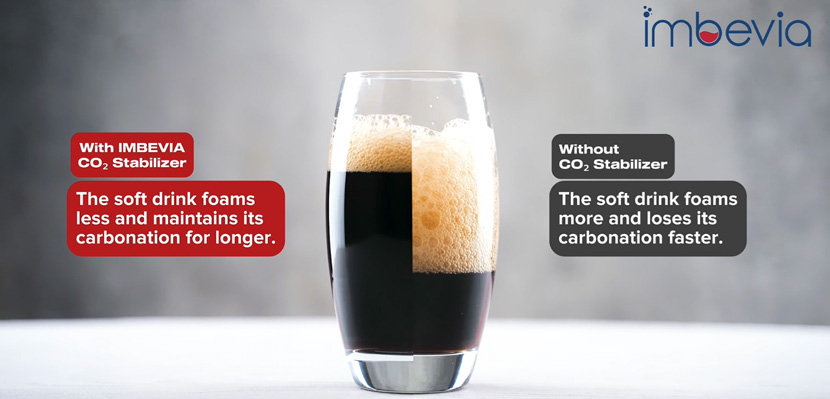
In a comparative pouring test, the beverage containing IMBEVIA produced approximately one-quarter of the foam observed in the control sample. Actual performance may vary with beverage composition and test conditions.
Sensory Evaluation
Blind sensory testing indicated that most participating consumers perceived the beverage containing IMBEVIA as more effervescent than the untreated sample.
Application in Syrup-Based Production
The product is a liquid additive designed for integration into concentrated beverage syrups. Its compatibility, dosage and performance should be evaluated in the target formulation and production process.
3. How IMBEVIA CO₂ Stabilizer Works
IMBEVIA CO₂ Stabilizer is developed to improve carbonation stability in carbonated soft drinks.
Its intended function is to help retain CO₂ in the beverage and reduce gas loss associated with handling and pouring. The product’s performance is evaluated through comparative measurements of gas retention, sensory perception and foam formation.
The degree of improvement depends on the beverage formulation and the conditions under which the product is used and tested.
4. Application and Dosage
Product format: Liquid additive
Application: Carbonated soft drinks and syrup-based beverage formulations
Addition stage: Concentrated syrup, according to the product’s application protocol
Recommended dosage:
The product has been evaluated using a syrup-based protocol that included a stabilizer level of 0.1 g/kg. The dosage basis and its applicability to the commercial formulation should be confirmed by the IMBEVIA technical team before this figure is presented as a general usage recommendation.
For reliable evaluation, use a treated sample and an untreated control prepared under comparable conditions. Keep the beverage formulation, carbonation conditions, sample handling and measurement procedure consistent.
For application-specific instructions, contact the IMBEVIA technical team.
5. Performance Evaluation and Test Results
IMBEVIA CO₂ Stabilizer has been evaluated using sensory testing, carbon dioxide measurements and foam assessment.
The following results were reported in a customer evaluation of a cola soft drink.
5.1 Sensory Test
Two trained evaluators and 50 consumers participated in a blind comparison of samples with and without the stabilizer.
According to the reported results, all trained evaluators and 46 of the 50 consumers described the sample containing IMBEVIA as more effervescent than the regular sample.
These findings indicate a positive sensory response under the conditions of the reported evaluation.
5.2 CO₂ Retention Measurement
The gas measurement protocol used an Anton Paar CO₂/O₂ measuring module and a precision scale to assess the mass of CO₂ released from the beverage.
The reported results included:
- Approximately 20% higher CO₂ retention when the beverage was poured into a glass.
- Approximately 40% more gas retained in the treated sample than in the control after 80 minutes.
These figures describe the results of the reported evaluation and should not be interpreted as guaranteed performance across all beverage formulations or production conditions.
5.3 Foam Formation Assessment
Foam formation was assessed by pouring beverage samples into graduated cylinders and recording the resulting foam levels.
Under the reported test conditions, the sample containing the gas stabilizer produced approximately one-quarter of the foam observed in the control sample.
The result provides a basis for further application trials to assess foam control in the manufacturer’s own beverage and filling process.
5.4 Important Note on Test Results
Test outcomes can vary with beverage composition, carbonation level, preparation procedure, temperature, handling and measurement conditions. Manufacturers should conduct comparative trials using their own formulations before determining the expected production benefits.
6. How to Evaluate IMBEVIA in Your Beverage
For an initial assessment, compare a beverage prepared with IMBEVIA against an otherwise equivalent untreated control.
A practical evaluation can include:
- Sensory assessment: Conduct a blind comparison of perceived effervescence.
- CO₂ measurement: Measure carbonation or gas release using an appropriate analytical instrument.
- Foam assessment: Compare foam formation using the same pouring procedure and measurement equipment.
- Time-based assessment: Repeat measurements at defined intervals to evaluate changes in gas retention.
- Application trial: Confirm performance under the beverage manufacturer’s actual processing and handling conditions.
For meaningful comparisons, use consistent sample preparation, carbonation conditions, temperatures and measurement intervals.
Questions? You’re covered
IMBEVIA CO₂ Stabilizer is a liquid additive developed for carbonated soft drinks. It is designed to improve CO₂ retention and reduce foam formation, with performance evaluated through comparative beverage testing.
The product is designed for addition to concentrated beverage syrup. The precise addition procedure and dosage should be confirmed for the intended formulation and application.
A level of 0.1 g/kg was used in one syrup-based evaluation protocol. The dosage basis must be confirmed before this value is applied as a general recommendation. Contact the IMBEVIA technical team for application-specific guidance.
In a customer evaluation, approximately 20% higher CO₂ retention was reported when the beverage was poured into a glass. After 80 minutes, the treated sample retained approximately 40% more gas than the control. Foam formation was approximately one-quarter of the control level, and 46 of 50 consumers described the treated sample as more effervescent.
These are results from a particular evaluation, not guaranteed outcomes for every formulation.
Reduced foam formation may be relevant to filling-line performance. However, any effects on filling speed, filling temperature, energy consumption, product losses or packaging requirements should be verified through trials on the manufacturer’s actual production line.
A comparative trial can assess sensory perception, CO₂ retention and foam formation in treated and untreated samples. The IMBEVIA technical team can provide further application guidance.