
Foam Stabilizer
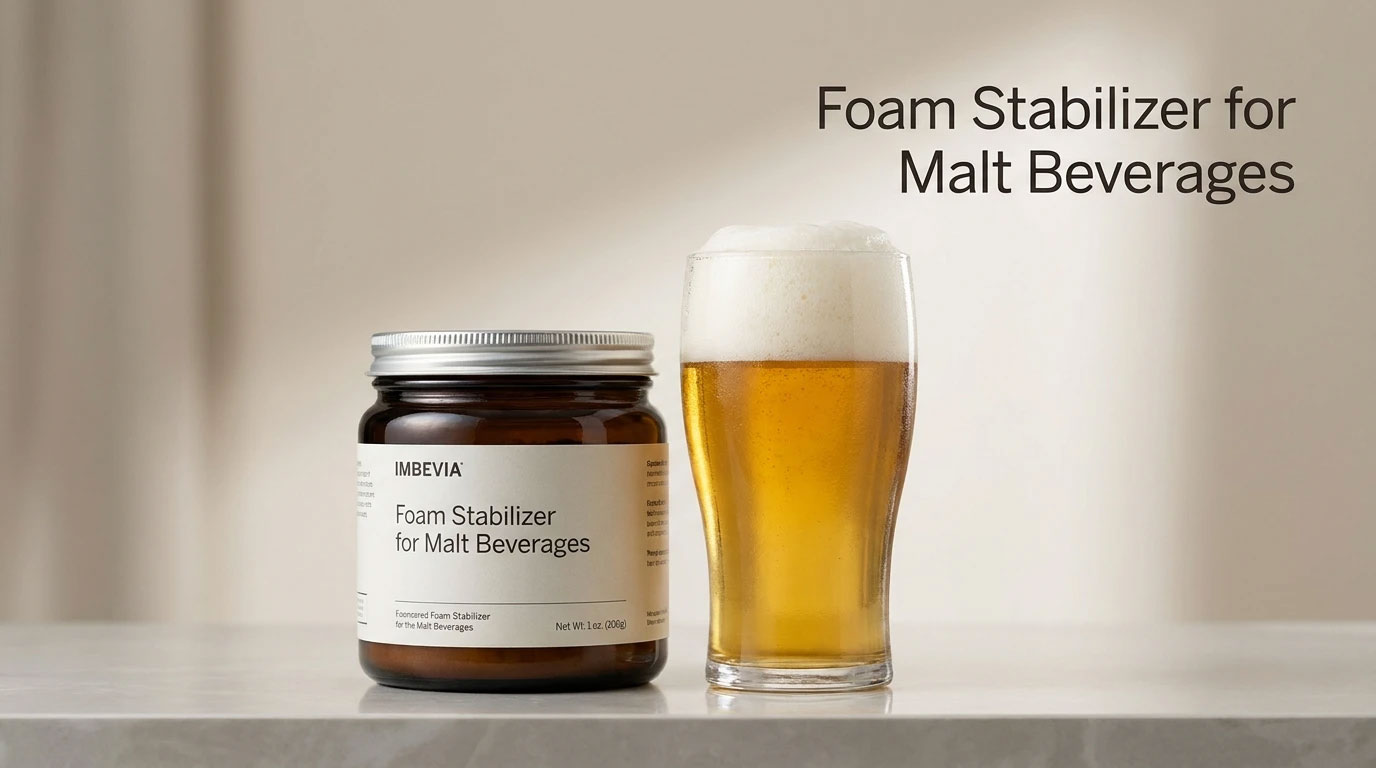
Foam Stabilizer for Malt Beverages
Achieve Uniform, Stable and Long-Lasting Foam.
IMBEVIA Foam Stabilizer is a functional ingredient developed to improve foam stability and consistency in malt-based beverages. It helps maintain a uniform foam structure, supports foam retention and reduces the dependence of foam performance on variations in product quality and malt type.
Designed for use at low concentrations, IMBEVIA Foam Stabilizer offers beverage manufacturers a practical solution for improving foam characteristics while maintaining stable physicochemical properties across a range of formulation conditions.
Its performance is particularly relevant to beverage manufacturers seeking consistent foam quality, improved resistance to challenging processing conditions and reliable product presentation.
1. Why Foam Stability Matters in Malt Beverages
Foam is an important quality attribute of malt-based beverages, particularly beer and other beverages where foam appearance, uniformity and persistence contribute to the overall drinking experience.
The quality of beverage foam depends on several factors, including malt composition, barley proteins, hop-derived compounds, formulation characteristics and the conditions under which the beverage is produced and served.
Variations in raw material quality and malt type can affect foam formation and stability. In addition, contamination of glassware by substances such as detergents, fats and cosmetic products may negatively affect foam performance.
For beverage manufacturers, maintaining consistent foam characteristics across different production batches is therefore an important aspect of product quality.
IMBEVIA Foam Stabilizer is designed to support uniform and stable foam, helping manufacturers achieve more consistent results despite variations in beverage composition and certain external conditions.
2. Key Benefits of IMBEVIA Foam Stabilizer
Uniform and Stable Foam
IMBEVIA supports the formation of uniform and stable foam, helping improve foam retention in malt-based beverages.
High Efficiency at Low Concentrations
The product is designed to deliver effective foam stabilization at relatively low application levels, with a recommended concentration range of 40–100 ppm in the final beverage.
Reduced Dependence on Malt Type and Product Quality
IMBEVIA helps reduce the dependence of foam performance on variations in product quality and malt type, supporting more consistent foam characteristics.
Improved Resistance to Foam-Destabilizing Contamination
The stabilizer supports foam performance in the presence of potential glassware contaminants, including detergent residues, fats and cosmetic products.
Stability Across Different Formulation Conditions
The product demonstrates relative physicochemical stability, particularly in viscosity, across different pH levels and concentrations of monovalent and multivalent ions.
3. How IMBEVIA Foam Stabilizer Supports Foam Stability
Foam stability in malt-based beverages is closely associated with interactions between barley proteins and isohumulone, the bitter compounds derived from hops.
These components can form complexes that contribute to an amphiphilic structure at the gas–liquid interface of foam bubbles. This structure strengthens the bubble film and helps improve foam resilience.
Hydrophobic interactions also contribute to the characteristics of the bubble interface, helping reduce gas escape and support foam retention.
IMBEVIA Foam Stabilizer is designed to enhance foam stability within this system. The relationship between stabilizer concentration and foam retention can be evaluated through comparative application tests.
The effectiveness of foam stabilization depends on beverage composition, processing conditions and the characteristics of the existing foam-forming system.
4. Application and Dosage
Product format: Powder additive
Application: Malt-based beverages and beer-type beverage systems
Recommended dosage: 40–100 ppm in the final beverage
Preparation: Prepare an aqueous solution containing 1–2% foam stabilizer.
Addition stage: Add the prepared aqueous solution after the malt syrup has been filtered.
Processing consideration: Ensure sufficient headspace is available in the mixing tank before adding the stabilizer solution.
The recommended dosage range should be evaluated according to the beverage formulation and desired foam characteristics.
Due to the product’s high hydrophilicity and viscosity-building properties, careful mixing during solution preparation is important to ensure proper dispersion and prevent lump formation.
For application-specific recommendations, contact the IMBEVIA technical team.
5. Technical Characteristics and Performance
IMBEVIA Foam Stabilizer has several physicochemical characteristics that support its use in beverage formulations.
5.1 Performance at Different Concentrations
The product exhibits a concentration-dependent increase in viscosity. It dissolves in both cold and hot water and can produce high-viscosity aqueous solutions.
Its high hydrophilicity requires careful mixing during preparation to achieve uniform dispersion and prevent clumping.
5.2 Stability Under Acidic Conditions
IMBEVIA Foam Stabilizer exhibits relatively stable viscosity within the pH range of 3–5.
This characteristic makes it suitable for consideration in acidic food and beverage formulations, including relevant malt-based beverage systems.
5.3 Resistance to Monovalent Ions
High concentrations of mineral electrolytes can reduce the solubility of hydrocolloids and may cause precipitation.
According to the product’s reported technical evaluation, IMBEVIA maintains its solubility and physicochemical stability at elevated concentrations of monovalent electrolytes, including sodium chloride.
5.4 Resistance to Multivalent Ions
The product demonstrates viscosity stability in the presence of multivalent cations, including calcium ions.
This characteristic is relevant when formulating beverages in which mineral ion concentrations may influence the behavior of hydrocolloid-based stabilizing systems.
5.5 Stability Across Different pH and Ionic Conditions
The product’s relative viscosity stability across pH levels, monovalent ions and multivalent ions provides flexibility for beverage formulation and process optimization.
Actual performance should be assessed in the intended beverage matrix and under the manufacturer’s processing conditions.
6. How to Evaluate IMBEVIA Foam Stabilizer
To assess the performance of foam stabilizer in a beverage formulation, manufacturers can conduct comparative tests using treated and untreated samples.
A practical evaluation may include:
- Foam Formation: Compare foam development under consistent pouring or dispensing conditions.
- Foam Retention: Measure the time required for foam to decrease to a defined level.
- Concentration Assessment: Evaluate different stabilizer concentrations within the recommended 40–100 ppm range.
- Viscosity Measurement: Assess the viscosity of prepared stabilizer solutions at different concentrations.
- pH Stability: Compare physicochemical behavior across the relevant pH range, particularly pH 3–5.
- Ionic Stability: Evaluate product behavior in the presence of relevant monovalent and multivalent ions.
For reliable comparisons, maintain consistent sample preparation, temperature, beverage composition, mixing conditions and evaluation procedures.
Improve Foam Quality with IMBEVIA
Consistent foam characteristics are an important part of beverage quality and product presentation.
IMBEVIA Foam Stabilizer offers beverage manufacturers a functional solution for supporting uniform, stable foam at low application concentrations, with useful physicochemical characteristics across different formulation conditions.
Questions? You’re covered
IMBEVIA Foam Stabilizer is a functional ingredient developed to improve foam stability and consistency in malt-based beverages. It is designed to support uniform foam structure and longer foam retention.
The recommended concentration is approximately 40–100 ppm in the final beverage. The optimum dosage depends on beverage composition and the desired foam characteristics.
Prepare an aqueous solution containing 1–2% foam stabilizer. Careful mixing is required because of the product’s high hydrophilicity and viscosity-building properties.
According to the recommended application procedure, add the aqueous stabilizer solution after the malt syrup has been filtered. Ensure sufficient headspace in the mixing tank before addition.
The product exhibits relatively stable viscosity between pH 3 and 5, making it suitable for consideration in acidic food and beverage formulations. Its performance should be confirmed in the target beverage.
The product demonstrates relative physicochemical stability in the presence of monovalent and multivalent ions. Its reported characteristics include resistance to elevated sodium chloride and calcium ion concentrations.
Yes. IMBEVIA Foam Stabilizer dissolves in both cold and hot water. Due to its high hydrophilicity, careful mixing is recommended to prevent clumping and ensure uniform dispersion.
Foam stability is influenced by barley proteins, hop-derived isohumulone, beverage composition, raw material quality and potential contamination from substances such as detergents and fats.