
Protein Composition and Its Effect on Foam Quality in Non-Alcoholic Malt Drinks
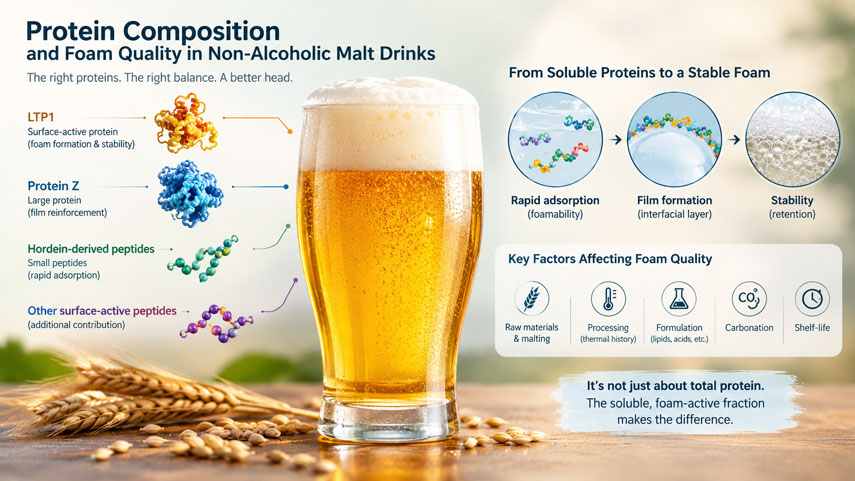
Foam formation, head retention, collapse rate, and bubble structure in non-alcoholic malt drinks depend on the composition and functional state of the soluble, foam-active protein fraction rather than on total protein concentration alone. Total protein includes fractions that remain insoluble, form aggregates, participate in haze, or have little interfacial activity. During malting and beverage manufacture, barley proteins are hydrolyzed, extracted, unfolded, glycated, oxidized, aggregated, precipitated, and selectively removed. The finished beverage therefore contains only a modified subset of the original barley proteome. LTP1, Protein Z isoforms, hordein-derived peptides, BDAI-1, and other surface-active peptides can contribute meaningfully when they remain soluble and possess suitable adsorption and film-forming behavior [1-5].
The manufacturing target is therefore not the highest possible total protein level, but a balanced soluble foam-active fraction capable of rapidly covering newly formed carbon dioxide bubbles and subsequently forming a cohesive, viscoelastic interfacial film. Excessive proteolysis may increase foamability while weakening retention; excessive thermal treatment may convert functional proteins into poorly soluble aggregates. Lipids, flavor emulsions, acidification, protein-polyphenol complexation, over-stabilization, and inappropriate dealcoholization conditions can further reduce the concentration or effectiveness of foam-active proteins and surface-active peptides. Effective industrial control requires coordinated management of raw materials, malt modification, thermal history, formulation, clarification, carbonation, and shelf-life conditions [3-11].
Protein Composition Is a Functional Quality Attribute
The protein content of a malt drink should not be interpreted as a single functional variable. Total protein includes soluble and insoluble proteins, small peptides, protein aggregates, haze-active fractions, and molecules with little direct activity at the gas-liquid interface. The functionally relevant pool is the soluble foam-active fraction: proteins and surface-active peptides that remain dispersed, adsorb rapidly enough to protect newly generated bubbles, and then form or reinforce a film that resists drainage and rupture. Other proteinaceous fractions may be analytically measurable yet functionally irrelevant to foam or primarily associated with haze and sediment.
For this reason, four protein parameters must be distinguished:
- Total protein quantifies all measurable proteinaceous material, including fractions that may be insoluble, aggregated, haze-active, or interfacially inactive.
- Soluble protein quantifies the fraction remaining dispersed under final product conditions, but not all soluble proteins are necessarily foam-active.
- Foam-active proteins and surface-active peptides are the soluble molecules that adsorb at the gas-liquid interface rapidly enough to influence bubble formation.
- Foam-stabilizing proteins are the adsorbed molecules that reorganize and reinforce a cohesive interfacial film, thereby improving retention and resistance to rupture.
Foamability and foam stability are distinct performance attributes. Small surface-active peptides generally diffuse and adsorb rapidly, so they can promote bubble coverage and initial foam formation. Larger, structurally resilient proteins such as Protein Z typically adsorb more slowly but can build a stronger interfacial network and improve foam retention. A peptide-rich beverage may therefore produce a high initial head yet collapse rapidly, whereas a beverage with insufficient fast-adsorbing material may fail to protect bubbles even when larger film-forming proteins are present.
Effective performance requires both functions: rapid adsorption for foamability and film reinforcement for stability. The most informative specification is therefore the concentration and molecular-weight distribution of the soluble foam-active fraction, together with its interfacial behavior, rather than total protein alone [1,3].
The Main Protein Fractions Governing Malt-Drink Foam
Barley proteins are commonly classified as albumins, globulins, hordeins, and glutelins according to solubility. However, this classification describes the grain rather than the finished beverage. Much of the original storage protein remains in the insoluble grain fraction or is removed with spent grain. Other proteins are hydrolyzed during germination and mashing or precipitated during heating and clarification. The protein profile of the finished malt drink is therefore a process-selected population rather than a direct representation of the raw barley [2,4,5].
The principal foam-relevant fractions are LTP1, Protein Z4 and Z7, hordein-derived peptides, BDAI-1, and several other heat- or protease-resistant albumins and inhibitor proteins. LTP1 is typically detected near 9.7–12 kDa, Protein Z near 40–43 kDa, and hordein-derived peptides across a wider range, commonly around 10–30 kDa [1,3,4].
| Protein fraction | Main structural characteristics | Predominant function in foam | Principal industrial risk |
| LTP1 | Small, disulfide-rich and relatively heat-resistant lipid-transfer protein | Supports rapid interfacial adsorption and film formation after controlled structural modification | Insufficient unfolding, excessive aggregation, oxidation, proteolysis, or lipid overloading |
| Protein Z4 | Heat-resistant serpin and usually the dominant Protein Z isoform | Reinforces the interfacial film and supports foam persistence | Removal during heating, clarification, filtration, or stabilization |
| Protein Z7 | Related serpin isoform with process- and cultivar-dependent abundance | May contribute to film structure but its effect is strongly matrix-dependent | Concentration may not correlate consistently with final foam performance |
| Hordein-derived peptides | Proteolytic fragments with variable size and hydrophobicity | Provide rapid bubble coverage and contribute to initial foam formation | Weak films after over-hydrolysis; protein–polyphenol haze |
| BDAI-1 | Low-molecular-weight barley α-amylase inhibitor | Contributes to the foam-active protein population | Strong dependence on cultivar and malt modification |
| Other soluble peptides | Generated during germination, mashing, or controlled hydrolysis | Increase interfacial mobility and initial foamability | Very small peptides may lack sufficient film-forming capacity |
| Protein aggregates | Associated proteins formed by heat, oxidation, or pH changes | Small soluble aggregates may modify interfacial rheology | Large aggregates cause haze, sediment, filtration problems, and poor interfacial diffusion |
| Protein–polyphenol complexes | Reversible or irreversible molecular associations | Limited interactions may reinforce interfacial structure | Excessive complexation removes soluble protein and produces haze |
Functional summary. Low-molecular-weight surface-active peptides and some hordein-derived fragments mainly support foamability through rapid adsorption. LTP1 can contribute to early surface coverage and film development when it remains soluble and appropriately modified. Protein Z4 and, under some conditions, Protein Z7 are more closely associated with interfacial film reinforcement and foam retention. Large aggregates and extensively cross-linked protein-polyphenol complexes are primarily associated with haze, sediment, filtration losses, and depletion of the soluble foam-active fraction.
LTP1: Surface Activity Depends on Processing History
LTP1 is a small, disulfide-rich barley protein with a compact native structure and an internal hydrophobic cavity. This structure provides resistance to heat and proteolysis, allowing part of the LTP1 population to survive malting, mashing, and thermal processing [2,4,6].
Its lipid-binding capacity is functionally important but does not produce a single outcome. Free fatty acids can adsorb rapidly at the gas-liquid interface and displace proteins; triglyceride residues and dispersed oil droplets can contaminate the interface and weaken local film integrity; flavor oils and their emulsifiers can compete with foam-active proteins during adsorption. LTP1 can bind some lipid species, but excessive lipid loading may alter its conformation and reduce its film-forming effectiveness [6,8].
Thermal treatment and glycation can shift LTP1 from a tightly folded native state toward a more flexible, surface-active state. Moderate unfolding exposes hydrophobic regions needed for adsorption, while controlled glycation may help the modified protein remain soluble. The benefit depends on process intensity and prior protein history [4,5].
After modification, soluble LTP1 can adsorb at the bubble surface, reorganize, and contribute to the interfacial film. If heating, oxidation, or proteolysis becomes excessive, exposed hydrophobic regions promote protein-protein association, aggregation, and precipitation. LTP1 is then lost from the soluble foam-active fraction and can no longer contribute effectively to bubble coverage or film development.
Oxidized lipids should be considered separately from direct interfacial contaminants. They may weaken foam when they or their surface-active products reach the interface, but they also accelerate broader oxidative ageing, including flavor deterioration and modification of LTP1 thiol and disulfide chemistry. These changes can alter molecular flexibility, aggregation behavior, and foam performance before visible haze or sediment develops [6,8].
Protein Z: A Major Contributor to Interfacial Film Reinforcement
Protein Z is a heat-resistant barley serpin that remains one of the most abundant intact protein groups in malt-derived beverages. Protein Z4 is generally the predominant isoform, while Protein Z7 contributes a smaller and more variable proportion [2,3].
Protein Z can contribute more strongly to foam persistence than to rapid initial adsorption. Its larger molecular structure supports intermolecular association and the development of a thicker, more cohesive interfacial layer. Once adsorbed, Protein Z may improve the elasticity and mechanical resistance of the film surrounding the bubble.
Protein Z functionality depends on its structural state. Moderate thermal denaturation increases molecular flexibility and exposes interaction sites. Controlled glycation can alter solubility and protect part of the protein population from precipitation. Excessive denaturation, however, promotes aggregation and removes Protein Z from the fraction available for interfacial adsorption [4,10].
Iso-α-acids can reinforce the function of Protein Z by forming non-covalent complexes dominated by hydrogen bonding. Under compatible formulation conditions, this association may modify Protein Z secondary structure and surface activity, support the formation of smaller and more uniform bubbles, and improve foam persistence [9].
For non-alcoholic malt drinks, this interaction creates a formulation constraint. Low-bitterness products may contain sufficient Protein Z but only limited iso-α-acid concentrations. Increasing bitter compounds may improve interfacial film strength but can make the sensory profile unacceptable. Foam optimization must therefore balance Protein Z retention, bitter-acid concentration, sweetness, acidity, aroma, and intended flavor positioning.
Protein Z concentration alone is not a complete predictor. Two beverages containing similar Protein Z levels may perform differently because of differences in glycation, denaturation, aggregation, iso-α-acid concentration, pH, and competitive adsorption by other surface-active materials.
Hordein-Derived Peptides and the Foam–Haze Balance
Hordeins are the main storage proteins of barley. Intact hordeins have limited solubility in aqueous malt systems, but germination and mashing release smaller hordein-derived peptides into the soluble fraction.
These peptides can reach newly formed bubble surfaces quickly because of their relatively low molecular size. Their hydrophobic sequence regions support adsorption and contribute to initial foam formation. However, extensive proteolysis can reduce them to fragments that are too small to form a cohesive film. The product may then generate a high foam volume during pouring but lose the head rapidly.
Hordein-derived peptides can also enter the haze pathway. Proline-rich peptide regions associate with polyphenols to form initially soluble protein-polyphenol complexes; continued cross-linking increases particle size, producing chill haze, permanent haze, and eventually sediment. Stabilization and filtration remove part of this material, but they can simultaneously deplete the soluble foam-active fraction. The result can be improved visual clarity accompanied by weaker foam formation or retention [7].
The target is therefore not maximum hordein solubilization. The required outcome is a reproducible peptide-size distribution that supports rapid surface coverage without producing excessive colloidal reactivity. This creates a direct trade-off between foamability, foam persistence, clarity, and storage stability.
How the Protein Film Forms Around a Carbon Dioxide Bubble
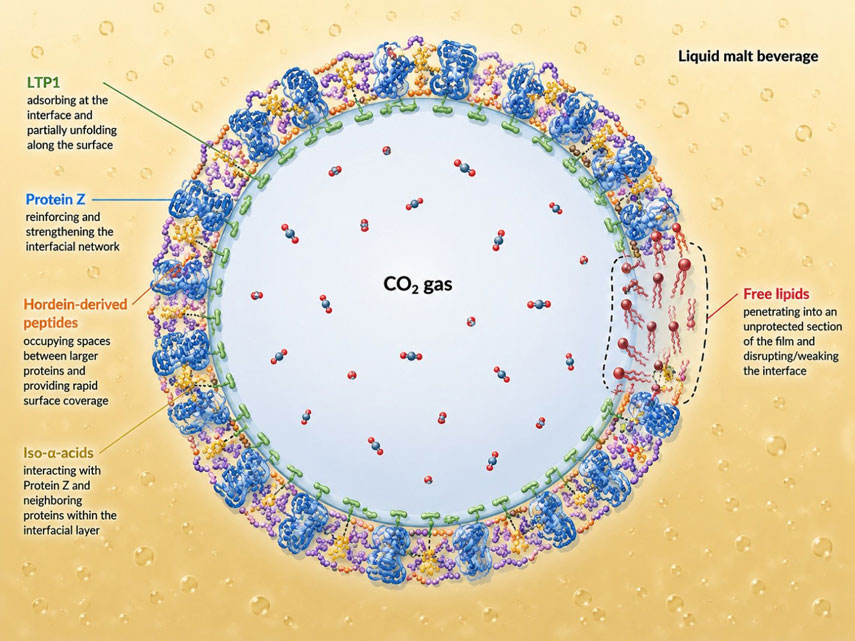
When a carbonated malt drink is opened or poured, dissolved carbon dioxide expands at nucleation sites and creates new gas–liquid interfaces. Protein stabilization occurs through four linked stages.
First, soluble proteins and peptides diffuse from the bulk beverage toward the bubble. Molecular size, viscosity, temperature, and existing interactions determine the diffusion rate.
Second, amphiphilic molecules adsorb at the interface. Hydrophobic regions orient toward the gas phase, while hydrophilic regions remain exposed to the liquid.
Third, adsorbed proteins partially unfold and reorganize. Molecular flexibility is necessary for spreading and interaction with adjacent molecules.
Fourth, proteins and surface-active peptides form the primary interfacial film, whereas iso-α-acids, polyphenols, ions, and compatible polysaccharides modify its behavior. Iso-α-acids can reinforce protein-protein association; limited polyphenol interactions may alter film cohesion; ions influence molecular packing and aggregation; and polysaccharides mainly increase drainage resistance through the continuous phase. Together, these effects determine film elasticity, drainage rate, and resistance to local rupture.
Rapid peptide adsorption mainly supports foamability, while subsequent recruitment and rearrangement of LTP1 and Protein Z can increase interfacial film strength and foam stability. Neither function is sufficient alone: fast adsorption without reinforcement produces rapid collapse, whereas strong but slow-adsorbing proteins may leave new bubbles unprotected.
The film is not stabilized by surface tension alone. Its behavior also depends on surface viscosity, interfacial elasticity, molecular rearrangement, and Marangoni stresses generated by local differences in surface composition. Different malt-drink matrices may rely on different combinations of these mechanisms [11].
Raw-Material and Process Variables That Change Foam-Active Protein Functionality
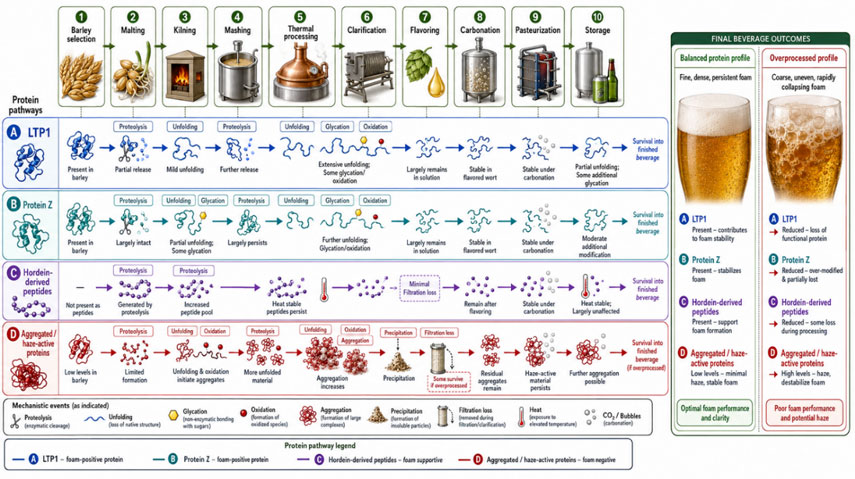
Protein functionality is established progressively from barley selection to packaged product. Each processing stage changes protein size, solubility, conformation, or concentration.
Barley cultivar and growing conditions determine the initial balance of hordeins, LTP1, Protein Z isoforms, enzyme inhibitors, and total nitrogen. High grain protein does not automatically produce superior foam. It may increase the pool of potentially useful proteins, but it can also reduce extract yield, increase hot-break loading, and increase haze-active material.
During germination, proteolytic enzymes release soluble proteins, peptides, and free amino nitrogen. Under-modification leaves an excessive proportion of the protein in insoluble form. Over-modification produces too many small peptides and reduces the fraction capable of forming strong films.
The Kolbach index is useful for monitoring proteolytic modification because it relates soluble nitrogen to total malt nitrogen. It should not be interpreted as a direct foam specification. The same index may produce different foam outcomes depending on cultivar, molecular-weight distribution, mashing program, and final production route. Kolbach index, soluble protein, free amino nitrogen, and actual foam performance must be interpreted together.
Kilning causes partial denaturation, glycation, oxidation, and Maillard reactions. Moderate treatment may improve the solubility and surface activity of selected proteins. Excessive heat produces irreversible aggregation and reduces the amount of functional protein available later in the process.
Mashing extracts soluble proteins and continues enzymatic hydrolysis. An intensive protein rest can be useful for under-modified malt but detrimental for well-modified malt. Excessive time in the protease-active temperature range can reduce Protein Z, LTP1, and hordein-derived fractions to peptides with limited film strength [4,5].
Heating or wort boiling unfolds proteins, promotes hot-break formation, and removes unstable protein–polyphenol complexes. Controlled heating can improve LTP1 surface activity and eliminate undesirable aggregates. Excessive temperature or residence time removes desirable proteins through precipitation.
Clarification and stabilization improve visual quality but can also remove foam-active proteins and surface-active peptides. Silica-based adsorbents, PVPP, filter aids, membrane systems, and filtration intensity must be evaluated for selectivity. A process that produces excellent clarity may weaken foam if it strips Protein Z, LTP1, or useful peptide fractions.
Overall, processing acts as a cause-effect chain: kilning, mashing, heating, oxidation, glycation, and Maillard reactions can expose interfacial sites and improve solubility under controlled conditions, but excessive intensity or repeated thermal history can drive over-hydrolysis, aggregation, precipitation, and depletion of the soluble foam-active fraction. The net effect on foamability and retention therefore depends on both process severity and the molecular state inherited from earlier stages.
| Process stage | Main protein transformation | Potential benefit | Main risk |
| Barley selection | Determines initial protein and isoform profile | Establishes the available foam-protein pool | Low extract yield or high haze potential |
| Germination | Proteolysis and protein solubilization | Releases soluble, mobile protein fractions | Excessive production of weak low-molecular-weight peptides |
| Kilning | Partial denaturation and glycation | Improves surface activity of selected proteins | Irreversible aggregation |
| Mashing | Extraction and continued hydrolysis | Adjusts soluble protein availability | Over-hydrolysis of foam-positive proteins |
| Thermal processing | Unfolding, aggregation and hot-break formation | Activates selected proteins and removes unstable material | Loss of LTP1 and Protein Z |
| Clarification | Removal of particles and aggregates | Improves clarity and reduces sediment | Non-selective removal of functional proteins |
| Stabilization | Removal of haze precursors | Improves colloidal shelf life | Excessive stripping of protein or polyphenols |
| Flavoring and acidification | Changes protein charge and competitive adsorption | Enables product differentiation | Acid shock, oil-induced film rupture, or aggregation |
| Pasteurization | Additional denaturation and association | Microbial stability | Post-process haze and foam loss |
| Storage | Oxidation and complex growth | No direct foam benefit | Progressive decline in soluble foam-active protein |
Why the Production Route Matters in Non-Alcoholic Malt Drinks
Non-alcoholic malt drinks are produced through different technological routes, and each route creates a different protein environment. Protein specifications should therefore be established separately for each process platform rather than transferred from conventional fermented beverages.
Direct malt-extract beverages
Products prepared from wort, malt extract, or reconstituted malt solids contain a predominantly malt-derived protein system. Concentration, evaporation, spray drying, reconstitution, acidification, and final pasteurization can expose proteins to substantial cumulative heat.
A malt extract with acceptable total protein may contain a high proportion of glycated or aggregated material. Supplier evaluation should therefore include soluble protein after reconstitution, turbidity, molecular-weight profile, and foam performance in the final formula.
Restricted or arrested fermentation
Restricted fermentation introduces yeast contact without complete attenuation. Malt proteins may be adsorbed onto yeast cells, modified by yeast proteases, or supplemented by yeast-derived peptides and mannoproteins. The final matrix retains more residual extract and generally differs in viscosity, pH, and carbohydrate composition from a fully fermented product [15,16].
The arrest point must be controlled because differences in fermentation duration affect protein exposure to yeast proteases and change the balance between malt-derived and yeast-derived surface-active components.
Full fermentation followed by thermal dealcoholization
Thermally dealcoholized products experience a complete fermentation process followed by an additional heating stage. Vacuum operation lowers the required temperature but does not eliminate thermal effects. Additional residence time can increase protein denaturation, aggregation, and precipitation.
Aroma recovery and subsequent flavor restoration may also introduce oils or emulsifiers that compete with the remaining proteins at the bubble surface. Foam must therefore be assessed after dealcoholization and again after aroma restoration.
Membrane dealcoholization
Reverse osmosis and related membrane processes retain much of the macromolecular fraction while removing ethanol, water, and selected small molecules. Even when proteins remain in the retentate, their functional environment changes because ionic strength, extract, bitterness, acids, and low-molecular-weight ligands are redistributed [17].
Protein concentration may therefore remain relatively stable while foam performance changes because Protein Z and LTP1 no longer interact with the same concentrations of bitter acids, salts, and other soluble compounds.
Blending and dilution
Dilution reduces proteins, iso-α-acids, polyphenols, polysaccharides, and soluble solids simultaneously. Recarbonation restores carbon dioxide but does not restore the original interfacial film composition. A diluted malt base may therefore produce adequate bubbling but weak foam retention.
| Production route | Main protein characteristic | Principal foam risk |
| Direct malt-extract beverage | Protein state controlled mainly by extract manufacture and final heat treatment | Pre-existing heat damage, acid shock, or flavor-oil competition |
| Restricted fermentation | Limited yeast contact and high residual extract | Variable proteolysis and inconsistent arrest point |
| Thermal dealcoholization | Fully fermented protein system exposed to additional heat | Secondary aggregation and loss of soluble protein |
| Membrane dealcoholization | Macromolecules retained but small-solute environment altered | Imbalance between proteins, bitter acids, salts, and extract |
| Concentrated base followed by dilution | Simultaneous dilution of all foam-active components | Insufficient Protein Z, LTP1, peptides, and bitter compounds |
Interaction with the Complete Beverage Matrix
Protein performance cannot be assessed independently of the final formulation. Non-alcoholic malt drinks may contain acids, sugar syrups, fruit flavors, botanical extracts, preservatives, clouding emulsions, stabilizers, and minerals. Each component can change protein solubility or interfacial behavior.
pH and acidification
Acidification changes protein charge and electrostatic repulsion. As the pH approaches the isoelectric region of a protein fraction, intermolecular repulsion decreases and aggregation becomes more likely. Localized acid addition can expose proteins to a much lower pH than the final bulk value and cause irreversible precipitation.
Operationally, acid should be pre-diluted where practical, metered below the liquid surface into a well-recirculated or high-mixing zone, and added at a rate that avoids direct contact between concentrated acid and the protein-rich malt base. Bulk pH should be confirmed only after complete homogenization. Insufficient mixing can create transient local pH shocks that temporarily change turbidity and foam behavior; more severe local exposure may trigger irreversible aggregation or precipitation.
Iso-α-acids and polyphenols
Iso-α-acids can reinforce Protein Z-containing films but also contribute bitterness. Their concentration must be optimized against the sensory target [9].
Polyphenols can strengthen limited protein associations, but progressive cross-linking produces haze and removes protein from the soluble phase. Protein and polyphenol stabilization should therefore be selective rather than maximized independently [7].
Lipids, flavor oils, and clouding emulsions
Lipids are among the most destructive foam-negative components. They adsorb rapidly, disrupt protein continuity, and accelerate bubble coalescence. A flavor emulsion can remain visually stable while still weakening foam.
Carrier oil type, oil concentration, emulsifier system, droplet size, and oxidation state should therefore be included in flavor qualification. Foam testing in water or sugar solution is not sufficient; the flavor must be tested in the complete malt-protein matrix.
Emulsifiers
Low-molecular-weight emulsifiers can reach the interface faster than proteins. Some form compatible mixed films, while others displace proteins and produce highly mobile interfaces with poor mechanical strength. Increased initial foam after emulsifier addition does not necessarily indicate improved stability.
Hydrocolloids and soluble solids
Hydrocolloids mainly act in the bulk liquid by increasing continuous-phase viscosity and slowing foam drainage. Proteins and compatible surface-active peptides remain primarily responsible for adsorption and interfacial film stabilization. A slower collapse rate after hydrocolloid addition therefore does not necessarily indicate a stronger protein film.
The distinction is operationally important:
- Interfacial stabilization: adsorption, rearrangement, and film reinforcement by foam-active proteins, surface-active peptides, and compatible low-molecular-weight components.
- Drainage control: slower liquid loss from lamellae caused mainly by viscosity and polysaccharide structure.
Excessive hydrocolloid levels may reduce drainage but can impair filling, filtration, flavor release, and mouthfeel and may also make foam difficult to dispense consistently.
Minerals
Calcium, magnesium, sodium, alkalinity, and total ionic strength affect protein charge screening, aggregation, and polyphenol association. Water-treatment changes can therefore alter foam performance even when raw materials and formulation remain unchanged.
The Foam–Clarity–Shelf-Life Trade-Off
The same protein characteristics that support interfacial adsorption can increase colloidal reactivity. Soluble hydrophobic peptides may improve initial foam but also associate strongly with polyphenols. Protein Z and LTP1 should be retained, but unstable aggregates and haze-active complexes must be controlled.
Over-stabilization creates a clear product with weak foam. Under-stabilization preserves protein but increases the risk of chill haze, permanent haze, and sediment. The appropriate treatment intensity is the point at which haze-active material is reduced without excessive removal of functional protein.
Foam deterioration can precede visible haze. Oxidation, soluble aggregate formation, disulfide exchange, and gradual protein–polyphenol association can reduce interfacial availability before particles become visible. Shelf-life qualification must therefore include foam performance, not only turbidity and sediment inspection.
Analytical Control of Protein-Related Foam Performance
A single analytical result cannot diagnose protein-related foam failure. Total protein, molecular composition, interfacial behavior, and final foam performance must be evaluated at different levels.
An integrated QC system should group variables into three buckets: (1) foam performance metrics – initial foam height, retention time, collapse rate, and bubble structure; (2) composition metrics – total and soluble protein, turbidity, molecular-weight distribution, and selected protein markers; and (3) process and product context – temperature, package type, carbonation, pH, formulation, and process history. Results should be interpreted across all three buckets because a change in one category can alter the meaning of another.
| Measurement | Main information obtained | Industrial use |
| Total protein or total nitrogen | Overall proteinaceous loading | Raw-material and batch comparison |
| Soluble protein | Protein remaining available in the final matrix | Detection of precipitation or excessive removal |
| Free amino nitrogen | Degree of protein breakdown | Monitoring malt modification and proteolysis |
| SDS-PAGE | Approximate distribution of major protein bands | Comparison of LTP1-, Protein Z-, and peptide-rich regions |
| Size-exclusion chromatography | Distribution of peptides, intact proteins, and aggregates | Detection of over-hydrolysis or aggregation |
| Targeted Protein Z or LTP1 analysis | Retention of selected foam-positive proteins | Process mapping and root-cause investigation |
| Dynamic surface tension | Speed of interfacial adsorption | Detection of changes in surface-active composition |
| Interfacial rheology | Film elasticity, viscosity, and resistance to deformation | Mechanistic assessment of foam persistence |
| Turbidity and chill-haze testing | Protein association and colloidal instability | Shelf-life and stabilization control |
| Initial foam height | Ability to generate foam | Foamability assessment |
| Foam-retention time | Persistence of the foam head | Routine finished-product control |
| Collapse rate | Rate of foam loss | Sensitive batch and shelf-life comparison |
| Bubble-size distribution | Bubble uniformity and coalescence | Structural evaluation of foam |
| Digital image analysis | Objective measurement of foam height and bubble evolution | Automated and repeatable QC monitoring |
Each analytical method answers a different question: SDS-PAGE compares the major protein profile; size-exclusion chromatography resolves the molecular-weight distribution and distinguishes hydrolysis from aggregation; targeted proteomics identifies specific proteins and isoforms; dynamic surface tension measures adsorption kinetics and interfacial activity; and interfacial rheology measures film elasticity, viscosity, and resistance to deformation.
Objective foam imaging is reproducible only when the acquisition protocol is fixed. Use constant lighting and background, identical glass geometry and cleanliness, a defined filling or pouring procedure, controlled carbonation and sample temperature, fixed camera distance and angle, reflection control, locked autofocus or manual focus settings, and predefined lacing and edge-detection criteria. The same analysis window and time points should be used for every batch; depth imaging can further reduce errors from reflections and residual foam on the glass [14].
Protein data should be interpreted as part of an integrated specification rather than as isolated release limits. Total protein indicates overall loading, soluble protein indicates the fraction remaining available, molecular-weight distribution shows whether hydrolysis or aggregation has shifted the profile, turbidity reflects colloidal instability, and foam-retention and bubble analysis confirm final performance. Process-history data are required because identical concentrations can represent proteins with different conformations and interfacial behavior.
Industrial Troubleshooting
| Observed defect | Probable protein-related cause | Confirmation method | Corrective direction |
| High initial foam with rapid collapse | Excessive low-molecular-weight peptides or insufficient film reinforcement | SEC, SDS-PAGE, collapse-rate analysis | Reduce proteolysis severity and improve Protein Z retention |
| Low foam formation and low retention | Low soluble protein or excessive protein removal | Soluble protein before and after clarification | Review malt modification, stabilization, and filtration |
| Good malt-base foam but weak final-product foam | Competitive adsorption by flavor oils or emulsifiers | Foam testing after each formulation addition | Reformulate the flavor emulsion or reduce foam-negative lipid loading |
| Foam loss after acid addition | Localized protein aggregation caused by acid shock | Turbidity during ingredient addition | Change acid dilution, addition order, and mixing intensity |
| Foam loss after pasteurization | Thermal aggregation or loss of soluble Protein Z/LTP1 | Pre- and post-pasteurization protein profile | Reduce unnecessary thermal severity |
| Good fresh foam but poor shelf-life foam | Oxidation, protein–polyphenol association, or emulsion ageing | Aged foam, turbidity, particle-size and oxygen measurements | Improve oxygen control and colloidal stabilization |
| Fine foam with excessive haze | High concentration of reactive protein–polyphenol complexes | Chill-haze and protein profiling | Apply more selective stabilization |
| Clear product with weak foam | Over-stabilization or non-selective filtration | Protein comparison before and after treatment | Reduce treatment intensity or change adsorbent |
| Large and irregular bubbles | Slow protein adsorption or weak interfacial elasticity | Dynamic surface tension and bubble imaging | Improve soluble foam-active protein balance |
| Batch variation with stable total protein | Different protein isoforms or structural states | SDS-PAGE, targeted assays, process-history review | Strengthen functional raw-material and process specifications |
Industrial Control Strategy
A protein-management program should begin with a product-specific specification organized into the same three buckets: foam performance (initial height, retention, collapse rate, bubble structure, and lacing), composition (total and soluble protein, turbidity, molecular-weight distribution, and relevant markers), and process/product context (serving temperature, package type, pH, carbonation, formulation, and process history). Limits should be defined separately for each SKU.
Raw-material approval should include more than total malt protein. Soluble protein, Kolbach index, free amino nitrogen, wort turbidity, molecular-weight distribution, and historical foam performance provide a more functional specification.
Protein losses should be mapped across the process. Samples taken before and after thermal treatment, clarification, stabilization, filtration, flavor addition, and pasteurization can identify the stage at which functional protein is removed or damaged.
Formulation trials must use the complete product matrix. Flavors, emulsifiers, acids, and hydrocolloids should be tested at minimum, target, and maximum dosage under final solids, pH, carbonation, and pasteurization conditions.
Routine QC should integrate soluble protein and turbidity with standardized foam-retention, collapse-rate, and image-analysis results under controlled product conditions. SDS-PAGE provides comparative protein profiles, size-exclusion chromatography identifies hydrolysis or aggregation shifts, targeted proteomics confirms protein identity, dynamic surface tension characterizes adsorption kinetics, and interfacial rheology quantifies film strength. These methods should be selected according to whether the question is release control, process mapping, or root-cause investigation.
Shelf-life validation must monitor foam at multiple storage times and temperatures. Initial conformity does not guarantee stability because oxidation, aggregation, and protein–polyphenol association continue after packaging.
The recommended control sequence is:
Define the target foam profile → characterize raw-material protein quality → map protein transformation through processing → evaluate complete-formula interactions → validate pasteurization → confirm foam and clarity throughout shelf life.
Conclusion
Foam formation, retention, collapse rate, and bubble structure in non-alcoholic malt drinks depend on the identity, molecular size, conformation, solubility, and processing history of the soluble foam-active protein fraction rather than on total protein concentration alone.
LTP1 can support interfacial adsorption when controlled processing produces sufficient unfolding and flexibility without promoting aggregation. Protein Z, particularly Protein Z4, may contribute strongly to interfacial film reinforcement and can interact with iso-α-acids to improve bubble fineness and foam retention under compatible formulation conditions. Hordein-derived peptides can support rapid surface coverage but may form weak films after excessive proteolysis and can participate in protein-polyphenol haze.
Each major manufacturing stage can alter the soluble foam-active fraction. Malting establishes peptide distribution; kilning and heating modify conformation; clarification and stabilization remove selected fractions; flavoring introduces competing surface-active compounds; and pasteurization adds further thermal stress. The production route – direct malt-extract preparation, restricted fermentation, thermal dealcoholization, membrane dealcoholization, or dilution – also shapes the final interfacial environment.
The optimum system is not necessarily the formulation with the highest total or soluble protein. It is the system that combines rapid adsorption by surface-active peptides, adequate interfacial film reinforcement by soluble proteins, controlled colloidal reactivity, and resistance to storage-related change.
Foam performance cannot be predicted reliably from a single marker. An integrated specification should combine total protein, soluble protein, molecular-weight distribution, turbidity, foam-retention testing, collapse rate, bubble analysis, and process-history data, with pH, carbonation, package, and temperature controlled during interpretation. Product-specific validation remains essential because identical total-protein values can correspond to different soluble foam-active fractions and different interfacial film behavior.
Evidence note. Several mechanistic statements in this article are supported by beer-foam literature because the underlying barley proteins and gas-liquid interfacial mechanisms are analogous. These sources should be treated as supportive evidence rather than direct product-equivalence data. Formulation and process recommendations should preferentially rely on non-alcoholic malt beverage evidence where available and should always be validated in the intended malt-drink matrix.
References and Further Reading
1. Li X, Jiang K, Jin Y, Liu J. Comparative Study on Protein Composition and Foam Characteristics of Barley and Wheat Beer. Foods. 2024;13(21):3400. doi:10.3390/foods13213400.
2. Jaeger A, Zannini E, Sahin AW, Arendt EK. Barley Protein Properties, Extraction and Applications, with a Focus on Brewers’ Spent Grain Protein. Foods. 2021;10(6):1389. doi:10.3390/foods10061389.
3. Gribkova IN, Eliseev MN, Belkin YD, Zakharov MA, Kosareva OA. The Influence of Biomolecule Composition on Colloidal Beer Structure. Biomolecules. 2022;12(1):24. doi:10.3390/biom12010024.
4. Jin B, Li L, Liu GQ, Li B, Zhu YK, Liao LN. Structural Changes of Malt Proteins During Boiling. Molecules. 2009;14(3):1081–1097. doi:10.3390/molecules14031081.
5. Kerr ED, Caboche CH, Schulz BL. Posttranslational Modifications Drive Protein Stability to Control the Dynamic Beer Brewing Proteome. Molecular & Cellular Proteomics. 2019;18(9):1721–1731. doi:10.1074/mcp.RA119.001526.
6. Wu MJ, Clarke FM, Rogers PJ, Young P, Sales N, O’Doherty PJ, Higgins VJ. Identification of a Protein with Antioxidant Activity That Is Important for Protection Against Beer Ageing. International Journal of Molecular Sciences. 2011;12(9):6089–6103. doi:10.3390/ijms12096089.
7. Wang Y, Ye L. Haze in Beer: Its Formation and Alleviating Strategies, from a Protein–Polyphenol Complex Angle. Foods. 2021;10(12):3114. doi:10.3390/foods10123114.
8. Gordon R, Power A, Chapman J, Chandra S, Cozzolino D. A Review on the Source of Lipids and Their Interactions During Beer Fermentation That Affect Beer Quality. Fermentation. 2018;4(4):89. doi:10.3390/fermentation4040089.
9. Chen C, Lv C. Interaction Between Iso-α-Acid Extracted from Hops and Protein Z Improves Beer Foam Quality and Stability. Chemistry. 2025;7(2):65. doi:10.3390/chemistry7020065.
10. Yang J, Zhang X, Zhang T, Zhang H, Guo Z, Lv C. Glycosylation Remodeling and Thermal Denaturation Dictate the Functional Diversification of Protein Z. Foods. 2026;15(5):853. doi:10.3390/foods15050853.
11. Chatzigiannakis E, Alicke A, Le Bars L, Bidoire L, Vermant J. The Hidden Subtlety of Beer Foam Stability: A Blueprint for Advanced Foam Formulations. Physics of Fluids. 2025;37(8):082139. doi:10.1063/5.0274943.
12. Akram MU, Agunbiade HO, Kadam D, Aluko RE, Koksel F. Adding Value to Brewery Industry By-Products as Novel Ingredients in Non-Alcoholic Malt Beverage Applications. Foods. 2025;14(16):2882. doi:10.3390/foods14162882.
13. Gonzalez Viejo C, Caboche CH, Kerr ED, Pegg CL, Schulz BL, Howell K, Fuentes S. Development of a Rapid Method to Assess Beer Foamability Based on Relative Protein Content Using RoboBEER and Machine Learning Modeling. Beverages. 2020;6(2):28. doi:10.3390/beverages6020028.
14. Nyarko EK, Glavaš H, Habschied K, Mastanjević K. Determination of Foam Stability in Lager Beers Using Digital Image Analysis of Images Obtained Using RGB and 3D Cameras. Fermentation. 2021;7(2):46. doi:10.3390/fermentation7020046.
15. Salanță LC, Coldea TE, Ignat MV, Pop CR, Tofană M, Mudura E, et al. Non-Alcoholic and Craft Beer Production and Challenges. Processes. 2020;8(11):1382. doi:10.3390/pr8111382.
16. Rettberg N, Lafontaine S, Schubert C, Dennenlöhr J, Knoke L, Diniz Fischer P, et al. Effect of Production Technique on Pilsner-Style Non-Alcoholic Beer Chemistry and Flavor. Beverages. 2022;8(1):4. doi:10.3390/beverages8010004.
17. Varga Á, Bihari-Lucena E, Ladányi M, Szabó-Nótin B, Galambos I, Koris A. Experimental Study and Modeling of Beer Dealcoholization via Reverse Osmosis. Membranes. 2023;13(3):329. doi:10.3390/membranes13030329.