

The science of Carbonated Malt Beverages: What Determines Stability and Head Retention
Foam in carbonated malt beverages is often judged within seconds, yet it is built by a chain of decisions that begins long before a bottle is opened. A dense, fine-bubbled head is a visible indicator of product quality and process control, and it strongly shapes the drinking experience. As bubbles burst, they carry aroma-active compounds toward the nose. The foam layer influences the first mouthful, the visual body of the carbonated malt beverages, and the lacing left on the glass. For beverage production teams, foam is not a cosmetic detail. It is a visible outcome of raw-material selection, process design, packaging consistency, closure integrity, headspace control, and gas-barrier performance, and serving and dispense conditions.
A lasting head is not created by carbon dioxide alone. Foam in a carbonated malt beverage is a dynamic colloidal system: gas bubbles are separated by thin liquid films, while surface-active molecules organize at the gas-liquid interface. Malt-derived proteins and, in formulations that use a hop-derived bittering system, iso-alpha-acids can help build a resilient interfacial layer. Polyphenols, polysaccharides, lipids, detergent residues, processing history, and CO₂ retention also influence the final result. This article explains how foam forms, why it collapses, and how malt-beverage manufacturers can protect head retention from production to the point of pour [1,2].
1. Foamability, Stability, Texture, and Lacing: Four Different Attributes
Foam quality should not be treated as a single property. Foamability describes how readily a carbonated malt beverages forms creates a head during pouring. Foamability depends on dissolved CO2, pour conditions, glass cleanliness and surface condition, and foam-active surface compounds. A carbonated malt beverages can foam vigorously at first and still have poor head retention.
Foam stability is the resistance of that head to collapse over time. Foam texture refers to bubble size, density, and uniformity. Fine, tightly packed bubbles usually create a creamier appearance and tend to be more stable than coarse, irregular foam. Lacing is the ring or pattern of foam left on the glass wall as a carbonated malt beverage is consumed. It is a useful visual cue of perceived quality, but it should not be treated as a substitute for controlled foam-stability measurement.
These attributes overlap but are not interchangeable. Higher carbonation may improve initial foamability without correcting rapid collapse. A product can also retain a thin head but look less attractive if its bubbles are uneven. A practical foam program therefore needs to optimize the complete sensory and physical picture rather than one isolated measurement [1,7].
Quantitative Foam Metrics for Routine Quality Control
For industrial use, foam should be managed as a defined quality attribute rather than a visual impression. Targets must be established separately for each SKU, package format, serving condition, and intended shelf life. The values below are therefore measurement categories, not universal acceptance limits.
| Metric | How to define it | Why it matters | Control principle |
| Initial foam height | Height in mm after a fixed pour, glass, product temperature, and observation time. | Separates initial foamability from later retention. | Set a product-specific target and action limit. |
| Foam-retention time | Time for the head to fall by a predefined distance or to a defined residual height. | Directly measures head retention. | Use one method consistently within the SKU. |
| Collapse rate | Rate of head-height loss, e.g., mm/min, under standardized conditions. | Shows whether collapse is gradual or abrupt. | Trend by batch and by shelf-life point. |
| Bubble-size distribution | Image-based median size, spread, and proportion of coarse bubbles. | Connects texture to coalescence and disproportionation. | Use fixed lighting, camera distance, and sample timing. |
| Lacing score | Standardized visual or image-analysis score on a controlled glass surface. | Useful secondary indicator of cling and visual quality. | Do not use as a substitute for stability measurement. |
| Dissolved CO2 | Measured at filling and at defined shelf-life points. | Links carbonation retention to initial head formation. | Define targets by product, pack, and storage profile. |
| Batch-to-batch variation | Mean, standard deviation/CV, and control-chart trend for core metrics. | Distinguishes true process drift from normal noise. | Set internal warning and action limits from validated production data. |
2. From Dissolved CO2 to a Head: How Foam Forms
When a carbonated carbonated malt beverages is opened or poured, pressure above the liquid falls. Dissolved carbon dioxide becomes less soluble and begins to leave the carbonated malt beverages. Bubbles form most readily at nucleation sites such as microscopic imperfections in glass, package-surface defects, suspended particles, yeast or protein aggregates, and deliberately etched points in serving glasses.They rise, collect at the surface, and begin to form a head.
This is only the physical starting point. A bubble on its own is short-lived because surface tension favors a reduction in interfacial area. To persist, the new gas-liquid interface must be rapidly occupied by compounds that lower interfacial tension and form a cohesive film. Malt proteins and peptides are well suited to this role because they contain both water-compatible and hydrophobic regions. The resulting layer can stretch as bubbles expand or compress and resist local thinning before it ruptures.
Where hop-derived bittering compounds are present, iso-alpha-acids can interact with proteinaceous components at the interface. Their role is not simply to increase bitterness; the relevant issue is the mechanical strength of the protein–bitter-acid film that develops around the bubbles. Stable foam is most likely when gas release, bubble size, interfacial adsorption, and liquid-film strength are aligned [1,4].
3. Why Collapses: Drainage, Coalescence, and Disproportionation
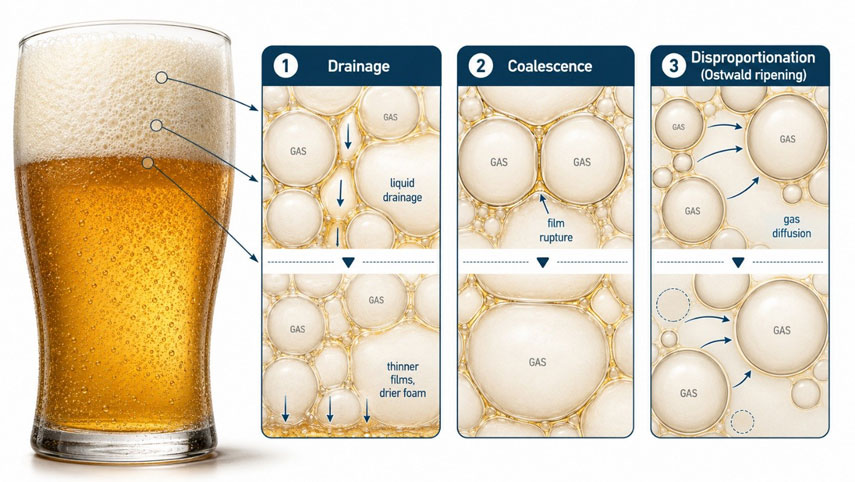
Foam is inherently unstable. Even a well-made carbonated malt beverages head changes continuously after pouring, and three physical processes explain most of that change.
The first is drainage. Gravity pulls liquid out of the thin films and channels between bubbles. As liquid drains downward, those films become thinner, less elastic, and more vulnerable. A dry-looking foam often indicates advanced drainage, where thinning films become prone to rupture, resulting in a coarse head, reduced creaminess, and rapid collapse. Proteins, polysaccharides, and other foam-active materials can slow drainage by increasing the viscosity and elasticity of the interfacial network.
The second process is coalescence. When the film between neighboring bubbles fails, the two bubbles merge. A fine head becomes coarser, larger bubbles rise faster, and the foam loses its smooth appearance. Strong protein-hop films help prevent coalescence, whereas lipids, detergent residues, and other hydrophobic contaminants weaken the interface and accelerate bubble merging.
The third process is disproportionation, in which gas diffuses from smaller, higher-pressure bubbles into larger, lower-pressure bubbles, causing progressive foam coarsening.
The relative importance of these mechanisms varies by carbonated malt beverages style and composition. Recent surface-rheology work shows that one carbonated malt beverages may be governed mainly by the elastic and viscous behavior of its surface layer, while another relies more on surface-tension gradients that replenish weak points in the film. There is no universal foam mechanism for every beverage; formulation changes must be evaluated in the final matrix [6].
4. The Molecular Architecture of a Stable Head
Malt-derived proteins: building the interfacial film
Important foam-positive components in malt-based systems originate in the malt. Lipid transfer protein 1 (LTP1) and Protein Z are frequently discussed because they can persist through key brewing stages while retaining foam-relevant functionality and contributing to the interfacial film around bubbles. The practical lesson, however, is more nuanced than “more protein equals more foam.” Total protein content alone does not predict head retention reliably. The key questions are which proteins remain, how processing modified them, how surface-active they are, and how they interact with the rest of the beverage matrix [2,3,5].
LTP1 is notable for heat tolerance and surface activity. During mashing and wort boiling, it can unfold, aggregate, bind lipids, or undergo chemical modification. These changes influence its behavior at the bubble surface. Heat history is therefore not only a flavor or process-efficiency issue; it can shape the future interfacial chemistry and foam performance of the finished beverage [3].
Protein Z is also associated with foam performance, but it should be viewed as one contributor within a broader foam-active matrix. Its effect depends on concentration, hydrophobicity, interactions with bitter acids where present, polysaccharides, and the overall colloidal environment. Treating LTP1, Protein Z, or any single fraction as an independent solution is not scientifically sound [2,4,5].
Polyphenols: a balancing component, not a universal benefit
Polyphenols should be included in the foam discussion because they can interact with proteins and influence the colloidal environment that supports or undermines foam. Their effect is conditional. Depending on chemical type, concentration, oxidation state, and the balance between protein and polyphenol fractions, they may support interfacial structure or contribute to haze-active aggregates and instability. In practical terms, the objective is not to maximize or minimize total polyphenols indiscriminately; it is to manage the protein–polyphenol balance required for the intended clarity, sensory profile, and foam behavior [2,8].
Hop bitter acids: reinforcing the interface when used
Iso-alpha-acids from hops contribute not only to bitterness but also to foam-film strength and foam cling, depending on concentration, pH, bitter-acid form, and the surrounding colloidal environment. At the gas-liquid interface, iso-alpha-acids can interact with foam-active proteins and peptides, increasing the mechanical strength and elasticity of the interfacial film around bubbles. Work with lager carbonated malt beverages has shown that iso-alpha-acids and several reduced bitter-acid forms affect both foam stability and cling formation [4]. This does not mean carbonated malt beverages should simply be made more bitter. Hop-product type, isomerization efficiency, dosage, pH, and sensory target all matter. Bitter-acid chemistry is one foam lever, but it must remain aligned with the intended flavor profile.
Foam-negative compounds: small amounts, large effects
Lipids are among the most effective foam-destabilizing components in malt beverages, as they disrupt the protein-based interfacial film and accelerate foam collapse. Free fatty acids, triglycerides, oils, equipment lubricants, process carryover, and other hydrophobic materials can compete with foam-active proteins at the interface or weaken the cohesive film that proteins have formed. Potential sources include raw materials, poor trub separation, processing lubricants, contaminated transfer lines, food residues, and glassware. Detergent or rinse-aid residues can similarly impair head formation, lacing, and foam retention, even when glassware appears visually clean. A visually clean glass is not necessarily beer-clean; residual surfactants can severely impair head formation, lacing, and retention. Ethanol also generally reduces foam stability because it changes surface tension and can weaken interfacial films; its final effect, however, depends on the complete carbonated malt beverages matrix [1,2].
5. Process Factors That Shape Foam Stability
Foam is not fixed at one point in production. It is assembled gradually through the process and can be damaged at several stages. The most relevant process route depends on the product: some carbonated malt beverages are produced from fresh malt wort, whereas others rely more heavily on malt extract, reconstitution, flavor systems, and post-process carbonation. The control strategy should match the actual process route rather than borrowing every control point from beer production.
For wort-based products, raw-material selection establishes the starting point. Barley variety, malting conditions, modification level, and grist composition influence the proteins and peptides available for the finished beverage. A foam-oriented raw-material specification should not rely only on crude protein; it should connect raw-material analysis with pilot trials and finished-product foam performance.Mashing determines the degree of protein modification before the wort reaches the kettle, directly influencing the balance between foam-active protein fractions, processability, and colloidal stability. Excessive proteolytic activity can reduce larger foam-active protein fractions, whereas insufficient breakdown may create downstream processing and colloidal-stability challenges.The appropriate compromise depends on the malt, target carbonated malt beverages, and brewhouse design. Monitoring soluble nitrogen and protein-related indicators alongside finished-carbonated malt beverages foam data is more useful than treating a conventional mash program as universally suitable.
Wort boiling is a critical control stage because it affects hop-acid isomerization, protein denaturation, trub formation, and the final balance between clarity and foam-active colloidal material. Heat changes proteins, drives hop-acid isomerization, and promotes separation of hot trub. The aim is not to preserve every protein indiscriminately, but to retain a functional population of foam-active molecules while maintaining clarity, flavor quality, and efficiency. Boil intensity, duration, and evaporation rate should be reviewed when a recurring foam problem appears.
Fermentation, maturation, filtration, and stabilization add further complexity. Yeast strain and fermentation conditions affect alcohol, residual carbon dioxide, acidity, and colloidal material. Over-aggressive clarification or stabilization may improve visual brightness but can reduce foam performance by removing foam-positive proteins, peptides, and colloidal material. Foam should be treated as part of the same quality system as flavor stability, haze control, and microbiological security, not as a final visual check.
6. Carbonation, Packaging, and Dispense: Protecting Foam Until the Pour
Carbon dioxide is essential for head formation, but it is not a substitute for a stable interfacial film. High CO2 may create a dramatic first pour, then collapse into coarse bubbles if the protein-hop system is weak. At the other extreme, a carbonated malt beverages with a well-designed foam-active composition may still look flat if too little CO2 remains dissolved by the time it reaches the consumer.
The CO₂ specification at filling is only the starting point. Product temperature, filler pressure, headspace consistency, closure or seam integrity, package barrier performance, oxygen pickup, distribution temperature, storage conditions, and mechanical handling can all alter the gas and colloidal conditions that govern foam behavior. Service conditions matter too: line pressure, serving temperature, faucet condition, glass cleanliness, and pouring technique can protect or undermine the intended foam profile [12,13].
In products vulnerable to CO2 loss during storage or distribution, compatible carbonation-retention strategies can be evaluated as a complementary formulation tool. Their purpose is not to replace the protein-hop system that stabilizes foam. Rather, they may help preserve CO2 availability and support more consistent bubble release at the moment of serving. Any approach should be tested in the real beverage matrix for shelf-life CO2, foam height, foam stability, sensory impact, haze, and package compatibility.
Package Format Matters
The package does not create the foam film, but it influences the carbon dioxide and oxygen conditions under which the product reaches the consumer. Package comparisons must be based on the actual container, closure, storage profile, and distribution route rather than on a simple ranking of materials.
| Format | Foam-relevant considerations | Priority checks |
| Glass bottle | The glass wall is essentially impermeable to gas, closure integrity and headspace management therefore become central. Light exposure can affect flavor stability, especially in clear or lightly colored glass, but it is not a direct measure of foam stability. | Fill CO₂, headspace, closure torque/crown performance, light protection, and storage temperature. |
| Aluminum can | The metal body provides a strong barrier to light and gas when the can and double seam remain intact. Foam performance can still be affected by fill conditions, headspace, seam integrity, and thermal abuse during distribution. | Seam integrity, fill CO₂, headspace, dissolved oxygen, can conditioning, and post-transport foam tests. |
| PET bottle | PET has finite CO₂ and O₂ permeability; performance depends on resin, wall thickness, bottle geometry, barrier layer, cap/liner, and temperature. It requires the most explicit shelf-life gas-retention validation. | CO₂ loss curve, oxygen ingress, cap/liner performance, barrier specification, temperature-abuse testing. |
| Draft / keg service | No individual retail package is opened at service. Gas supply, regulator pressure, product and line temperature, line cleanliness, faucet condition, and pour practice directly shape foam behavior. | Gas blend/pressure, line temperature, cleaning records, faucet flow, glass cleanliness, and standardized pour. |
7. Measuring Head Retention: Turning Appearance into Data
A brewer should not rely only on visual impressions from an informal pour. Standardized measurement makes it possible to distinguish a raw-material issue from a dispense issue, or a true stability loss from a change in initial foam volume. NIBEM-type tests measure the time required for a foam layer to fall by a defined distance. Other approaches include the Rudin test, controlled-pour methods, and automated image analysis that tracks foam height, bubble distribution, and collapse rate [7].
Whichever method is selected, the surrounding controls are essential. Product temperature, glass geometry, pour rate, sample agitation, and time between opening and testing can all change the result. A useful foam specification combines a repeatable instrumental data with structured sensory review: how the head looks, how quickly it changes, whether bubbles remain fine, whether lacing is appropriate, and whether the result stays consistent through shelf life.
This discipline also helps teams diagnose whether a failure originates in recipe design, brewhouse execution, packaging performance, or point-of-service handling, instead of making changes based only on appearance, anecdote, or one-dimensional test results.
Troubleshooting Foam Problems: Symptom to Likely Cause
The following table is intended for structured troubleshooting, not one-step diagnosis. Several causes may operate at the same time, so corrective action should follow a controlled check of product, package, and service variables.
| Observed symptom | Likely contributors | First checks | Corrective direction |
| Weak initial head | Low dissolved CO₂ at point of pour; warm product; poor pour geometry; low nucleation; low foam-active solids. | Verify CO₂, temperature, glass condition, and standardized pour before changing formulation. | Correct service/fill variables; then review carbonation target and foam-active matrix. |
| Rapid foam collapse | Weak protein/polysaccharide interface; lipids or surfactants; high temperature; incompatible flavor emulsion. | Check collapse rate, lipids/oil-based flavors, rinse residue, and temperature. | Remove foam-negative contamination; review protein and colloid balance. |
| Coarse or uneven bubbles | Aggressive gas release; nonuniform nucleation; low interfacial elasticity; excessive agitation. | Compare bubble-size images under controlled pour conditions. | Control release rate, handling, and interfacial formulation. |
| Poor lacing | Glass contamination; surfactants; inadequate film strength; unsuitable glass surface. | Run a clean-glass test and compare with a validated control glass. | Correct wash/rinse practices and verify foam-active components. |
| Batch-to-batch inconsistency | Variation in malt/extract lot, thermal history, CO₂, flavor addition, or cleaning carryover. | Review control charts for protein-related indices, CO₂, fill data, and foam metrics. | Investigate the first drifting parameter; do not adjust multiple variables at once. |
| Foam loss after packaging | CO₂ loss, package/closure/seam issue, oxygen exposure, temperature abuse, or shelf-life interaction. | Compare fill-day and end-of-life CO₂ plus foam retention for each pack format. | Correct package specification or filling conditions; confirm with real shelf-life testing. |
| Different behavior by bottle, can, PET, or draft | Different barrier, closure, headspace, light, distribution, or serving conditions. | Test the same batch across formats under matched storage and service conditions. | Set format-specific specifications and acceptance limits. |
The Takeaway for Beverage Production Teams
A lasting foam head is the visible result of careful interfacial science. CO2 provides the gas, but the protective architecture around bubbles is created by a functional matrix of proteins, peptides, polyphenols, polysaccharides, hop-derived bitter acids where used, and the absence of foam-negative contaminants. Process history determines whether those components arrive in the finished carbonated malt beverages in a functional form, while lipids, detergents, poor carbonation control, and poor service practice can undo the benefit.
The most reliable strategy is integrated rather than corrective. Build foam potential into raw materials and brewhouse conditions, protect it through fermentation and packaging, and verify it under real dispense conditions. The result is not merely more foam, but a fine, persistent head that supports aroma, texture, and the consumer’s perception of quality.
Practical Control Framework for Malt beverage manufacturers
| Quality lever | What to monitor | Main foam risk | Practical response |
| Malt and grist | Malt modification, soluble nitrogen, lot-to-lot protein profile | Loss of foam-positive proteins or excessive proteolysis | Set performance-based malt specifications and verify with pilot brews and finished-carbonated malt beverages foam tests. |
| Hop bittering system | Iso-alpha-acid level, type, and composition | Weak protein-hop interfacial reinforcement | Optimize bittering against both the sensory target and measured foam performance. |
| Brewhouse thermal profile | Mash and boil time-temperature history | Unfavorable protein transformation or loss | Review heat load and boiling conditions against finished-carbonated malt beverages foam data. |
| Lipid and detergent control | Raw-material lipids, transfer hygiene, glass washing and rinsing | Surface-film disruption, rapid collapse, poor lacing | Audit lubricants, cleaning chemistry, rinse quality, and glass-handling practices. |
| Carbonation, packaging, and dispense | CO2 at filling and end of shelf life, pack integrity, line pressure and serving temperature | CO2 loss, weak initial head, or unstable over-foaming | Standardize filling, storage, and dispense; screen compatible CO2-retention approaches when justified. |
References and Further Reading
1. Gonzalez Viejo, C.; Torrico, D. D.; Dunshea, F. R.; Fuentes, S. (2019). Bubbles, Foam Formation, Stability and Consumer Perception of Carbonated Drinks: A Review of Current, New and Emerging Technologies for Rapid Assessment and Control. Foods, 8(12), 596. https://doi.org/10.3390/foods8120596
2. Gribkova, I. N.; Eliseev, M. N.; Belkin, Y. D.; Zakharov, M. A.; Kosareva, O. A. (2022). The Influence of Biomolecule Composition on Colloidal Beer Structure. Biomolecules, 12(1), 24. https://doi.org/10.3390/biom12010024
3. Mizuguchi, J.; Asaka, K.; Konishi, M.; Inui, T.; Uchiyama, S.; Torisu, T. (2025). Heat-Induced Changes in the Chemical Structure, Hydrophobicity, and Size Distribution of Free/Bound Lipid Transfer Protein 1 and Their Effects on Beer Foam. Journal of Agricultural and Food Chemistry, 73(38), 24343-24353. https://doi.org/10.1021/acs.jafc.5c07895. Open full text: https://hdl.handle.net/11094/103489
4. Chen, C.; Lv, C. (2025). Interaction Between Iso-alpha-Acid Extracted from Hops and Protein Z Improves Beer Foam Quality and Stability. Chemistry, 7(2), 65. https://doi.org/10.3390/chemistry7020065
5. Li, X.; Jiang, K.; Jin, Y.; Liu, J. (2024). Comparative Study on Protein Composition and Foam Characteristics of Barley and Wheat Beer. Foods, 13(21), 3400. https://doi.org/10.3390/foods13213400
6. Chatzigiannakis, E.; Alicke, A.; Le Bars, L.; Bidoire, L.; Vermant, J. (2025). The Hidden Subtlety of Beer Foam Stability: A Blueprint for Advanced Foam Formulations. Physics of Fluids, 37(8), 082139. https://doi.org/10.1063/5.0274943
7. Nyarko, E. K.; Glavas, H.; Habschied, K.; Mastanjevic, K. (2021). Determination of Foam Stability in Lager Beers Using Digital Image Analysis of Images Obtained Using RGB and 3D Cameras. Fermentation, 7(2), 46. https://doi.org/10.3390/fermentation7020046
8. Wang, Y.; Wang, Z.; et al. (2021). Haze in Beer: Its Formation and Alleviating Strategies, from a Protein–Polyphenol Complex Angle. Foods, 10(12), 3114. https://doi.org/10.3390/foods10123114
9. American Society of Brewing Chemists (ASBC). Beer 22. Foam Collapse Rate and Foam Stability. Official Methods index. https://www.asbcnet.org/Methods/BeerMethods/pages/default.aspx
10. American Society of Brewing Chemists (ASBC). Beer 50. Foam Stability by NIBEM. Archived Methods index. https://www.asbcnet.org/Methods/Pages/ArchivedMethods.aspx
11. Mitteleuropäische Brautechnische Analysenkommission (MEBAK). Method Database: B-420.08.041 Foam Stability, NIBEM; B-420.09.100 Ross and Clark; B-420.12.820 Foam Cling Capacity, NIBEM Cling Meter. https://www.mebak.org/en/methoden-datenbank
12. Ramos, M.; Valdés, A.; Mellinas, A. C.; Garrigós, M. C. (2015). New Trends in Beverage Packaging Systems: A Review. Beverages, 1(4), 248–272. https://doi.org/10.3390/beverages1040248
13. Michiels, Y.; Van Puyvelde, P.; Sels, B. (2017). Barriers and Chemistry in a Bottle: Mechanisms in Today’s Oxygen Barriers for Tomorrow’s Materials. Applied Sciences, 7(7), 665. https://doi.org/10.3390/app7070665