
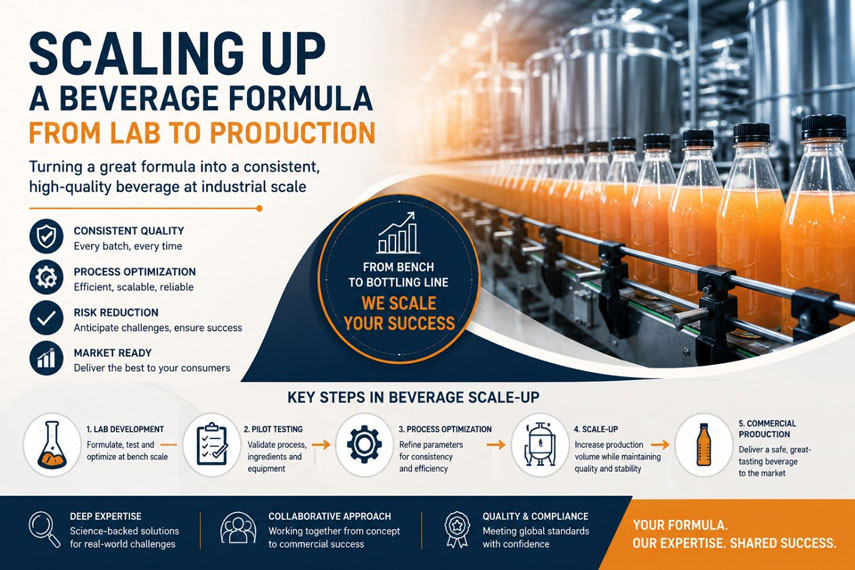
Scaling Up a Beverage Formula from Lab to Production: Common Challenges
A beverage formula that tastes perfect in a one-liter jar can behave unpredictably in a nine-thousand-liter tank. This is the central challenge of scale-up: the empirical process of transitioning a product from lab or pilot scale to industrial production, starting the moment, the first ingredient is chosen and ending only once a consistent process is established on the production floor.
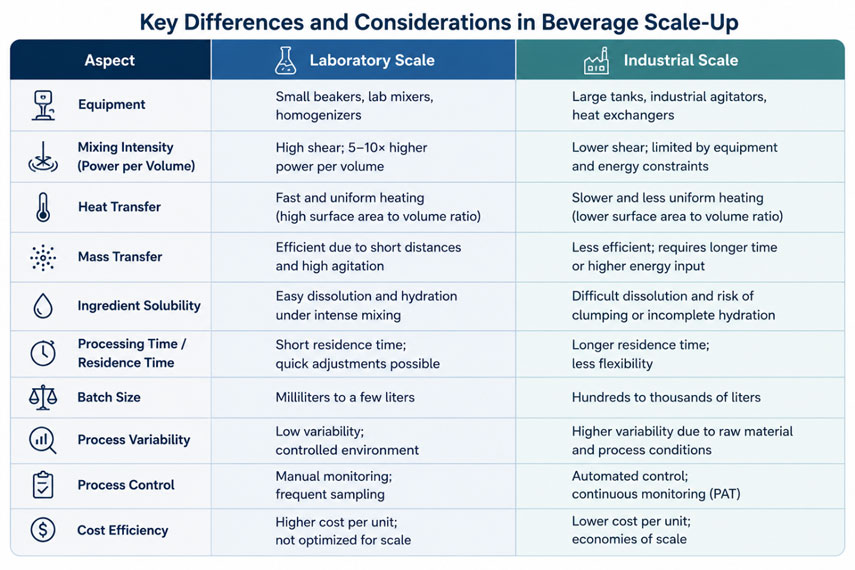
Scale-up is not simply multiplication. Mixing intensity, heat transfer, mass transfer, and shear all change as batch volume grows, and a recipe that never accounted for these shifts can fail in ways that have nothing to do with the formula itself. For beverage companies, this matters even more than for most food products, since a single drink formula has to survive dissolution, thermal processing, carbonation, filling, and months on a shelf, all while keeping the same taste, clarity, and safety profile that impressed everyone at the bench.
Why Beverage Formulas Fail During Scale-Up
The transition from lab bench to commercial line is rarely linear. Formulas that succeed at small scale often run into trouble industrially because the physical and mechanical conditions of large-scale manufacturing differ fundamentally from a controlled lab environment [1].
Equipment Differences and Mixing Dynamics
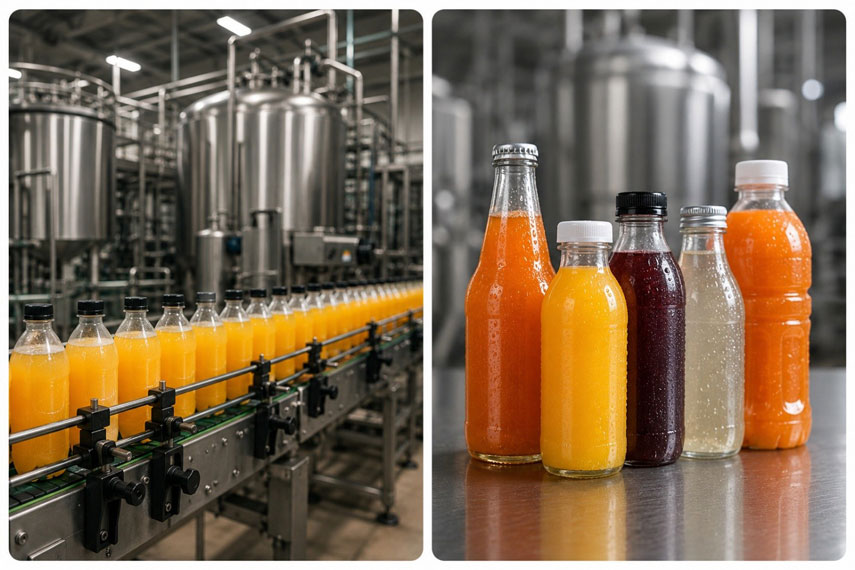
Laboratory equipment, such as Waring blenders, routinely produces mixing intensities and power-per-volume levels five to ten times greater than what is practical, or even available, in industrial food operations [1][2]. High-speed bench agitation disperses ingredients and homogenizes emulsions with ease, but duplicating that intensity in a large production tank is often impossible, since power requirements in turbulent flow rise with impeller diameter to the fifth power [2]. Bench mixers are also rarely geometrically similar to production mixers. Without matching ratios for impeller diameter, tank height, and baffle width, the flow patterns and turbulence levels needed for consistency cannot be reliably predicted [3].
Heat and Mass Transfer Challenges
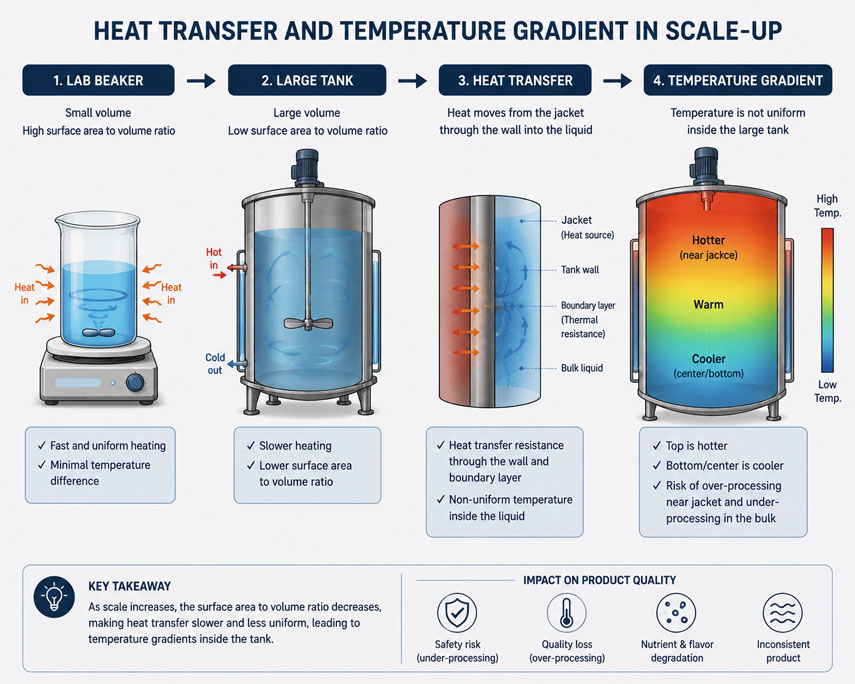
As batch volume increases, the ratio of surface area to volume drops. Commercial thermal treatments rely on heat transferred through a jacket or heat exchanger, and in large vessels the ratio of heating surface to liquid volume is much lower than in a small lab beaker. The result is slower heat transfer and non-uniform temperature distribution, which can overprocess liquid near the heat source while under processing the bulk [4]. Mass transfer efficiency declines in a similar way: in processes like solid-liquid extraction or sugar crystallization, distributing the energy needed to move molecules between phases becomes harder in a large vessel, often requiring longer processing times or adjusted agitation to match lab-scale yield [5].
Shear Forces and Residence Time
Commercial tanks create highly non-uniform shear environments. Energy dissipation near the impeller can be an order of magnitude higher than in the rest of the vessel, so some of the liquid experiences shear intense enough to damage proteins, enzymes, or microorganisms, while other regions stay poorly mixed [6]. Residence time distribution also widens at scale: in continuous processes, some material can short-circuit through quickly while other portions linger far longer than intended, producing an inconsistent processing history across a single batch [6].
Process Variability and Material Inconsistency
Finally, bench formulations are usually built with unusually consistent, small-batch ingredients. Commercial production draws on large quantities of raw material that vary by harvest timing, geographic origin, or the specific plant part used, and the older habit of testing quality in after the fact is not fast enough for that variability [7]. The more reliable approach, and the one the industry is steadily shifting toward, is building quality in by design, where formulation science and process engineering are integrated from the start [5].
Ingredient Solubility at Scale
Ingredient solubility underlies both uniformity and stability. Nutritive sweeteners such as sucrose and high-fructose corn syrup dissolve predictably at the bench but behave differently when added in bulk industrially. High-potency sweeteners like aspartame are pH-dependent, dissolving best in acidic solution, while preservatives such as sodium benzoate need a less acidic environment for good initial dissolution [8].
Vitamins and minerals bring their own complications. Fat-soluble vitamins need successful emulsification to stay dispersed, and water-soluble vitamins are prone to partial destruction under high heat. Calcium phosphate is unusual in that its solubility falls as temperature rises, which during thermal processing can precipitate insoluble salts onto proteins and cause sedimentation. Proteins such as whey and casein are sensitive to pH and heat, and excessive thermal stress can trigger denaturation and aggregation that hurts both solubility and mouthfeel [8]. Hydrocolloids like gellan gum or modified starch add kinetic stability by thickening the continuous phase, but they need precise hydration conditions and high shear to avoid forming insoluble clumps [9].
At scale, dissolution efficiency often drops because industrial tanks suffer from non-uniform shear and dead zones where agitation cannot drive molecular transfer the way an intense lab blender can [1][9]. As batch volume grows, the power-per-volume ratio usually falls, lengthening dissolution time, and large dry-ingredient additions raise the risk of air entrainment and clumping if the powder is not spread evenly across the moving liquid surface [9].
Mixing and Homogeneity
Mixing is the random distribution of ingredients throughout a system to reduce non-uniformity in composition, temperature, and properties, achieved through agitation that sets up axial, radial, or tangential flow [10]. The efficiency of these flow patterns is governed by the Reynolds number, a dimensionless ratio of inertial to viscous forces; stirred-tank flow is generally laminar below a Reynolds number of ten and fully turbulent above ten thousand, with a wide transitional zone in between [10].
Impeller design and tank geometry shape the resulting flow. Hydrofoil impellers favor bulk blending and solids suspension through strong axial flow at low power draw. Pitched-blade turbines offer a mix of radial and axial flow, while straight-blade turbines create mostly radial flow, which is less effective for bulk blending but useful for high-power dispersion [3]. Industrial tanks typically use wall baffles to stop uncontrolled swirling, or solid-body rotation, which forms a surface vortex but produces poor top-to-bottom movement; dished bottoms are also preferred over flat ones because they allow full particle suspension at lower impeller speeds [7].
A recurring scale-up problem is the formation of dead zones. In viscous or non-Newtonian beverages, agitation may only stir a well-mixed cavern immediately around the impeller while the rest of the tank sits nearly still, which is bad for both heat and mass transfer [3]. Mixing time, the time needed for concentration fluctuations to settle to a target range, rarely scales linearly and typically grows as vessel volume increases [11].
Heat Transfer and Thermal Processing
Thermal processing is the main industrial route to microbial safety and enzyme deactivation, ranging in intensity from pasteurization, aimed at a five-log reduction of target organisms, to full commercial sterilization [4]. High Temperature-Long Time treatments, typically eighty degrees Celsius or higher for more than thirty seconds, are common but can produce slow conduction and uneven heat distribution in large vessels [4].
Acidic beverages often use hot-fill systems, heating the product to roughly ninety to ninety-five degrees Celsius, filling directly into containers, and holding for ten to twenty minutes before cooling, which uses the liquid’s own heat to sterilize the container interior [4]. Ultra-High-Temperature processing instead heats the beverage to around one hundred thirty-five to one hundred fifty degrees Celsius for only a few seconds before aseptic packaging; whether by direct steam injection or indirect heat exchange, Ultra-High Temperature (UHT) typically causes less chemical damage than traditional retort methods because the thermal exposure is so short [10].
Balancing microbial lethality against sensory quality is where scale-up gets difficult. Excessive thermal load degrades water-soluble vitamins, particularly B-complex vitamins and vitamin C, and ascorbic acid loss is a reliable indicator of overprocessing, especially where residual oxygen is present in the package [8]. High heat also drives off volatile aroma compounds and can create cooked flavors through oxidation of sulfhydryl groups, while triggering the Maillard reaction and breaking down natural pigments such as anthocyanins and carotenoids [12]. Because industrial heat transfer is usually slower than at the bench, teams need to optimize time-temperature profiles carefully to protect quality while still meeting the required lethality value [12]. Functional beverages built around heat-sensitive bioactives feel this most: trials on a blackberry-soy-flaxseed beverage found that thermal treatment intensity had a measurable effect on retained bioactive compounds and physicochemical quality, reinforcing why scale-up teams need to revisit the thermal profile whenever a formula relies on delicate actives rather than just microbial safety [29].
Emulsion Stability and Hydrocolloid Hydration
Beverage emulsions, sometimes called cloud systems, are colloidal dispersions that give clear drinks opacity, flavor, and a juice-like appearance. They combine a dispersed oil phase, typically flavor or vegetable oils, with an aqueous phase containing surface-active biopolymers, and because the two liquids are immiscible, stabilizers are needed to keep the oil droplets from merging or separating [13]. Gum Arabic and modified starches are the most common stabilizers, forming a steric barrier around droplets while thickening the continuous phase [14].
Xanthan gum is especially effective because it produces a shear-thinning, high-viscosity network that limits droplet movement at rest, while high-methoxyl pectin stabilizes acidified protein beverages by forming electrostatic and steric complexes that resist aggregation under acidic conditions [13]. The move from lab to production, though, is where hydrocolloid hydration often fails. A lab blender delivers intense, uniform shear that hydrates quickly, but industrial tanks with lower power-per-volume ratios can leave clumps, sometimes called fish-eyes, where the stabilizer never hydrates properly, weakening the protective network [9].
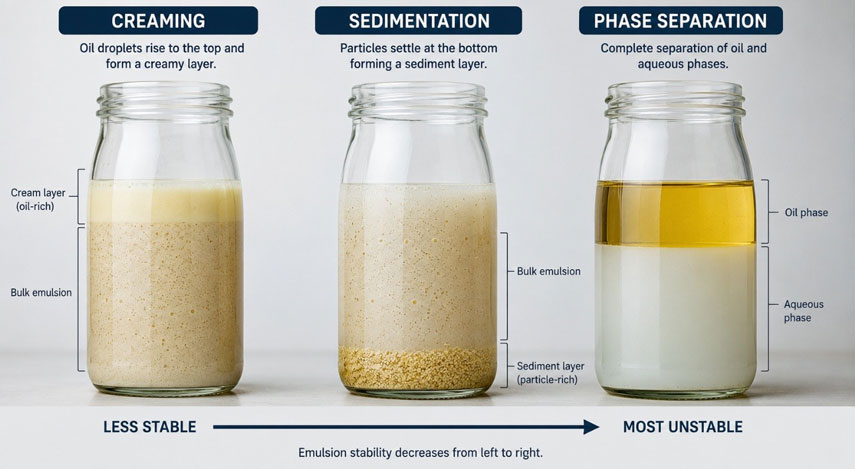
The two most common defects at scale are creaming and sedimentation. Creaming happens when oil droplets, being less dense than the aqueous phase, rise to form a whitish ring at the neck of the bottle; this follows Stokes’ Law[1], so creaming can be slowed by reducing droplet size or matching the densities of the two phases with weighting agents [14]. Sedimentation is the opposite problem, where particles migrate downward, often because weighting agents are overdosed or because proteins and minerals are not properly suspended by the hydrocolloid network [15]. Left uncontrolled, either mechanism can progress to full phase separation, with droplets coalescing into a visible oil layer [16].
Carbonation, pH, and Brix2 Control
Carbonation, pH, and Brix all shift from manual, batch-tested parameters in the lab to values that require in-line monitoring and automated dosing at industrial scale.
Carbonation and CO2 Retention
Carbonation saturates a liquid with carbon dioxide under specific pressure and temperature, following Henry’s law[3], which states that dissolved CO2 concentration is directly proportional to the gas’s partial pressure in the container [17]. Industrial carbonators keep the gas and liquid in close contact, usually at chilled temperatures around four degrees Celsius, to maximize solubility. CO2 retention during storage is more effective in larger containers, such as magnums, than in standard bottles, since the ratio of volume to surface area is higher [18].
Foaming and Deaeration
Fobbing, or excessive frothing during filling, is a common industrial defect usually caused by dissolved air acting as a nucleation site for rapid gas release. Industrial lines counter this with a deaeration step, typically vacuum or reflux based, to bring residual air below roughly 0.5 parts per million before carbonation [12].
pH Consistency and Acid Balance
Acidulants such as citric or phosphoric acid deliver the acidic bite that defines both flavor and preservation. Carbonation itself lowers pH by forming carbonic acid, and maintaining a stable pH at scale matters because it governs preservative efficacy; sodium benzoate, for instance, works best between pH 2.0 and 4.0 [12]. In fruit-based drinks, the juice’s own buffering capacity can help hold pH steady through carbonation.
Brix and Sweetness Perception
Brix measures total soluble solids, mainly sugar concentration. Lab work often relies on a simple syrup around sixty-seven degrees Brix, while industrial lines use mass flow meters and in-line detectors to hold the target Brix despite density variation [17]. Sweetness perception depends on the acid-to-sugar ratio as much as Brix itself, and the slow inversion of sucrose into dextrose and fructose in acidic conditions can shift perceived sweetness over the shelf life of the product [12].
Shelf-Life and Packaging Compatibility
Packaging is a decisive factor in shelf life, providing a passive barrier against moisture, light, and, most critically, oxygen. Oxidation drives much of beverage deterioration, encouraging microbial growth, generating off-flavors, and degrading heat-sensitive nutrients such as vitamin C; total oxygen exposure depends on the container’s transmission rate, closure permeability, and residual oxygen trapped in the headspace at filling [19].
Glass remains the benchmark for barrier performance thanks to its chemical inertness, but its weight and fragility have pushed the industry toward lighter formats [19]. Aluminum cans offer strong physical protection and recyclability but need acid-resistant enamel coatings to prevent corrosion and metallic off-tastes in acidic drinks. PET is popular for its clarity and strength, but its variable gas permeability can compromise oxygen-sensitive formulas, which is why manufacturers turn to multilayer PET or active packaging with built-in oxygen scavengers [20].
Aseptic cartons, built from paperboard, polyethylene, and aluminum foil, suit preservative-free juices well, but the mechanical scoring used to form the carton can raise oxygen transmission at the scored line by forty to fifty times compared with a flat surface [22]. Plastic packaging also risks flavor scalping, where the polymer matrix absorbs volatile aroma compounds and skews the sensory profile; polyethylene, common as the food-contact layer in cartons and bottle liners, is a notorious scalper of lipophilic citrus aromas [21].
Migration, the transfer of residual monomers, plasticizers, or ink solvents from packaging into the beverage, is influenced heavily by storage temperature and by how lipophilic the beverage is, since fats and oils help dissolve plastic constituents [23]. To confirm commercial viability, manufacturers run accelerated shelf-life studies using the Q10[4] factor, predicting stability at ambient or refrigerated conditions from reaction rates measured at elevated temperature, and commercially sterile products typically go through a fourteen-day room-temperature incubation followed by microbiological and chemical evaluation [19]. A similar accelerated protocol on a protein-enriched carbonated fruit drink was used to project storage stability and set a realistic shelf-life claim before the product ever reached full commercial volume [26].
Critical Process Parameters
Critical process parameters, or CPPs, are the variables whose variation has a direct impact on safety, quality, and physical stability. Identifying and controlling them is what keeps industrial output aligned with the bench-scale result.
| Parameter | Why It Matters | Scale-Up Risk |
| Temperature | Drives microbial and enzyme inactivation; also drives vitamin loss, browning, and CO2 solubility | Slower, uneven heat transfer in large vessels |
| Mixing speed / shear rate | Governs mass and energy transfer and droplet size | Bench mixers run 5-10x more intense than production equipment |
| Homogenization pressure | Reduces droplet size in emulsions | A threshold pressure (roughly 100-150 MPa) exists; exceeding it can re-coalesce droplets |
| Residence time / flow rate | Determines uniformity of thermal treatment | Too fast risks under-lethality; too slow risks cooked flavor and nutrient loss |
| Filling conditions | Chilled fill maximizes CO2 solubility and speed | Poor deaeration causes fobbing and oxidative off-flavors |
Temperature also interacts with pressure through Henry’s law, since CO2 solubility rises at low temperature and high pressure, and internal bottle pressure must be managed carefully during thermal processing to avoid container failure [9][17]. Mixing speed accelerates transfer but raises shear, and while high shear helps break up clumps and reduce droplet size, too much can damage proteins and delicate particles; this is difficult to scale because lab mixers already run far more intensely than plant equipment [2]. Homogenization pressure follows a similar logic: more pressure generally means smaller, more stable droplets, but past a threshold, typically one hundred to one hundred fifty megapascals, newly formed droplets can recombine and increase particle size instead [25]. Residence time and flow rate are inseparable in continuous processing, since the spread of time different portions of liquid spend in a heating or mixing zone decides whether the batch reaches the required lethality without tipping into cooked flavors [12]. Filling conditions round out the list: chilled filling around four degrees Celsius helps both CO2 solubility and line speed, but deaeration beforehand is still needed to prevent fobbing and the oxidative reactions that cause browning during storage [12].
Best Practices and Common Scale-Up Mistakes
The most persistent mistake in beverage scale-up is assuming a recipe will scale linearly. Small producers frequently discover that a formula tuned in a one-liter container behaves unpredictably in a nine-thousand-liter tank, and industry accounts describe brands missing major retail orders when a first industrial batch failed to match the bench-scale prototype [6].
Common Failures
The biggest driver of failure remains the mismatch in mixing intensity between bench and plant, since lab equipment routinely produces power-per-volume levels five to ten times higher than what industrial lines can deliver, leading to phase separation or clumping once ingredients are dispersed at the intensities the lab assumed [1][2]. In powder mixing, overfilling ribbon blenders past the top edge of the ribbons is a frequent cause of poor blending along the vertical walls. Raw material behavior can also surprise a team at scale; grinding certain botanical roots, for instance, can release noxious gases in quantities that require dedicated equipment never needed at the bench [6].
Industrial Recommendations
Process Analytical Technology, which uses real-time monitoring to build quality in during manufacture rather than testing it in afterward, is becoming standard practice. Identifying CPPs and Critical Control Points is essential; in instant ginger drink production, for example, crystallization is treated as a Critical Control Point because mistimed crystallization leads to clumped, wet product or unwanted caramelization [24].
The principle of similitude, maintaining geometric, kinematic, and dynamic similarity between scales, is the gold standard. Where geometric similarity is not possible, a step-by-step approach works better: scale first to the production tank’s diameter, then adjust for the larger volume, and finally add impellers or adjust rotational speed to hold torque per volume constant [2].
Practical Advice for Beverage Manufacturers
1. Pre-blend minor ingredients. Anything under 0.5 percent of the total batch should be pre-blended with a carrier, or with a portion of the major ingredients, until it reaches at least a 2 percent concentration before it goes into the main mixer.
2. Sequence additions deliberately. Add major ingredients first, then secondary ones, and use spray nozzles when adding liquid to powder so the liquid lands on the moving powder surface instead of crusting the mixer wall.
3. Simulate before investing. Process simulation tools can project techno-economic feasibility and flag transport-phenomena bottlenecks before a single physical trial [5].
4. Consider co-packers. Contract manufacturers who already own specialized equipment, such as high-pressure homogenizers, can reduce the financial risk of a first industrial run [6].
5. Standardize agitation for fermented products. In processes like kombucha fermentation, static systems or carefully controlled low-speed agitation preserve bioactive compounds and keep pH decay consistent [28].
These same principles carried a functional beverage project through scale-up successfully in practice: work on a Java tea-based functional drink used a structured formula-optimization process to move from bench trials to a scaled-up formula while holding onto the target functional profile, showing that the biggest risk in scale-up is treating the recipe as fixed rather than treating the process around it as the thing that needs re-optimizing [27].
A Quick Worked Example
Picture a bench-scale herbal RTD formula that performed well in ten-liter trials: clear, stable, with a clean acid-sweet balance. At the first pilot run of five hundred liters, the hydrocolloid failed to hydrate fully, leaving faint fish-eyes near the tank wall, since the plant mixer could not reproduce the shear the lab blender delivered [9].
The team responded by pre-hydrating the gum in a smaller high-shear side stream before adding it to the main batch, which resolved the clumping. At full commercial scale, a second issue appeared: the pasteurization step slightly dulled the top aromatic notes, since the larger vessel’s slower heat transfer meant more time near peak temperature than the lab process implied [4]. Adjusting the time-temperature profile, rather than the recipe itself, recovered the intended flavor while still meeting the required lethality. The formula never changed; the process around it did.
Conclusion
Moving a beverage formula from the lab to commercial production is an empirical process, not a simple act of multiplying ingredient quantities. The core challenge is a lack of similitude between bench-scale development and industrial reality: lab equipment often reaches mixing intensities five to ten times greater than a production tank can deliver, opening a real gap in dispersion and homogenization that shows up as clumping or phase separation once volumes grow.
Physical and chemical parameters do not scale uniformly either. Changes in the volume-to-surface-area ratio alter heat transfer rates and raise the risk of nutrient loss and flavor degradation during pasteurization or UHT processing, while the stability of carbonated and emulsified systems stays highly sensitive to shear, homogenization pressure, and residence time. The shift from testing quality in after the fact to building quality in by design, supported by simulation tools, in-line monitoring, and clearly defined critical control points, is what allows formulation science and process engineering to work together instead of against each other. A strong bench-scale formula is a starting point, not a finish line; the work is only done once a repeatable, industrial-scale process stands behind it.
Frequently Asked Questions (FAQ)
Why doesn’t a beverage formula scale linearly?
Because mixing intensity, heat transfer, and shear all change with vessel size in different ways. A lab blender can deliver five to ten times more mixing intensity per unit volume than a production tank, so a formula optimized at that intensity may not disperse or hydrate the same way at scale.
What is the principle of similitude?
It is the standard for scale-up that calls for keeping geometric, kinematic, and dynamic similarity between the bench and plant, so that flow patterns and ingredient dispersion behave consistently as volume increases.
What causes fish-eyes in hydrocolloid-stabilized beverages?
Fish-eyes are insoluble clumps that form when a hydrocolloid like xanthan gum or pectin does not hydrate fully, usually because industrial mixing delivers less shear per unit volume than the lab equipment used during development.
Why does thermal processing behave differently at scale?
Larger vessels have a lower ratio of heating surface area to liquid volume, which slows and uneven heat transfer. This can overprocess liquid near the heat source while under processing the bulk, affecting both safety margins and sensory quality.
What is flavor scalping?
It is the absorption of volatile aroma compounds by packaging material, particularly polyethylene, which reduces flavor intensity and can skew the sensory profile of the finished beverage over its shelf life.
How can small brands reduce scale-up risk?
Working with a co-packer that already owns the right equipment, running a pilot batch before a full commercial run, and using process simulation tools to flag bottlenecks ahead of time all reduce the risk of a costly first industrial batch.
References
1. Cullen, P. J. (Ed.). (2009). Food Mixing: Principles and Applications. Wiley-Blackwell.
2. Dickey, D. S. (2009). Mixing scale-up. In P. J. Cullen (Ed.), Food Mixing: Principles and Applications (pp. 90-106). Wiley-Blackwell.
3. Dickey, D. S. (2009). Equipment design. In P. J. Cullen (Ed.), Food Mixing: Principles and Applications (pp. 73-89). Wiley-Blackwell.
4. Petruzzi, L., et al. (2017). Thermal Treatments for Fruit and Vegetable Juices and Beverages: A Literature Overview. Comprehensive Reviews in Food Science and Food Safety, 16(4), 668-691.
5. Gonzalez, Y., et al. (2024). Framework for scaling-up extraction processes in nutraceutical beverages: A simulation, techno-economic, and environmental analysis approach. Food and Bioproducts Processing, 147, 544-553.
6. Schrock, G., et al. (2019). Appetite for Growth: Challenges to Scale for Food and Beverage Makers in Three U.S. Cities. Economic Development Quarterly, 33(1), 39-50.
7. Barigou, M. (2009). Solid-liquid mixing. In P. J. Cullen (Ed.), Food Mixing: Principles and Applications (pp. 200-225). Wiley-Blackwell.
8. Chavan, R. S., et al. (2011). UHT Milk Processing and Effect of Plasmin Activity on Shelf Life: A Review. Comprehensive Reviews in Food Science and Food Safety, 10(5).
9. Muthukumarappan, K. (2009). Mixing fundamentals. In P. J. Cullen (Ed.), Food Mixing: Principles and Applications (pp. 6-20). Wiley-Blackwell.
10. Abu-Reidah, I. M. (2020). Carbonated Beverages. In Trends in Non-alcoholic Beverages.
11. Fagan, C. C., et al. (2009). Monitoring and control of mixing operations. In P. J. Cullen (Ed.), Food Mixing: Principles and Applications (pp. 107-124). Wiley-Blackwell.
12. Yudianto, D., et al. (2026). Thermal process validation for low-cost commercial sterilization of traditional Indonesian herbal and functional beverages. Food and Humanity, 6, 101150.
13. Molet-Rodriguez, A., et al. (2018). Beverage Emulsions: Key Aspects of Their Formulation and Physicochemical Stability. Beverages, 4(3), 70.
14. Taherian, A. R., et al. (2006). Effect of added oil and modified starch on rheological properties, droplet size distribution, opacity and stability of beverage cloud emulsions. Journal of Food Engineering, 77(3), 687-696.
15. Given Jr., P. S. (2009). Encapsulation of Flavors in Emulsions for Beverages. Current Opinion in Colloid & Interface Science, 14(1), 43-47.
16. Spyropoulos, F., et al. (2009). Immiscible liquid-liquid mixing. In P. J. Cullen (Ed.), Food Mixing: Principles and Applications (pp. 175-194). Wiley-Blackwell.
17. Osofisan, P. B. (2007). Fuzzy Logic Control of the Syrup Mixing Process in Beverage Production. Leonardo Journal of Sciences, 11, 93-108.
18. Liger-Belair, G., et al. (2026). Predicting CO2 Pressure Loss in Aged Traditional-Method Sparkling Wine Bottles for Compliance with European Regulations. Beverages, 12, 70.
19. Ramos, M., et al. (2015). New trends in beverage packaging systems: a review. Beverages, 1, 248-272.
20. Bacigalupi, C., et al. (2013). Changes in nutritional and sensory properties of orange juice packed in PET bottles: an experimental and modelling approach. Food Chemistry, 141, 3827-3836.
21. Sajilata, M. G., et al. (2007). Scalping of flavors in packaged foods. Comprehensive Reviews in Food Science and Food Safety, 6, 17-35.
22. Matche, R. S. (2018). Packaging Technologies for Fruit Juices. In Fruit Juices. Elsevier Inc.
23. Franz, R. (2000). Migration of plastic constituents. In Plastic packaging materials for food. Wiley-VCH.
24. Estiasih, T., et al. (2017). Determination of Critical Processing Parameters of Instant Ginger Drink Production. Current Research in Nutrition and Food Science, 5(3), 230-237.
25. Martinez-Monteagudo, S. I., et al. (2017). Improvements in Emulsion Stability of Dairy Beverages Treated by High Pressure Homogenization: A Pilot-scale Feasibility Study. Journal of Food Engineering.
26. Hemanth, K. J., & Sinija, V. R. (2019). Accelerated shelf-life study on protein-enriched carbonated fruit drink. Journal of Food Process Engineering, e13311.
27. Wijaya, C. H., et al. (2018). Development of Java Tea based Functional Drink: Scale-up Formula Optimization. Journal of Applied Pharmaceutical Science.
28. Alves, R. O., et al. (2025). Evaluation of the Impact of Fermentation Conditions, Scale Up and Stirring on Physicochemical Parameters, Antioxidant Capacity and Volatile Compounds of Green Tea Kombucha. Fermentation, 11, 201.
29. Bonilla, A. I., et al. (2024). Effect of thermal treatment on selected bioactive compounds and physicochemical properties of a blackberry-soy-flaxseed beverage. NFS Journal, 35, 100177.