
EU and FDA Approved Colorants for Beverages: What Manufacturers Need to Know
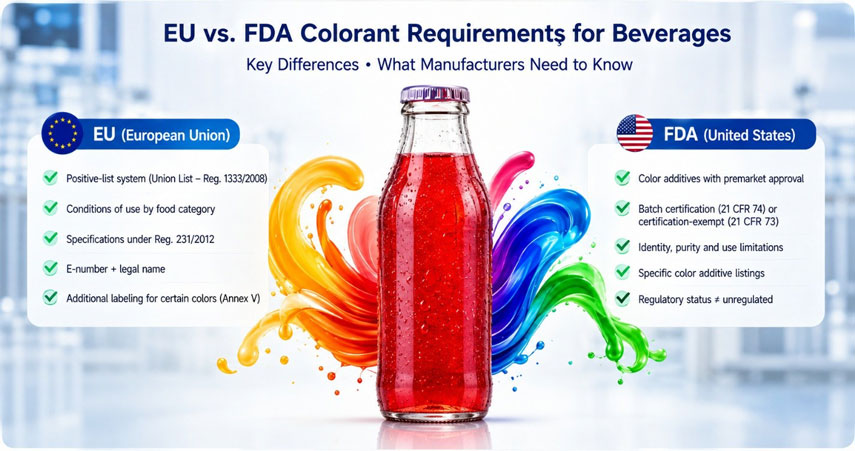
Selecting a beverage color is not simply a matter of shade or visual appeal. For manufacturers, the decision sits at the intersection of regulatory authorization, legal identity, use conditions, formulation performance, stability, labeling, supply, and target-market requirements. The European Union and the United States both regulate food colors through positive-list systems, but the terminology and regulatory pathways are different. In the EU, authorized food additives and their conditions of use are set out in the Union List under Regulation (EC) No 1333/2008, while specifications are established under Regulation (EU) No 231/2012. In the United States, color additives require FDA authorization for their intended use and are regulated primarily through 21 CFR Parts 73 and 74, with some colors subject to batch certification and others exempt from batch certification. This article explains how manufacturers should interpret those systems, highlights selected colorants relevant to beverage applications, and shows why regulatory approval is only the starting point: the final color choice must also survive processing, packaging, storage, and shelf-life conditions in the actual beverage matrix.
In this article, the term “color additive” is used specifically when referring to substances regulated under the applicable EU or U.S. regulatory framework, including their legal identity, authorization and conditions of use. The broader term “colorant” is used when referring to color-producing ingredients or systems from a technical or formulation perspective.
How Beverage Colorants Are Regulated in the EU and U.S.
European Union
In the EU, food additives are authorized through a positive-list system. Regulation (EC) No 1333/2008 establishes the framework for food additives, including definitions, authorization procedures, conditions of use, and labeling. Annex II contains the Union List of additives authorized for use in foods and their conditions of use, while Annex V contains additional labeling requirements for certain food colors. Specifications for additives listed in Annexes II and III are established under Commission Regulation (EU) No 231/2012 [1,2].
For a beverage manufacturer, an E-number is therefore not a universal permission slip. The relevant questions are: Is the additive on the current Union List? Does the exact beverage fall within the applicable food category? Is the proposed use permitted under that category, including any maximum level, group restriction, footnote, or exception? Does the material meet the applicable identity and purity specifications?
Beverages are organized under food category 14, with non-alcoholic beverages further divided into categories such as waters, fruit and vegetable juices, nectars, flavoured drinks, and tea/coffee/infusion products. The exact food category matters because authorization and conditions of use can differ between categories [3].
United States
In the United States, color additives are subject to FDA premarket approval for their intended uses. FDA distinguishes between color additives subject to batch certification and those exempt from batch certification. Certified colors are generally synthetic dyes, lakes, or pigments and are listed primarily in 21 CFR Part 74. Certification-exempt colors are listed primarily in 21 CFR Part 73 and must still comply with the identity, purity, and use limitations in their individual regulations.
This distinction is operational rather than a distinction between ‘regulated’ and ‘unregulated’ colors. Certification-exempt does not mean that a manufacturer can use any commercial material under the same name. The exact regulatory identity, specification, source or preparation, and conditions of use must match the applicable FDA listing [4-6].
EU vs. FDA: The Differences That Matter in Formulation
| Issue | European Union | United States |
| Primary framework | Regulation (EC) No 1333/2008; Union List in Annex II | FD&C Act; color-additive regulations in 21 CFR |
| How colors are identified | E-number plus legal name | Specific FDA/CFR color-additive name and listing |
| Use authorization | Depends on food category and conditions of use | Depends on the individual color-additive regulation and intended food use |
| Certification | No U.S.-style batch certification system | Some colors require FDA batch certification; others are exempt |
| Specifications | Regulation (EU) No 231/2012 and applicable specifications | Identity/purity specifications in the applicable listing regulations |
| Labeling | General additive declaration plus additional rules for certain colors | Declaration depends on the applicable color-additive identity and labeling requirements |
An EU E-number and a U.S. color-additive designation may refer to related or corresponding colorants, but the legal identity, source, specification, and permitted uses must be verified separately.
Selected Colorants Relevant to Beverage Manufacturers
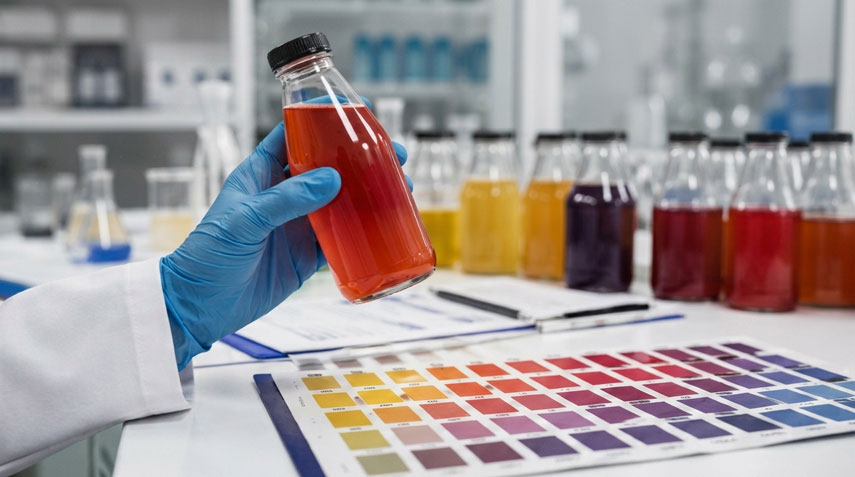
The table below is a practical screening table, not an exhaustive list of every color permitted in every beverage category. EU status must be checked against the current Union List and the exact food category. U.S. status must be checked against the applicable 21 CFR listing and, where relevant, FDA’s current Regulatory Status of Color Additives database [1,3-4,6].
| Colorant | EU designation | U.S. designation / status | Beverage relevance | Key formulation issue | Regulatory caution |
| Curcumin / turmeric color | E100 | Turmeric / turmeric oleoresin; curcumin itself is not the current FDA-listed color additive | Yellow to yellow-orange systems | Light and oxidation sensitivity; dispersion | Do not treat E100 as a direct U.S. legal identity. Verify the U.S. material and listing. |
| Tartrazine | E102 | FD&C Yellow No. 5; batch certification | Yellow beverages and blends | Shade and blend compatibility | Check the exact beverage use and U.S. labeling requirements. |
| Sunset Yellow FCF | E110 | FD&C Yellow No. 6; batch certification | Yellow-orange beverages | Shade, blend balance, processing | EU use is category-specific; do not generalize from one beverage category. |
| Allura Red AC | E129 | FD&C Red No. 40; batch certification | Red beverages | Shade, light/process stability | Verify market-specific authorization and labeling. |
| Brilliant Blue FCF | E133 | FD&C Blue No. 1; batch certification | Blue and green blends | Blend interactions and shade stability | Verify exact use conditions and label declaration. |
| Caramel colors | E150a–d | Caramel; certification-exempt | Cola, malt and brown beverages | pH, colloidal behavior, minerals, clarity | Caramel subtypes are not interchangeable; match the material to the beverage matrix. |
| Beta-carotene | E160a | β-Carotene; certification-exempt | Yellow-orange beverages | Hydrophobicity, dispersion/emulsion, oxidation | Commercial preparation and formulation form matter. |
| Paprika / paprika oleoresin | E160c | Paprika / paprika oleoresin; certification-exempt | Orange-red systems | Dispersion, haze, flavor carryover | Verify the exact source/preparation and intended use. |
| Beetroot red / beet color | E162 | Dehydrated beets / beet powder; FDA’s 2026 beetroot-red order is subject to a delayed effective date pending objections | Pink-red beverages | Heat, light and oxygen stability | The 2026 FDA order should not be described as an unconditional effective authorization while the effective date is delayed. |
| Anthocyanin-related colors | E163 | Examples include grape color extract and grape skin extract; exact FDA listing depends on identity/source | Red-purple beverages | Strong pH, light, oxygen and metal-ion dependence | E163 is not a single universal U.S. legal identity. |
| Riboflavin | E101 | Riboflavin; certification-exempt | Yellow beverages | Light sensitivity | Check use conditions and protection from light. |
| Grape skin extract (enocianina) | E163 | Permanently listed, certification-exempt; 21 CFR 73.170 | Still/carbonated drinks, ades and beverage bases | Anthocyanin stability and pH | The FDA listing is specific to the listed identity and uses. |
The Most Important Regulatory Detail: Beverage Category Matters
The phrase ‘approved for beverages’ can hide an important regulatory distinction. In the EU, the authorization must be checked against the exact beverage category in Annex II. For example, category 14.1.4 covers flavored drinks, and the Union List can specify color groups, combined maximum limits, footnotes, or exclusions. Historical and current amendments also show that individual colors may have different maximum levels or conditions within beverage categories [1,3,7].
The same principle applies in the United States. FDA’s summary tables are useful for screening, but FDA explicitly states that they are not a substitute for the regulations that list each color additive and its conditions of use. A manufacturer should therefore move from the summary table to the individual 21 CFR section before finalizing a formulation [4,6].
Therefore, an “FDA approved” designation or an E-number alone is not sufficient to establish that a color is suitable for a formulation. Manufacturers should verify the specific colorant identity, beverage category, target market, permitted use level, and applicable labeling requirements before making the final selection.
Regulatory Approval Is Not the Same as Formulation Performance
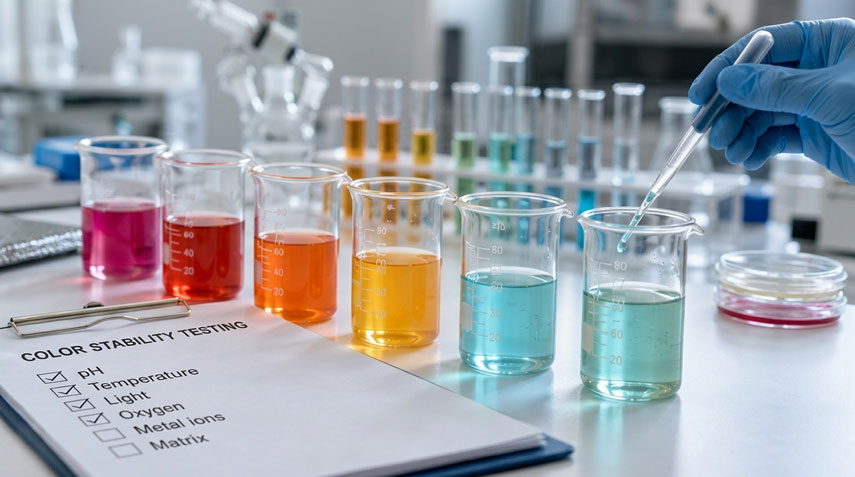
A regulatory listing answers a legal question: may this color be used under the stated conditions? It does not answer the formulation questions that determine whether the color will remain commercially acceptable. In practice, color stability depends on several interrelated parameters, including pH, temperature and processing conditions, light exposure, oxygen and metal ions, ingredient interactions, and the composition of the beverage matrix [8–9].
pH
pH is especially important for natural colors. Anthocyanins are strongly affected by pH because changes in molecular form can alter both hue and stability. Betalains also show pH-dependent stability, with practical behavior depending on the specific pigment and matrix. Therefore, a color selected from a supplier’s shade card should be tested at the actual finished-product pH rather than in water alone.
Heat and processing
Pasteurization, hot-fill, thermal holding, and other process steps can accelerate color degradation. The relevant exposure is not simply the peak temperature: time-temperature history, oxygen availability, pH, dissolved solids, and the chemical structure of the colorant all influence retention.
Light and packaging
Light exposure can be a major driver of fading for several natural color systems. Packaging therefore becomes part of the color system. Bottle material, UV transmission, headspace oxygen, closure performance, and storage illumination should be considered during stability development rather than after the color has already been selected.
Oxygen, metals and ingredient interactions
Oxygen and trace metal ions can contribute to color degradation, while other beverage ingredients can either destabilize or protect a pigment. For anthocyanins, published reviews identify pH, temperature, light, oxygen, metal ions, enzymes, proteins, and ascorbic acid among relevant stability factors. Betalain stability is likewise influenced by temperature, light, oxygen, pH, and metal ions.
Matrix-specific testing
A simple aqueous color solution is useful for early screening but is not a substitute for testing the actual beverage. The final matrix can contain acids, minerals, flavors, proteins, sweeteners, preservatives, vitamins, dissolved gases, and other components that alter color behavior. Stability testing should therefore be performed in the final or representative formulation and under the intended process and packaging conditions.
Color-Specific Formulation Considerations
Caramel colors
Caramel colors are widely relevant to cola, malt, coffee-style, and other brown beverage systems. In the EU, E150a–d are distinct caramel classes. In the U.S., caramel is a certification-exempt color additive under 21 CFR 73.85. The practical choice should consider shade, clarity, ionic environment, pH, processing conditions, and the interaction of the caramel type with the beverage matrix [1,4,6].
Carotenoids and beta-carotene
Beta-carotene is a hydrophobic colorant, so successful beverage application depends on the commercial form and the dispersion or emulsion system. Oxidation and light can reduce color intensity. In practice, the carrier system, droplet size, oxygen exposure, antioxidants where permitted and appropriate, and packaging should be evaluated together [8,10].
Anthocyanins
Anthocyanins are attractive natural colorants for red-to-purple beverage systems, but their performance is strongly matrix-dependent. Anthocyanin color and stability are strongly pH-dependent. In acidic beverage systems, anthocyanins generally show greater color stability at pH values around 3.5 or below, whereas increasing pH can shift the color toward purple or blue and accelerate degradation. Temperature, light, oxygen, metal ions and ingredient interactions are additional important stability factors. This makes anthocyanin selection a formulation and packaging decision, not simply a color-selection decision [8,10].
Beetroot red / betalains
Beet-derived colorants can provide pink-to-red shades, but betalain systems are sensitive to processing and storage conditions. Heat, light, oxygen, pH outside a suitable range, and metal ions can accelerate degradation. For pasteurized or hot-filled beverages, thermal and shelf-life validation should be built into development from the beginning [9].
Curcumin and turmeric-derived colors
A critical regulatory correction is necessary here: E100 is associated with curcumin in the EU, but the current FDA color-additive listing is for turmeric and turmeric oleoresin, while FDA’s regulatory-status database lists curcumin itself as delisted as a color additive. Therefore, ‘E100 = FDA-approved curcumin’ is not a valid regulatory shortcut. The U.S. material must be matched to the specific FDA listing and intended use [11,12].
Labeling: The Color’s Legal Identity Matters
United States
For certified colors, the applicable FDA color-additive name must be used in the ingredient declaration. FDA’s regulations also establish how specific color additives are to be declared. For certification-exempt colors, the declaration depends on the exact regulatory identity and applicable listing. This is another reason why a supplier’s commercial trade name should never be treated as the legal identity [4-6].
European Union
EU additive labeling generally uses the functional class followed by the specific name or E-number. In addition, Annex V of Regulation (EC) No 1333/2008 requires an additional statement for foods containing certain colors, including E102, E104, E110, E122, E124 and E129. The exact labeling artwork should therefore be reviewed for the target market rather than copied from a U.S. label [1].
Being naturally sourced does not necessarily exempt a color from labeling requirements. A naturally derived color may still be regulated as a food color additive and subject to specific requirements regarding its identity, permitted uses, and declaration on the label. Similarly, exemption from batch certification does not mean that all naturally colored ingredients share the same regulatory identity or can be used interchangeably.
A Professional Manufacturer Workflow
1. Define the target market: EU, U.S., or multiple markets.
2. Classify the beverage: Identify the exact legal food category and product characteristics.
3. Screen authorized colors: Use the current Union List and FDA color-additive regulations/databases.
4. Confirm legal identity: Match the supplier material to the regulatory identity, source, preparation and specification.
5. Check use conditions: Verify maximum level, group restrictions, footnotes, exclusions and any special conditions.
6. Review specifications and COA: Confirm identity, purity, contaminants, residuals where relevant, and lot consistency.
7. Run formulation screening: Evaluate shade, dose, clarity, dispersion, flavor impact and interactions.
8. Run process stability: Test the actual pasteurization, hot-fill, carbonation and filling conditions.
9. Run packaging and shelf-life testing: Evaluate light, oxygen, temperature and real packaging over the intended shelf life.
10. Finalize labeling and claims: Confirm legal declaration, market-specific requirements and compatibility with claims such as ‘natural’ or ‘no artificial colors’.
11. Validate at pilot/industrial scale: Confirm that performance is maintained after scale-up and across commercial lots.
Common Mistakes to Avoid
- Treating ‘FDA approved’ as a blanket authorization for every beverage.
- Assuming an E-number automatically means the color is permitted in every EU beverage.
- Using a commercial trade name without confirming the legal identity and source.
- Assuming certification-exempt means unregulated.
- Assuming natural color means the same regulatory status in the EU and U.S.
- Using an EU E-number as if it were a U.S. legal designation.
- Selecting a color before the target market and beverage category are defined.
- Testing stability only in water or a simple buffer instead of the final beverage matrix.
- Ignoring packaging and light exposure during color selection.
- Treating a supplier COA as a substitute for checking the applicable regulatory specification.
- Using an outdated regulatory table without checking current amendments and effective dates.
2026 Regulatory Updates Manufacturers Should Watch
FD&C Red No. 3
FDA issued an order on January 15, 2025 to revoke the food and ingested-drug authorizations for FD&C Red No. 3. For food, manufacturers have until January 15, 2027 to reformulate; the ingested-drug deadline is January 18, 2028. For beverage manufacturers selling into the U.S., this makes Red No. 3 a current reformulation issue rather than a suitable color choice for a new long-life formulation [13].
Beetroot red and other 2026 FDA actions
FDA issued final orders on February 6, 2026 approving beetroot red for human food and expanding approved uses of spirulina extract. On March 20, 2026, FDA delayed the effective dates of those orders while evaluating objections. Therefore, the status of these colors should be described carefully: the orders were issued, but the effective date was delayed pending evaluation of objections. Manufacturers should verify the current FDA status immediately before commercialization [4].
A Better Way to Think About Color Selection
For industrial beverage development, color selection is best treated as a decision chain rather than a single ingredient choice:
Regulatory Screening → Formulation & Process Evaluation → Packaging & Stability Testing → Labeling & Market Approval
This approach prevents a common development failure: choosing a visually attractive color first and discovering later that the material has a regulatory limitation, performs poorly at the beverage’s pH, fades during pasteurization, or fails shelf-life testing in the final package.
Conclusion
For beverage manufacturers, the question is not simply whether a color is ‘EU approved’ or ‘FDA approved.’ The correct question is whether the exact colorant identity is legally authorized for the exact beverage and target market, under the proposed conditions of use, and whether it can deliver stable commercial performance through processing, packaging and shelf life.
The EU and U.S. systems share the same fundamental principle: color additives are regulated and their use is conditional. The practical difference is how the systems express identity, authorization, conditions of use and certification. In the EU, the Union List and beverage food categories are central. In the U.S., the applicable 21 CFR color-additive listing and certification status are central.
The final decision should therefore combine four pillars: legal status, identity/specifications, formulation performance, and labeling. For natural colors in particular, pH, light, oxygen, heat, metal ions, ingredient interactions and packaging can determine whether a technically authorized color actually succeeds in the market.
References
[1] European Union. Regulation (EC) No 1333/2008 on food additives, including Annex II and Annex V.
[3] European Union. Current consolidated framework for food category 14, Beverages.
[4] U.S. Food and Drug Administration. Color Additives.
[5] U.S. Food and Drug Administration. Color Additives in Foods.
[6] U.S. Food and Drug Administration. Summary of Color Additives for Use in the United States.
[8] Xue, H., Zhao, J., & Wang, Y. (2024). Factors affecting the stability of anthocyanins and strategies for improving their stability. Food Chemistry: X, 24, 101883. https://doi.org/10.1016/j.fochx.2024.101883
[9] Calva-Estrada, S. J., Jiménez-Fernández, M., & Lugo-Cervantes, E. (2022). Betalains and their applications in food: The current state of processing, stability and future opportunities in the industry. Food chemistry: molecular sciences, 4, 100089. https://doi.org/10.1016/j.fochms.2022.100089
[10] Wijesekara, T., & Xu, B. (2024). A critical review on the stability of natural food pigments and stabilization techniques. Food Research International, 179, 114011. https://doi.org/10.1016/j.foodres.2024.114011
[11] U.S. FDA. Regulatory Status of Color Additives: Grape Skin Extract (Enocianina), 21 CFR 73.170.
[12] U.S. FDA. Regulatory Status of Color Additives: Curcumin.