
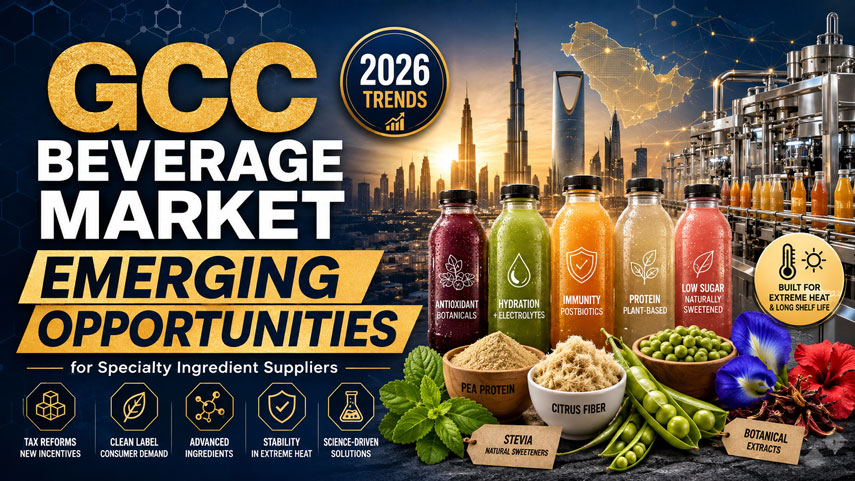
Emerging Opportunities for Specialty Ingredient Suppliers in the GCC Beverage Sector
The GCC beverage market is growing, though the pace depends heavily on which analyst is asked. One widely cited market report estimates the region’s functional food and beverage sector at roughly USD 18–20 billion in 2025–2026, projecting expansion toward USD 57 billion by 2036 [1].
Other commercial estimates for adjacent category definitions differ by an order of magnitude typical for an early-stage, loosely defined category rather than evidence of a single “true” figure. The spread is a reason for caution, not for discarding the estimate: it signals directional growth, not a guaranteed outcome for any individual supplier.
Three forces appear to be reshaping demand, based on the market and regulatory sources reviewed: urbanization and tourism expanding retail and hospitality channels in Saudi Arabia, the UAE, and Qatar; rising disposable income shifting consumption toward premium, better-for-you formats; and younger, health-aware consumers asking for less sugar and more functional benefit without sacrificing taste. These are patterns described in industry commentary, not causally verified drivers, and their relative weight likely varies by country and category.
More concretely, formulators need ingredients that survive extreme heat, long supply chains, and new tax rules while still tasting good, combination commodity ingredients alone struggle with. This creates room for specialty suppliers to move from selling raw materials toward selling formulation outcomes, though whether any given supplier captures that opportunity depends on execution, not market size.
This article reviews the drivers reshaping ingredient demand in the GCC, profiles six ingredient categories with reported technical and commercial relevance, and outlines how suppliers might differentiate through technical support. Readers evaluating a specific formulation should treat the studies cited here as starting points, not substitutes for their own stability trials.
Market Drivers
Climate and Distribution
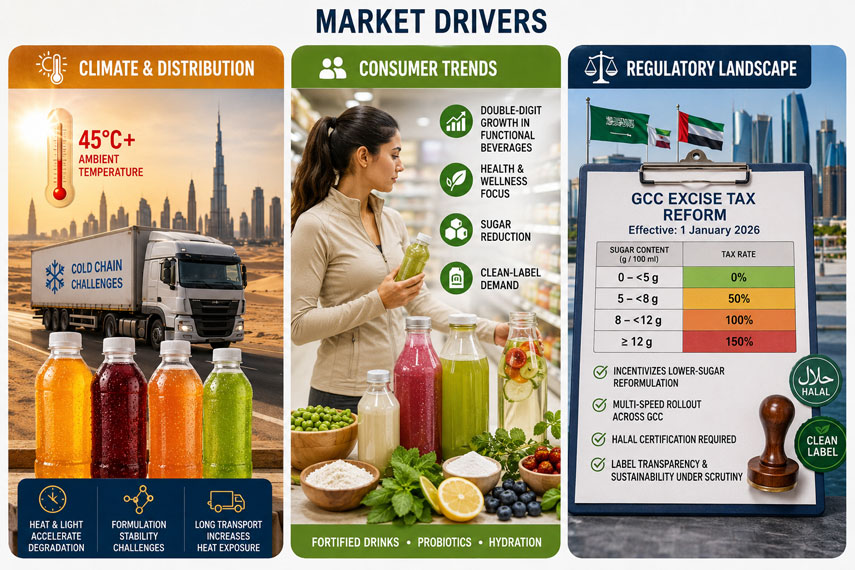
GCC ambient temperatures regularly exceed 45°C in summer, and cold-chain coverage is uneven outside major cities a widely reported logistical characteristic of the region. These conditions plausibly place unusual stress on beverage formulations during storage and transport, though direct comparative data on GCC-specific spoilage rates versus temperate markets is limited in the literature reviewed here.
Heat and light are known, from controlled experimental work, to accelerate degradation pathways. Two related studies by Chung and colleagues used model beverage systems to test anthocyanin stabilization: one found that polyphenol addition slowed anthocyanin color loss under accelerated storage [2], and a companion study found that whey protein isolate complexation similarly extended color stability [3].
Both report degradation half-lives on the order of days under accelerated heat exposure in their specific model systems evidence of a mechanism demonstrated in controlled conditions, not a general prediction for all matrices, since outcomes depend heavily on pH, pigment structure, and co-ingredients. A 2026 structural review of anthocyanin stability supports the general pattern that structure (e.g., degree of acylation) predicts relative stability, without claiming a universal half-life [4].
Long transport distances plausibly compound heat exposure, which is why shelf-life data collected under regionally representative conditions is likely more informative for GCC launches than temperate-climate studies alone an inference from the mechanism literature, not a GCC-specific trial in these sources.
Consumer Trends
Market analysts report double-digit growth estimates for functional beverages in the GCC and adjacent markets, with fortified drinks, probiotic beverages, and hydration products frequently named as leading categories [1]. As noted above, market-size figures vary considerably between research firms; read this as a directional signal rather than a precise number.
Sugar reduction is a recurring theme, plausibly reinforced by the fiscal policy discussed below, though the literature reviewed does not isolate tax policy as a causal driver separate from broader health trends. Clean-label expectations recognizable ingredient names rather than only “natural” claims are also frequently cited, pushing formulators toward fibers, plant extracts, and minimally processed stabilizers.
Regulatory Landscape
The GCC’s excise regime for sweetened beverages changed materially on 1 January 2026. Saudi Arabia’s Zakat, Tax and Customs Authority replaced the flat 50% ad valorem excise tax with a four-tier volumetric system based on sugar content per 100 ml, an approach the authority states e intended to incentivize reformulation toward lower-sugar products [5].
The UAE introduced an equivalent structure on the same date. Under the published Saudi tiers, beverages sweetened only with non-caloric sweeteners or under 5 g sugar per 100 ml fall into zero-tax bands, while beverages at or above 8 g per 100 ml attract the highest rate. Kuwait had not introduced an equivalent structure as of early 2026, and Qatar’s timeline was still developing suppliers should expect a multi-speed rollout rather than one unified date. This is reported directly by the issuing authority, not a forecast, and is the clearest, most verifiable driver in this article.
Beyond sugar taxation, halal certification remains a baseline requirement, and label-transparency and sustainability-claim scrutiny appear to be increasing, based on the sources reviewed, though this article did not locate quantitative data on enforcement trends.
Six Ingredient Categories
Natural Sweeteners
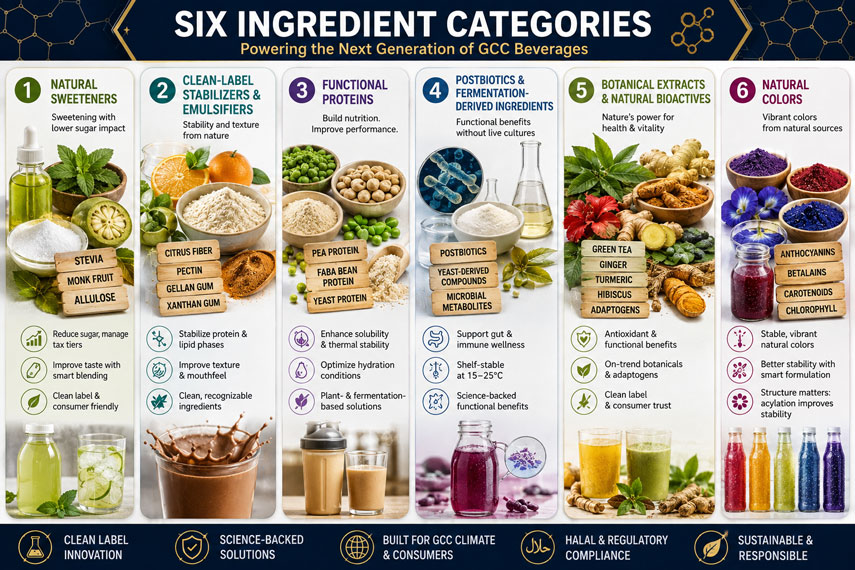
Stevia, monk fruit, allulose, and other rare sugars are gaining formulation attention as tax tiers create a direct financial incentive to reduce sugar content. None functions as a drop-in sucrose replacement: allulose behaves closest to sucrose in bulk and browning applications, while stevia and monk fruit are far sweeter by weight and can carry a lingering aftertaste at high use levels.
A controlled sensory study of ready-to-mix whey protein beverages used temporal sensory methods to profile stevia, monk fruit, and blends of the two, identifying blend ratios that improved acceptability relative to single sweeteners in that matrix [6].
This is evidence from one product category and one panel; the ratios should not be assumed to generalize to acidic juices or carbonated drinks without separate testing. A broader review of natural sweetener blending confirms combining high-intensity and bulk sweeteners is common practice for offsetting off-notes, without asserting one optimal formula [7].
For suppliers, the tiered tax structure creates a concrete commercial argument distinct from general health positioning: moving a product from a high-sugar tier to a lower tier changes its excise liability under a published, rule-based schedule [5]. Whether that reformulation is commercially worthwhile still depends on sensory outcome and cost, which the tax schedule alone does not determine.
Clean-Label Stabilizers and Emulsifiers
Citrus fiber, pectin, gellan gum, and xanthan gum remain common clean-label stabilizers. A 2025 experimental study in a milk-based cocoa beverage found that citrus fiber helped stabilize protein and lipid phases, supporting its use as an alternative to more processed stabilizers such as carrageenan in that specific dairy matrix [8].
This is a single study in one beverage system; results in acidic juices or plant-based drinks were not tested and may differ, since fiber-protein interactions are matrix-dependent.
Functional Proteins
Pea protein remains the most established plant protein alternative to soy but generally shows weaker solubility and heat stability than whey or soy, limiting direct use in high-protein ready-to-drink beverages.
A 2023 experimental study used controlled Maillard-induced glycation with chromatographic purification to improve pea protein solubility and thermal stability for acidic beverage conditions, without reducing in vitro digestibility in that trial [9]. As a single controlled study, scale-up performance and sensory impact were not evaluated and would need separate validation.
Faba bean protein shows different functional behavior. A controlled reconstitution study found that faba bean protein isolate solubility responded to temperature, pH, and water hardness in specific, measurable ways lower reconstitution temperature, for example, increased particle size and reduced solubility indicating formulators may need to adjust hydration conditions rather than treat faba protein as interchangeable with pea protein [10]. Yeast-derived proteins, drawing on fermentation expertise already present in the GCC’s biotech sector, represent a separate route not covered by the studies above.
Postbiotics and Fermentation-Derived Ingredients
Postbiotics non-living microbial metabolites and cell components are gaining interest as an alternative to live probiotics in shelf-stable beverages, since their function does not depend on microbial viability. A 2026 review in a peer-reviewed nutrition journal notes that postbiotics can offer shelf stability at 25°C for twelve months or more in some formulations, based on the in vitro and early clinical data its surveys [11] a range of reported outcomes, not a guarantee for any specific product. A 2025 microbiology-journal review similarly reports bioactivity was best retained at 15–25°C storage in the studies it examined, again a cross-source synthesis rather than one universal figure [12].
Yeast-derived postbiotics remain less studied than bacterial ones; most research to date has focused on lactic acid bacteria, with yeast-derived compounds described in recent reviews as an emerging, under-researched area [13].
For a supplier with fermentation and yeast-processing capability, this is a plausible extension an interpretation, not a demonstrated outcome and any application would need its own validation before launch.
Botanical Extracts and Natural Bioactives
Green tea, ginger, turmeric, hibiscus, and adaptogenic botanicals continue to appear in functional and premium launches, carrying consumer recognition that supports clean-label positioning, alongside challenges around solubility, color, bitterness, and heat stability. In the anthocyanin study cited above, green tea extract itself extended anthocyanin color half-life in the model system tested, suggesting some botanicals can serve a dual role as functional ingredient and stabilizer in that specific matrix [2].
This interaction effect is a reason to test botanical blends together rather than evaluate ingredients in isolation it does not establish that green tea extract stabilizes pigments generally.
Adaptogens such as ashwagandha or rhodiola are visible in stress- and energy-positioned drinks elsewhere, and industry commentary suggests this trend is reaching GCC premium retail, though this article did not locate GCC-specific sales or approval data to confirm the pace. Regulatory status for adaptogens varies by GCC member state, so suppliers should confirm local approval before proposing formulations.
Natural Colors
Anthocyanin-based natural colorants face a well-documented stability challenge. The evidence above indicates degradation follows first-order kinetics in model systems and can be rapid on the order of days under accelerated heat and light unless stabilized. Polyphenol addition, whey protein complexation, and structural features such as acylation have each slowed degradation in controlled studies, with effect size depending on the pigment and matrix [2-4].
The 2026 structural review notes highly acylated anthocyanins, such as those from butterfly pea flower, tend to show comparatively better stability in near-neutral systems than simpler glycosylated pigments in the studies its surveys [4] a comparative pattern, not a claim that acylated pigments are stable in every application.
This structure-dependent behavior is directly relevant to GCC formulators working across acidic juices, neutral dairy-alternative drinks, and hot-fill processes: a colorant validated in one matrix should not be assumed to perform equivalently in another without its own trial.
How Suppliers Can Differentiate
Selling a compliant, functional ingredient on its own appears less differentiating in a market this competitive, based on the pattern across categories above: co-development with manufacturer R&D teams, technical formulation support, regionally representative shelf-life data, local regulatory and halal documentation, and clean-label reformulation assistance are the activities repeatedly associated with stronger positioning in the sources reviewed. This is an interpretation, not a claim proven by controlled comparison of supplier strategies; no study here directly measured whether technical-support models outperform price-based competition in the GCC [14,15].
Future Outlook
Precision fermentation is a fast-growing ingredient technology, though market-size estimates vary widely. A 2026 PRISMA systematic review in the Journal of Basic Microbiology, covering 37 studies, describes precision fermentation as requiring less land and water and generating lower emissions than conventional livestock and crop systems for equivalent output, while noting that high capital and energy costs, scale-up inefficiency, and regulatory uncertainty remain unresolved barriers [14].
A separate 2026 peer-reviewed review estimated the global market at roughly USD 4.3 billion in 2025, projected toward USD 57 billion by 2032 a wide range consistent with an early-stage market [15].
Food and beverage applications, including animal-free proteins and natural flavor compounds, are described as a leading segment. Industry examples, such as precision-fermented hop aromas for alcoholic and non-alcoholic beer, illustrate the concept but are single-company cases, not evidence of category-wide adoption.
AI-assisted formulation, upcycled ingredients such as citrus fiber, and personalized nutrition are additional trends likely to shape the coming years, though the sources reviewed describe direction rather than quantify pace.
Conclusion
The GCC beverage sector combines rapid reported market growth, extreme climate demands, and fast-moving, verifiable regulation. The clearest, most evidence-backed driver here is the January 2026 tax reform, documented directly by the issuing tax authorities.
The technical claims about ingredient stability and functionality are grounded mainly in single experimental studies or reviews describing specific matrices and conditions useful for identifying plausible mechanisms and starting points, but not a substitute for matrix-specific validation.
Suppliers able to combine regionally representative stability data with regulatory fluency appear, based on the pattern in the sources reviewed, to be better positioned than those competing on price alone though this article did not identify controlled evidence directly comparing supplier strategies, and that conclusion should be read as a reasoned interpretation, not a proven result.
Claim–Evidence Table
| Claim | Evidence type | Strength of evidence | Reference |
| GCC functional food/beverage market ~USD 18–20B (2025–26), toward USD 57B by 2036 | Market report | Low–moderate; commercial estimate, wide variance across analysts | [1] |
| UAE/Saudi replaced flat 50% excise with 4-tier volumetric sugar tax, effective Jan 2026 | Regulatory source | High; directly reported by issuing tax authority | [5] |
| Polyphenol addition slows anthocyanin degradation in model beverages | Experimental study | Moderate; single model system, mechanism-level evidence | [2] |
| Whey protein complexation extends anthocyanin color stability | Experimental study | Moderate; single model system | [3] |
| Acylated anthocyanins show comparatively better stability near neutral pH | Review | Moderate; cross-study pattern, not a universal figure | [4] |
| Stevia/monk fruit blends improve sensory acceptability vs. single sweeteners in protein beverages | Experimental study | Moderate; single matrix (whey protein RTM beverage) | [6] |
| Sweetener blending is common practice to offset off-notes | Review | Moderate; general industry/literature pattern | [7] |
| Citrus fiber stabilizes protein/lipid phases in milk-cocoa beverage | Experimental study | Low–moderate; single study, single matrix | [8] |
| Maillard glycation improves pea protein solubility/thermal stability for acidic beverages | Experimental study | Low–moderate; single controlled study, no scale-up data | [9] |
| Faba bean protein solubility is sensitive to temperature, pH, water hardness | Experimental study | Moderate; direct reconstitution study | [10] |
| Postbiotics can offer extended shelf stability (up to ~12 months at 25°C in some formulations) | Review | Moderate; review of in vitro/early clinical data | [11] |
| Postbiotic bioactivity best retained at 15–25°C storage | Review | Moderate; cross-study synthesis | [12] |
| Yeast-derived postbiotics remain understudied relative to bacterial ones | Review | Moderate; literature-gap observation | [13] |
| Precision fermentation has lower land/water/emissions footprint than conventional systems, with unresolved cost/scale barriers | Review | Moderate–high; systematic review of 37 studies | [14] |
| Precision fermentation market ~USD 4.3B (2025) toward ~USD 57B (2032) | Review | Low–moderate; wide projection range | [15] |
References
- Future Market Insights. GCC Functional Food & Beverage Market to Reach USD 56.80 Billion by 2036. Published March 2026. https://www.futuremarketinsights.com/reports/gcc-functional-food-beverage-market
- Chung, C., Rojanasasithara, T., Mutilangi, W., & McClements, D. J. (2016). Stabilization of natural colors and nutraceuticals: Inhibition of anthocyanin degradation in model beverages using polyphenols. Food Chemistry, 212, 596-603.
- Chung, C., Rojanasasithara, T., Mutilangi, W., & McClements, D. J. (2015). Enhanced stability of anthocyanin-based color in model beverage systems through whey protein isolate complexation. Food Research International, 76, 761-768.
- Ahmed, M., Zhang, H., & Xiong, Y. (2026). Anthocyanin Structural Types and Stability: Implications for Natural Colorant Applications in Food Systems. Foods, 15(12), 2080.
- Zakat, Tax and Customs Authority (ZATCA), Kingdom of Saudi Arabia, via Saudi Press Agency. Amendments to Executive Regulations of Excise Tax to Take Effect January 1, 2026. Published December 30, 2025. spa.gov.sa/en/N2478517
- Keefer, H. M., Harwood, W. S., Castura, J. C., & Drake, M. (2022). Temporal ranking for characterization and improved discrimination of protein beverages. Journal of Sensory Studies, 37(4), e12751.
- Wazir, M., Verma, H., Singh, J., Singh, P., & Passey, S. (2025). The Battle of Natural Sweeteners: A Comprehensive Guide to Monk Fruit and Stevia. Current Research in Nutrition & Food Science, 13(1), 24.
- Öztürk, S. A., Altan Kamer, D. D., Karaca, A. C., & Toker, O. S. (2025). The Clean-Label-Friendly Solution: Stabilizing Milk-Based Cocoa Beverages with Citrus Fiber. ACS omega, 10(29), 31509-31522.
- Schneider, A. A., Bu, F., & Ismail, B. P. (2023). Enhancement of pea protein solubility and thermal stability for acidic beverage applications via endogenous Maillard-induced glycation and chromatography purification. Current Research in Food Science, 6, 100452.
- Yu, R., Huppertz, T., & Vasiljevic, T. (2024). Impact of Reconstitution Conditions on the Solubility of Faba Bean Protein Isolate. Foods, 13(23), 3857.
- Mafe, A. N., Sharifi‐Rad, J., Calina, D., Ogunyemi, A. J., & Tubi, A. O. (2026). Postbiotics in Functional Foods: Microbial Derivatives Shaping Health, Immunity and Next‐Generation Nutrition. Food Frontiers, 7(1), e70205.
- Amobonye, A., Pillay, B., Hlope, F., Asong, S. T., & Pillai, S. (2025). Postbiotics: an insightful review of the latest category in functional biotics. World Journal of Microbiology and Biotechnology, 41(8), 293.
- Postbiotics and parabiotics derived from bacteria and yeast: current trends and future perspectives. (2024). doi:10.1080/19476337.2024.2425838
- Adeyeye, S. A. O., Babu, A. S., Subudhi, A., & Adeyeye, B. R. (2026). Precision fermentation processes for producing novel foods and its sustainable applications. Journal of basic microbiology, 66(2), e70160.
- Shukla, A. D., Rai, S., Ramachandran, P., Sangeeta, S., Tiwari, A., & Tiwari, A. (2026). Precision fermentation: Pioneering the future of sustainable and alternative animal protein production. Applied Food Research, 102015.