
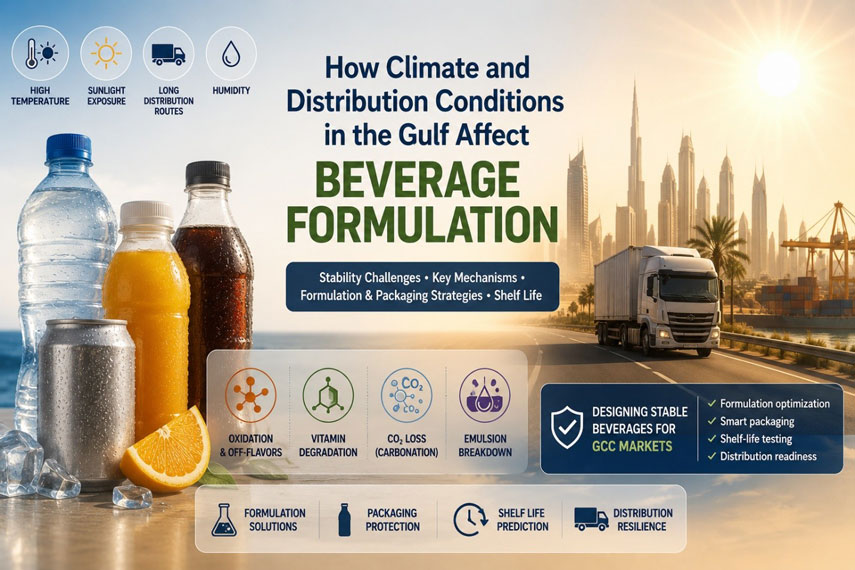
How Climate and Distribution Conditions in the Gulf Affect Beverage Formulation
The beverage sector in the Gulf Cooperation Council (GCC) countries has grown substantially, driven by rising incomes, urbanization, and a young population. Beverage formulation for hot and humid climates requires careful selection of ingredients with sufficient thermal and physicochemical stability. In addition to preventing quality deterioration, formulations must limit microbial growth through appropriate combinations of pH control, preservatives, and other preservation strategies. Consumer acceptance also depends on maintaining refreshing sensory attributes, including balanced acidity, sweetness, mouthfeel, and carbonation where applicable. The GCC region is broadly characterized by high ambient temperatures, often exceeding 40°C in summer, intense solar radiation, coastal humidity, and marked seasonal swings that place unusual stress on liquid food products (Tuntiteeraboon et al., 2026).
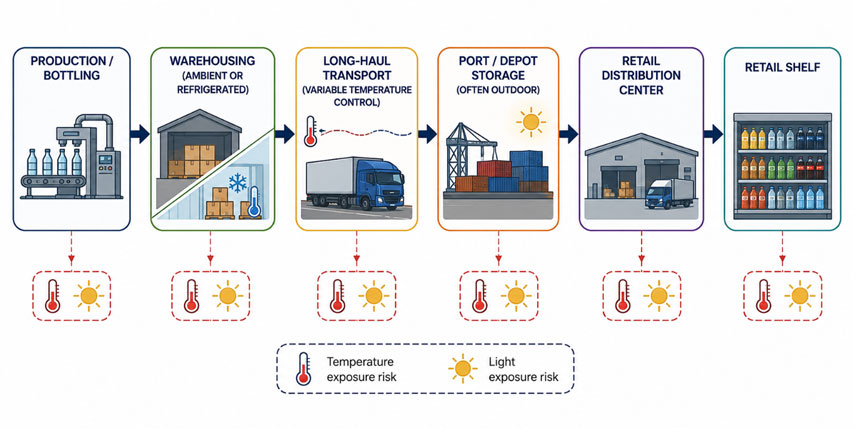
Distribution compounds these pressures: long transport routes, warehousing without full temperature control, container shipping through hot ports, and temperature abuse during loading and unloading are common realities. Del Nobile et al. (1998), in an experimental modeling study of carbonated beverages, showed that realistic thermal histories including outdoor storage and sunlight exposure can reduce shelf life far more severely than simplified, constant-temperature predictions suggest. This is why climate and distribution may need to be considered at the formulation stage itself, not only after a formulation is finalized. Formulation variables including pH, oxygen content, emulsifier selection, packaging compatibility, and processing conditions collectively determine beverage stability during storage and distribution (Skibsted et al., 2010; Coles & Kirwan, 2011). Consequently, environmental conditions should be considered as design parameters rather than only storage variables.
This article synthesizes findings from a narrative review of selected peer-reviewed studies, technical chapters, and industry application notes on beverage stability, packaging, and shelf-life prediction, focusing on relevance to hot-climate distribution. Because sources vary in type, the strength of evidence behind each claim is noted, and case-study findings are flagged as such rather than presented as general rules.
Climate and Distribution Challenges in the Gulf
Environmental Conditions
Elevated temperatures particularly accelerate oxidation of lipids and flavor compounds, hydrolysis of susceptible ingredients, and degradation of heat-sensitive bioactive compounds such as vitamin C and polyphenols. In beverages containing reducing sugars and amino compounds, prolonged thermal exposure may also promote Maillard reactions, resulting in undesirable color changes and roasted or bitter off-flavors (Skibsted et al., 2010). Rysstad and Johnstone (2009) report an even steeper sensitivity for milk-based beverages in their study context: shelf life approximately doubled for every 2°C reduction in storage temperature.
Solar radiation compounds thermal stress through photo-oxidation, which Ghelichi et al. (2023) describe as proceeding roughly 1,000 times faster than autoxidation when photosensitizers such as riboflavin are present. Outdoor pallet storage described by Del Nobile et al. (1998) as common practice among distributors may expose products to elevated temperature and direct sunlight simultaneously. Coastal humidity is comparatively under-documented in the sources reviewed; this is a genuine gap rather than an established finding. They also established a thermal-history model, which layers annual and daily temperature cycles with sunlight-driven spikes, offers a transferable template for hotter climates once regional data are substituted.
Distribution Conditions
Coles and Kirwan (2011) note that distribution hazards generally include temperature and humidity variation, shock, vibration, and compression. Rysstad and Johnstone (2009) note that extended shelf-life (ESL) products depend on refrigeration, and that once the cold chain exceeds roughly 7–8°C, more intensive processing may be needed to compensate. Del Nobile et al. (1998) found that a 9°C rise in average storage temperature was associated with a 41.5% reduction in predicted shelf life for a carbonated beverage in their specific case illustrating the scale of risk from cold-chain interruption, though this figure is product- and packaging-specific rather than universally applicable.
Effects of High Temperature on Beverage Stability
Chemical Stability
Ramos et al. (2015) note that oxygen presence may facilitate microbial growth and induce off-flavor and color changes; Ghelichi et al. (2023) describe lipid oxidation in emulsions as a free-radical chain process that proceeds faster than in bulk oils due to larger interfacial area. Ramos et al. (2015) also report that furfural, an off-flavor from a Maillard-type reaction, can appear three to five months after packaging, and that aroma sorption into PVC was roughly four times higher than into PET.
Vitamin degradation is a further concern for functional beverages: Rysstad and Johnstone (2009) modeled vitamin C loss in orange juice against headspace oxygen, dissolved oxygen, and temperature. Tuntiteeraboon et al. (2026), in an experimental date palm–bael–jujube study, reported total phenolic and carotenoid declines of roughly 50% and 55% over nine weeks of refrigerated storage even at 4°C suggesting bioactives may remain vulnerable even under good temperature control, though this single study cannot be generalized directly.
Physical Stability
Formulaction (2009), using multiple-light-scattering technology, reported that raising storage temperature from 25°C to 45°C increased emulsion migration velocity from 1.10 to 1.75 mm/h (~59%), and that stabilizer choice changed migration velocity more than five-fold in a chocolate milk system (16.6 vs. 3.0 × 10⁻⁵ mm/min) a single proprietary comparison rather than a general benchmark. The same source documented sedimentation in calcium-enriched milk (2.8 mm sediment after 50 days) and pH-driven casein aggregation from acidic flavor addition, an industry observation rather than a peer-reviewed experimental finding.
Carbonated Beverages
Del Nobile et al. (1998) modeled CO₂ loss in PET-bottled carbonated water and found predicted shelf life (10% CO₂ loss threshold) of 352 days at constant 20°C, falling to 206 days at 28.9°C (–41.5%), and to under two months under a realistic thermal history with sunlight spikes (–83% vs. 20°C). In carbonated beverages, formulation variables such as buffering capacity, sugar concentration, hydrocolloid content, and emulsified flavor systems can influence CO₂ retention and perceived carbonation during storage at elevated temperatures. This single modeling study illustrates the scale of possible risk rather than a precise prediction for other products. Steen and Ashurst (2006) note the underlying physical basis: CO₂ solubility increases with pressure and decreases with temperature (Henry’s Law). Temperature fluctuations during storage and distribution may accelerate CO₂ loss, reducing the perceived freshness of carbonated beverages. Elevated temperatures also increase internal package pressure and may lead to excessive foaming (gushing) upon opening. Therefore, carbonation levels should be optimized according to expected distribution conditions in hot climates.
| Attribute | Reported effect | Approx. magnitude | Source / evidence type |
| Vitamin C (orange juice) | Degrades faster with oxygen + temperature | Kinetically modeled; case-specific | Rysstad & Johnstone, 2009 — modeled |
| Total phenolics (date-palm blend) | Declined over 9 weeks even at 4°C | ~49.9% reduction | Tuntiteeraboon et al., 2026 — experimental |
| Emulsion migration velocity | Increased with temperature | 1.10→1.75 mm/h (25→45°C), ~59% | Formulaction, 2009 — industry note |
| CO₂ retention, PET bottle | Shelf life shortened under realistic history | 352 → <60 days | Del Nobile et al., 1998 — modeled |
Formulation Strategies for Gulf Markets
Ingredient Selection
Stabilizers such as carrageenan can act as thickening and surface-active agents (Formulaction, 2009), though this single comparison would need experimental verification for any specific formulation. Skibsted et al. (2010) note that emulsion stability also depends on emulsifier selection, homogenization, and pH, with creaming, flocculation, coalescence, and Ostwald ripening as distinct mechanisms. Antioxidants may offset accelerated oxidation: Ramos et al. (2015) suggest natural antioxidants (tocopherols, plant extracts) as alternatives to synthetic BHA/BHT, while Ghelichi et al. (2023) note effectiveness depends on where the antioxidant partitions relative to the oil–water interface. Chelating agents (EDTA, citric acid) are a broadly supported strategy for controlling metal-catalyzed oxidation (Skibsted et al., 2010). Preservative selection should consider beverage pH, storage temperature, and compatibility with other formulation ingredients. Organic acid preservatives such as potassium sorbate and sodium benzoate remain effective in acidic beverages when used within regulatory limits and under appropriate storage conditions. Their effectiveness should therefore be verified under the elevated storage temperatures expected during Gulf distribution.
Flavor and Color Stability
Rysstad and Johnstone (2009) found direct (infusion) heating caused less thermal degradation than indirect heating at equivalent microbial kill a dairy-processing finding that may not transfer directly to all beverage categories. Encapsulation is mentioned as a general strategy (Ramos et al., 2015) without detailed comparative data in the sources reviewed. Color protection is better evidenced: Tuntiteeraboon et al. (2026) found amber glass, which blocks light below ~450 nm, gave less color change and better bioactive retention than transparent glass over nine weeks a single-study finding consistent with the broader packaging literature’s endorsement of light-blocking packaging (Ramos et al., 2015; Coles & Kirwan, 2011).
Packaging Considerations
PET is light, clear, and shatter-resistant, but its gas-transport parameters change nonlinearly with temperature (Del Nobile et al., 1998), meaning averaged-temperature predictions may understate real CO₂ loss. Ramos et al. (2015) found monolayer PET retained less ascorbic acid than multilayer PET or glass, favoring multilayer/coated structures where oxygen sensitivity matters. Glass offers near-impermeable gas barriers and can be tinted for light protection (Ramos et al., 2015; Coles & Kirwan, 2011; Tuntiteeraboon et al., 2026). Aluminum provides full light and gas barrier properties at higher cost.
For beverages distributed under Gulf climatic conditions, packaging should provide effective barriers against oxygen ingress, ultraviolet light, and moisture transmission to minimize oxidation, preserve sensitive nutrients, and maintain overall product quality throughout storage and transport. Barrier performance also depends on extrinsic factors, including temperature, pressure, and humidity; therefore, actual barrier performance may differ between temperate and hot-climate conditions (Ramos et al., 2015).
Shelf-Life Evaluation Under Hot Climate Conditions
Accelerated shelf-life testing (ASLT) predicts stability without waiting out real-time storage. Formulaction (2009) showed that raising test temperature from 25°C to 45°C revealed formulation differences within 24 hours, while cautioning that results may not perfectly predict long-term ambient behavior for all mechanisms. The Arrhenius model and Q₁₀ coefficient (commonly ≈2 per 10°C; Skibsted et al., 2010) are the standard extrapolation tools, though they assume a single dominant mechanism, which may not hold in complex beverage systems. Rysstad and Johnstone’s (2009) milk data implied an even steeper sensitivity (shelf life doubling per 2°C) in their specific study.
Del Nobile et al. (1998) offer the clearest distribution-simulation example: a dynamic thermal-history model with daily/seasonal cycling and sunlight spikes predicted an 83% shorter shelf life than a constant-temperature model. Though built on a temperate reference climate, the methodology is transferable in principle once regional temperature data are substituted. In practice, beverages intended for GCC markets are commonly evaluated under accelerated storage conditions (e.g., 40–45°C) to simulate regional distribution stresses, although exact protocols require product-specific validation.
| Product type | Test temperatures | Duration | Outcome | Source |
| Carbonated water (PET) | 20°C, 28.9°C, dynamic profile | Modeled, up to 1 yr | 352 → <60 days | Del Nobile et al., 1998 |
| Concentrated emulsion | 25°C, 35°C, 45°C | 24 hours | Migration 1.10→1.75 mm/h | Formulaction, 2009 |
| Pasteurized / ESL milk | ≤6°C vs. ≤10°C | Days–weeks | Shelf life ~halved | Rysstad & Johnstone, 2009 |
| Date-palm RTD beverage | 4°C only | 9 weeks | ~50% bioactive loss | Tuntiteeraboon et al., 2026 |
Conclusions
Across experimental studies, technical chapters, and industry notes, a consistent theme emerges: temperature, light, and oxygen all intensified under Gulf climate and distribution conditions accelerate the chemical and physical pathways that limit beverage shelf life. Individual studies report shelf-life reductions of roughly 40–80% under realistic hot-climate-like thermal histories, though these figures are product- and packaging-specific and should not be generalized without local validation.
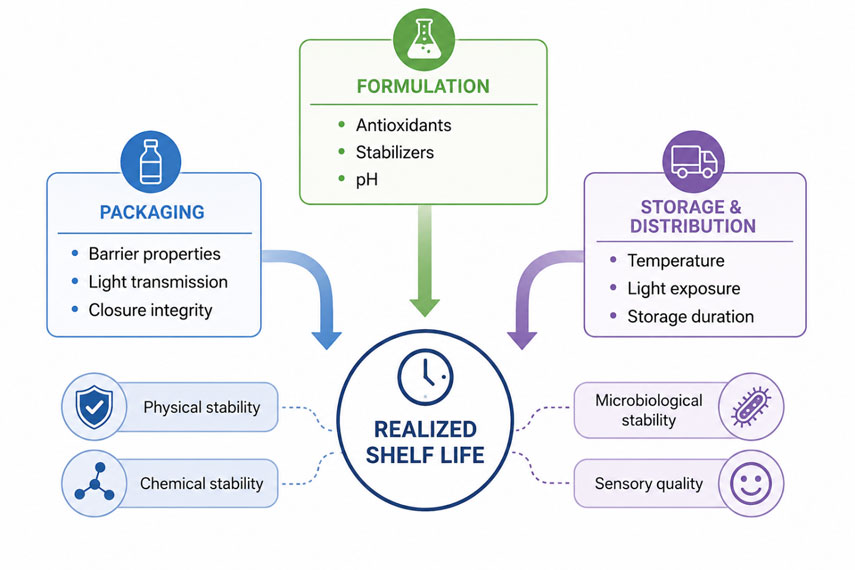
Defensible general recommendations include: matching packaging barrier and light-protection properties to formulation sensitivity; using antioxidants, chelating agents, and appropriate preservative systems where oxidation or microbial stability is a concern; validating stabilizers under elevated-temperature accelerated testing rather than ambient defaults; and building shelf-life protocols around realistic, dynamic thermal histories informed by regional data. This review reflects a narrative synthesis of selected literature, and very few sources were conducted under actual Gulf conditions considering climate at the earliest formulation stage remains a reasonable inference from the evidence rather than a directly demonstrated, region-specific conclusion.
References
- Coles, R., & Kirwan, M. (Eds.). (2011). Food and beverage packaging technology (2nd ed.). Wiley-Blackwell.
- Del Nobile, M. A., Mensitieri, G., Nicolais, L., & Masi, P. (1998). The influence of the thermal history on the shelf life of carbonated beverages bottled in plastic containers. Journal of Food Engineering, 39(1), 1–13. https://doi.org/10.1016/S0260-8774(97)00079-4
- Formulaction. (2009). Stability of various beverage emulsions (pp. 1–7) [Turbiscan Application Paper]. Formulaction.
- Ghelichi, S., Hajfathalian, M., Yesiltas, B., Sorensen, A.-D. M., Garcia-Moreno, P. J., & Jacobsen, C. (2023). Oxidation and oxidative stability in emulsions. Comprehensive Reviews in Food Science and Food Safety, 22(3), 1864–1901. https://doi.org/10.1111/1541-4337.13134
- Ramos, M., Valdés, A., Mellinas, A. C., & Garrigós, M. C. (2015). New trends in beverage packaging systems: A review. Beverages, 1(4), 248–272. https://doi.org/10.3390/beverages1040248
- Rysstad, G., & Johnstone, K. (2009). Extended shelf-life beverages. In Functional and speciality beverage technology (pp. 111–136). Woodhead Publishing.
- Skibsted, L. H., Risbo, J., & Andersen, M. L. (Eds.). (2010). Chemical deterioration and physical instability of food and beverages. Woodhead Publishing/CRC Press.
- Steen, D. P., & Ashurst, P. R. (Eds.). (2006). Carbonated soft drinks: Formulation and manufacture. Blackwell Publishing.
- Tuntiteeraboon, P., Jafari, S., Chheng, S., Shiekh, K. A., Kijpatanasilp, I., & Assatarakul, K. (2026). Sustainable shelf-life extension of date palm-bael-jujube beverages through HTST pasteurization and protective packaging. Sustainable Food Technology, 4, 4051–4061. https://doi.org/10.1039/d5fb00683j