
How Co-Development Partnerships Between Brands and Ingredient Specialists Work
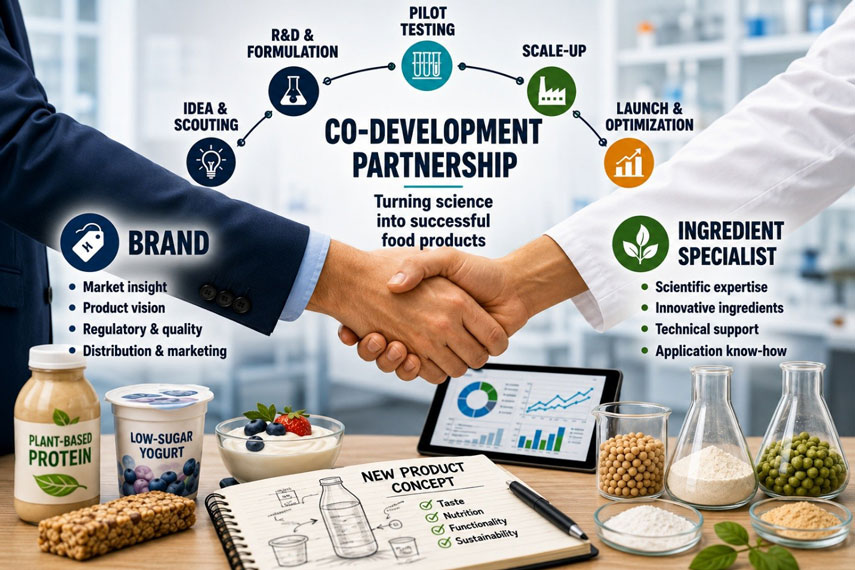
Every food or beverage product that reaches a consumer’s table began somewhere else: in a laboratory, a pilot plant, or a supplier’s technical center. Getting an ingredient from that early stage into a finished, sellable product requires close, structured cooperation between a brand and an ingredient specialist.
This process is known as co-development, and it has become one of the most important engines of innovation in the Food and Beverage Industry.
Co-development is not a single, fixed method. Depending on the partners involved, it can take the form of a licensing agreement, a multi-stakeholder alliance, or an open innovation network.
many successful projects depend on complementary capabilities from both partners [1,2].
This review presents a narrative synthesis of selected literature, including peer-reviewed studies, industry case studies, and practical reports. These sources are used to identify recurring themes rather than provide equally weighted evidence.
What Is Co-Development in the Food and Beverage Industry?
At its core, co-development means two or more organizations combining complementary resources, most often scientific knowledge on one side and market or manufacturing capability on the other, to design and commercialize a new product or process [3].
In the food sector, this usually pairs a brand or food manufacturer with an ingredient specialist: a supplier with deep expertise in a particular raw material, microorganism, or processing technology. The ingredient specialist might be a maker of starter cultures, an enzyme producer, a protein innovator, or a flavor house.
The relationship is deliberately structured around shared risk and shared benefit. The brand gains a differentiated product or a lower-cost process, and the ingredient specialist gains a commercial outlet for its technology, along with valuable feedback from real production conditions [1].
Why Brands Turn to Ingredient Specialists
Modern Food Industry Challenges push brands toward outside expertise. Consumers demand healthier formulations, regulators tighten safety and labeling rules, and competitors move quickly with new claims.
Many brands do not have deep expertise in every relevant scientific domain. Ingredient specialists may provide access to established know-how, including patented technologies, microbial strains, or proprietary formulations developed through years of research.By licensing or co-developing with them, a brand may reach the market faster in some settings[1].
There is also a strong financial argument. Working with an established ingredient partner is frequently a form of Production Cost Reduction, since the specialist has already amortized much of the research and scale-up cost across multiple customers [4].
For smaller companies and startups, this logic is even more pressing. A Food Industry Startup rarely has the laboratory infrastructure of a multinational, so partnering with an ingredient specialist, sometimes introduced through a Food Accelerator program or backed by a Venture Capital Fund, is often the only realistic route to bringing an innovative idea in food industry to market [5,6].
The Main Models of Co-Development Partnerships
Research on real partnerships shows that co-development does not follow one universal template. At least four recurring models appear across the literature.
| Model | How It Works | Typical Example |
| Bilateral Licensing & Research Grant | A research institution or ingredient specialist licenses a core technology to a single brand, often paired with a research grant that funds continued scientific work. | INRA–Chr. Hansen fermentation technology for lactic acid bacteria starter cultures [1] |
| Multi-Stakeholder Facilitated Partnership | An external catalyst, such as a development agency or industry association, brings producers, researchers, and companies together through structured diagnostic workshops. | Public-private agricultural value-chain partnerships in Latin America [7] |
| Supplier-Integrated New Product Development | The ingredient supplier is embedded directly into the brand’s NPD process, contributing design, engineering, or formulation work under a managed, project-based structure. | Manufacturer-supplier collaboration in industrial equipment development [8] |
| Open Innovation & Toolkits | The ingredient specialist gives brands direct, self-service access to its technology, letting the brand design or adjust its own formulation. | A flavor house’s online toolkit for customer-designed flavor profiles [2] |
1. Bilateral Licensing and Research Grant Model
In this model, a research institution or ingredient specialist licenses a core technology to a single brand or manufacturer, often paired with a research grant that funds continued scientific work.
The classic example is the fermentation-technology partnership between INRA and Chr. Hansen, which combined a patent license agreement with ongoing joint research on lactic acid bacteria [1].
2. Multi-Stakeholder Facilitated Partnerships
Here, an external catalyst, such as a development agency or industry association, brings together producers, research organizations, and private companies.
This model is common in agricultural value chains, where a facilitator organizes diagnostic workshops before any formal agreement is signed [7].
3. Supplier-Integrated New Product Development
In this model, the ingredient supplier is embedded directly into the manufacturer’s new product development process, contributing design, engineering, or formulation expertise under a managed, project-based structure.
Studies of manufacturer-supplier collaboration show that success depends on aligning short-term project management with longer-term strategic planning [8].
4. Open Innovation and Toolkits
Some ingredient specialists go further and give brands direct, self-service access to their technology.
A flavor house, for example, may offer an online toolkit that lets a customer design and adjust its own flavor profile, effectively outsourcing part of the creative process while keeping the underlying formulation expertise proprietary [2].
Stages of a Typical Co-Development Journey
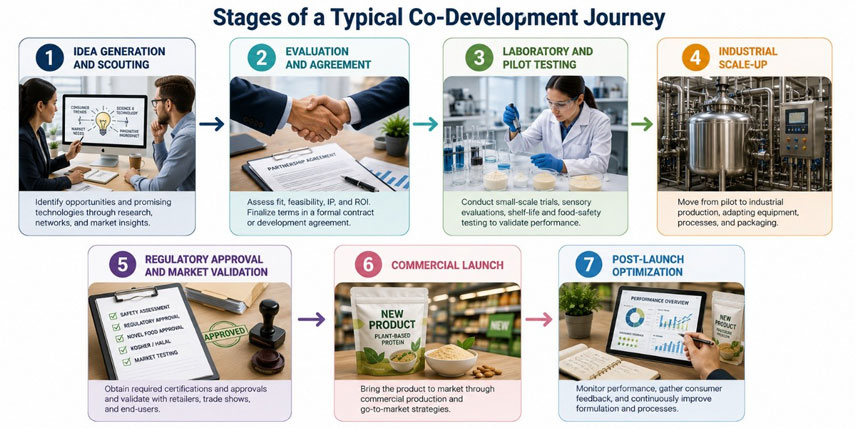
Although the exact steps vary, most co-development partnerships pass through a recognizable sequence, frequently organized as a Stage-Gate process with formal decision points between phases [1,6].
Idea generation and scouting. The relationship usually starts with awareness: a brand’s R&D team learns of a promising technology through scientific literature, conferences, or personal networks, or an ingredient specialist proactively pitches a new solution [1].
Evaluation and agreement. Both parties assess strategic fit, technical feasibility, intellectual property status, and expected return on investment. This stage typically ends with a formal contract, whether a license, a joint development agreement, or a research grant [1,7].
Laboratory and pilot testing. Small-scale trials confirm that the ingredient or process performs as expected, often including sensory panels, shelf-life testing, and food-safety checks before any commitment to larger production [6,9].
Industrial scale-up. Moving from milliliters or a test kitchen to industrial fermenters or full production lines is rarely straightforward; equipment, cooling, mixing, and packaging must all be adapted, and pilot-scale results do not always transfer predictably [1,8].
Regulatory approval and market validation. Depending on the ingredient, this stage can involve safety certifications, novel-food approval, or Kosher and Halal verification, alongside retailer or trade-show testing with real customers [1,6]. Regulatory responsibilities are often shared between partners. The brand typically manages product registration and market compliance, while the ingredient specialist provides technical documentation, safety data, and certification support. Early involvement of the supplier can help identify regulatory requirements before scale-up, reducing delays and unnecessary reformulation.
Commercial launch and post-launch optimization. After launch, many partnerships continue refining the product, adjusting recipes as ingredient variability, consumer feedback, or new production data come in [1,4].
Roles and Responsibilities in Co-Development
Clarity about who does what is one of the strongest predictors of a successful partnership.
The brand typically defines the product vision, sets specifications, manages regulatory compliance, and controls market access, distribution, and final go or no-go decisions [6,8].
The ingredient specialist brings scientific depth (strains, enzymes, proteins, or processing know-how) along with application laboratories, analytical testing, and technical documentation that supports scale-up [1,9].
Contract manufacturers or pilot facilities, when involved, provide equipment and production capacity for trials without requiring the brand to invest in its own machinery [6].
Retailers, chefs, and end-users frequently participate as validators later in the process, giving sensory feedback or committing to sales before wider rollout [5,6].
| Party | Main Responsibilities | Key Contribution |
| Brand | Defines product vision, sets specifications, manages regulatory compliance, and makes final go/no-go decisions. | Market access, distribution, and commercialization [6,8] |
| Ingredient Specialist | Provides scientific and technical depth, runs application laboratories, and supports scale-up with analytical testing and documentation. | Strains, enzymes, proteins, or processing know-how [1,9] |
| Contract Manufacturer / Pilot Facility | Provides equipment and production capacity for trials and scale-up testing. | Production capacity without requiring capital investment from the brand [6] |
| Retailers, Chefs & End-Users | Give sensory feedback, validate the product, and commit to sales before wider rollout. | Market validation and real-world demand signals [5,6] |
Real-World Examples
The dairy industry offers one of the best-documented examples of co-development. Chr. Hansen’s collaboration with the French research institute INRA transformed laboratory research on bacterial respiration into a commercially applicable fermentation process. In this case study, INRA contributed the underlying scientific discovery, while Chr. Hansen provided industrial development, scale-up, and commercialization expertise. The product reached the market approximately three years after the license agreement was signed, and by 2004 nearly 100,000 tons of cheese had been produced using the resulting cultures [1].
A frequently cited case study from the seafood sector involved a small vertically integrated Australian crab business using a modified Stage-Gate process with end-users, food technologists, and a commercial production facility. Food technologists and pilot-scale production facilities supported concept evaluation and product refinement, reducing 92 initial concepts to three final products. The selected crab cake sold approximately 288,000 units within three months of launch at less than one-quarter of the cost of a previous unsuccessful project [6].
Open innovation case studies illustrate similar collaboration models outside formal licensing agreements. In these examples, external partners contributed specialized technologies, product design tools, or stakeholder networks that supported product development and commercialization. However, the specific contributions and outcomes differed across projects and should be interpreted as project-specific examples rather than evidence of a uniform development advantage [2].
Applying Co-Development to Modern Ingredient Innovation
Many of today’s most active co-development projects center on ingredients that address consumer health concerns, and the same partnership principles described above apply directly to them.
Fungal Protein and Plant-Based Protein. Somebrands seeking alternative proteins rarely have in-house fermentation or extraction capability, so they typically co-develop with a specialist that already runs pilot-scale bioreactors or protein-isolation lines, sharing sensory and cost data until the ingredient performs in a finished formulation [2,5].
Sugar Reduction and Natural Sugar Substitute development. Replacing sugar without damaging taste or texture usually demands specialized sweetener or fermentation technology; a brand and its ingredient partner will typically run multiple rounds of sensory testing before a Natural Sugar Substitute is approved for a final recipe [9].
Salt Reduction and Salt Alternatives. Developing Salt Alternatives that preserve flavor and food-safety functions is technically demanding, and manufacturers commonly rely on ingredient specialists with proprietary mineral blends or taste-masking technology to reach an acceptable Salt Reduction level [4].
In each of these cases, the underlying co-development logic is the same one seen in the dairy and seafood examples above: shared risk, staged testing, and a gradual transfer of technical responsibility from specialist to brand as the product moves toward commercial scale.
Benefits of Co-Development
For brands, co-development may reduce,technical risk, since extensive trials catch problems before a product reaches the shelf [1]. It can also shorten development time and lower cost compared with building the same capability internally [2,6].
For ingredient specialists, a successful partnership provides a commercial outlet for years of research investment, along with real production data that can improve the technology for future customers [1,8].
At an industry level, well-run partnerships help unlock investment in areas such as sustainability metrics and functional nutrition, since credible science-based tools make it easier for companies and investors to evaluate new opportunities [3].
Common Challenges
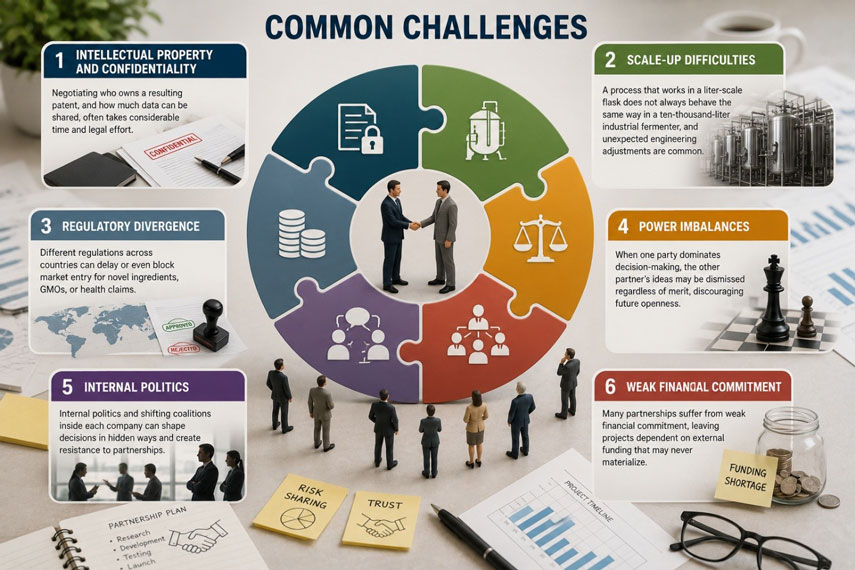
Intellectual property and confidentiality are recurring sources of friction. Negotiating who owns a resulting patent, and how much data can be shared, often takes considerable time and legal effort [1,7].
Scale-up is rarely smooth. A process that works in a liter-scale flask does not always behave the same way in a ten-thousand-liter industrial fermenter, and unexpected engineering adjustments are common [1,8].
Regulatory divergence between countries, particularly around novel ingredients, genetically modified organisms, or health claims, can delay or even block market entry in some regions while allowing it in others [1,10].
Power imbalances between partners can also undermine collaboration. When one party dominates decision-making, the other partner’s ideas may be dismissed regardless of merit, discouraging future openness [9].Beyond the two partner organizations themselves, internal politics and shifting coalitions inside each company can also shape decisions in ways that are not always visible from outside; resistance to a partnership is sometimes better understood as a rational defense of internal interests than as a purely technical objection [11]. Practical governance considerations. To reduce these risks, collaboration agreements should clearly define intellectual property ownership, confidentiality obligations, decision-making responsibilities, contingency plans such as second-sourcing where appropriate, and termination or technology transfer arrangements. Establishing these terms at the beginning of a project can help reduce uncertainty and support more effective long-term collaboration.
Finally, many partnerships suffer from weak financial commitment, particularly from smaller private-sector partners who prefer in-kind contributions over cash investment, leaving projects dependent on external funding that may never materialize [7].
Keys to Successful Partnerships
Across the studies reviewed, a few success factors appear multiple times.
Clear, fast decision-making with well-defined responsibilities keeps projects moving and prevents the drift seen in poorly managed collaborations [8].
Early and repeated involvement of end-users, whether retailers, chefs, or consumers, keeps the product grounded in real market needs rather than internal assumptions [5,6].
Balanced power and open communication between partners allow more novel ideas to survive the evaluation process, instead of being filtered out by a dominant partner’s existing preferences [9].
Aligning short-term project execution with a longer-term strategic relationship, rather than treating each collaboration as an isolated transaction, helps both sides capture lasting value such as shared technology roadmaps [8].
Conclusion
Co-development partnerships between brands and ingredient specialists are rarely simple, but they are increasingly essential.
From licensing agreements that took a dairy culture from a French laboratory to global cheese production, to a small seafood business that used a structured process to launch a successful new product in under a year, the underlying pattern is consistent: shared expertise, staged testing, and clear roles produce results that neither partner could achieve alone.
As the Food and Beverage Industry continues to face new Food Industry Challenges, from healthier formulations to sustainability targets, this model of collaboration is likely to become only more important.
Frequently Asked Questions
1. What is co-development in the food industry?
Co-development is a structured partnership in which a brand and an ingredient specialist combine their respective expertise, scientific know-how on one side and market or manufacturing capability on the other, to jointly design, test, and commercialize a new food or beverage product.
2. Why do food brands work with ingredient specialists instead of developing everything in-house?
Very few brands have the scientific depth to master every ingredient technology on their own. Partnering with a specialist gives access to existing patents and expertise, speeds up development, and is often a meaningful form of Production Cost Reduction.
3. What are the main stages of a co-development partnership?
Most partnerships move through idea generation, evaluation and agreement, laboratory and pilot testing, industrial scale-up, regulatory approval and market validation, and finally commercial launch with post-launch optimization.
4. What challenges most often affect these partnerships?
The most common issues are intellectual property disputes, unpredictable industrial scale-up, regulatory differences between countries, unequal power between partners, and insufficient financial commitment from one side.
5. How does co-development apply to ingredients like Fungal Protein, Plant-Based Protein, or Salt Alternatives?
The same partnership logic applies directly: a brand without in-house fermentation, protein-isolation, or taste-masking technology works with a specialist that already has it, running joint sensory and cost testing until the ingredient performs reliably in a finished product.
References
1. Pedersen, M. B., Iversen, S. L., Sørensen, K. I., & Johansen, E. (2005). The long and winding road from the research laboratory to industrial applications of lactic acid bacteria. FEMS Microbiology Reviews, 29(3), 611–624.
2. Sarkar, S., & Costa, A. I. A. (2008). Dynamics of open innovation in the food industry. Trends in Food Science & Technology, 9(11), 574-580.
3. Negra, C., Remans, R., Attwood, S., Jones, S., Werneck, F., & Smith, A. (2019). Sustainable agri-food investments require multi-sector co-development of decision tools. Ecological Indicators, 110, 105851.
4. Riddick, F., Wallace, E., & Davis, J. (2016). Managing Risks Due to Ingredient Variability in Food Production. Journal of Research of the National Institute of Standards and Technology, 121, 17.
5. Kukko-Liedes, V., Mikkonen, M., & Björklund, T. (2019). Experimentation Throughout the Product Development Process – Lessons from Food and Beverage Ventures. Proceedings of the International Conference on Engineering Design (ICED19). Cambridge University Press.
6. Howieson, J., Lawley, M., & Selen, W. (2014). New Product Development in Small Food Enterprises. Journal of New Business Ideas and Trends, 12(1), 11-26.
7. Hartwich, F., Gottret, M. V., Babu, S., & Tola, J. (2007). Building Public-Private Partnerships for Agricultural Innovation in Latin America: Lessons from Capacity Strengthening. IFPRI Discussion Paper 00699. International Food Policy Research Institute, 699.
8. van Echtelt, F. E. A., Wynstra, F., van Weele, A. J., & Duysters, G. (2008). Managing supplier involvement in new product development: A multiple-case study. Journal of Product Innovation Management, 25(2), 180-201.
9. Houman Andersen, P., & Munksgaard, K. B. (2009). Collaborative product development and situated knowledge contexts: The case of non-durable food products. European Journal of Innovation Management, 12(2):200-222.
10. Belay, Y. G., & Yimer, A. M. (2026). Determinants of new product market success in food processing company and its implication to microalgae-based nutritional supplement and food commercialization in case of Bahir Dar city, evidence from Ethiopia. Journal of Innovation and Entrepreneurship, 15, 29.
11. Calabrese, G., & Mastroberardino, P. (2017). How do Knowledge and Innovation Work within Organizations: The Situationist View of the Firm. International Journal of Innovation and Technology Management, 14, 5.