
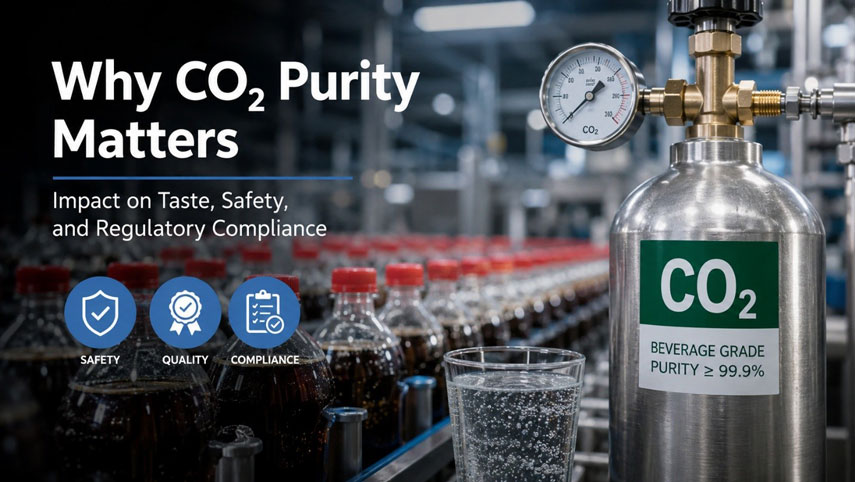
Why CO2 Purity Matters: Impact on Taste, Safety, and Regulatory Compliance
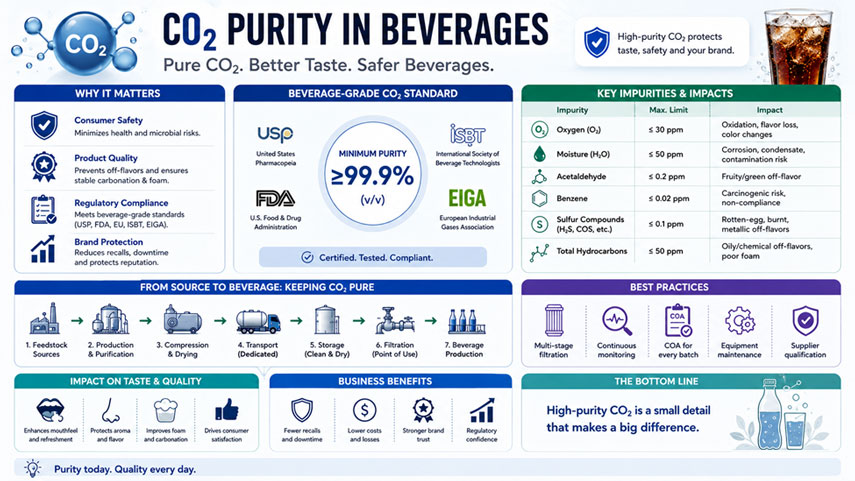
CO2 plays a key role in beverage production, as its purity directly affects product quality, safety, and taste [1]. Regulatory bodies and the industry make a clear distinction between food-grade and beverage-grade CO2 [1,2]. Strict limitations are imposed on food-grade CO2 regarding heavy metal content, pesticides, and microbes by the USP, FDA, and EU frameworks [1,2]. Beverage-grade CO2 must also meet more stringent regional standards to prevent unwanted colors, smells, flavors, and trace impurities. To ensure consumer safety and consistent carbonation, beverage CO2 for carbonated beverages should meet a minimum purity of approximately 99.9% v/v, as recommended by industry standards and common practice, rather than relying on the broader food-grade minimum specification [1,3,8].
Regulatory Standards and Industry Frameworks
Testing protocols and standards for CO2 purity in food and drinks are determined by multiple organizations. In the US, the USP and FDA establish impurity rules and testing requirements for food-grade gases, including CO2, N2, and O2 [1,2]. Industry groups such as the International Society of Beverage Technologists (ISBT) and the European Industrial Gases Association (EIGA) focus on supplier quality systems, formal certification, and Certificates of Analysis (COAs) for each gas batch to prove compliance. They also recommend auditing suppliers and verifying purity through independent laboratories when possible [1,3]. In practice, CO2 purity is explicitly stated in product specifications (CO2 ≥ 99.9%) and accompanied by documentation confirming compliance with relevant beverage standards [1,3].
Sources and Impacts of Impurities
Pollutants may originate from industrial feedstocks, gas production and purification, transportation, storage, or distribution systems [4]. Contamination can also occur within beverage manufacturing facilities due to poorly maintained storage tanks, transfer hoses, pipelines, valves, compressors, condensate buildup, saturated filters, or accidental beverage backflow into the gas distribution system [4]. Without effective purification and filtration, these contaminants may enter the beverage, negatively affecting carbonation stability, sensory quality, regulatory compliance, and consumer safety [1,4]. Key contaminants and their effects include benzene, acetaldehyde, sulfur compounds, hydrocarbons, oxygen, moisture, and microbiological contamination.
Benzene: A known human carcinogen that may enter through industrial sources or contamination during CO₂ production [4–6]. Regulatory limits protect consumer health and ensure compliance, while higher concentrations can also harm beverage quality [4–6].
Acetaldehyde: Imparts pungent, fruity, or green off-flavors that negatively influence beverage sensory quality [4].
Sulfur compounds (e.g., hydrogen sulfide and carbonyl sulfide) cause rotten-egg, burnt, or metallic off-flavors and are among the most common causes of sensory rejection in carbonated beverages [4,19].
Hydrocarbons: Industrial residues that can cause oily or chemical off-flavors, alter mouthfeel, and decrease foam stability [4,20].
Oxygen: Promotes oxidative reactions that accelerate flavor deterioration, color changes, and degradation of oxidation-sensitive beverage components, reducing product shelf life [3,4,21].
Microbiological contamination: Microorganisms typically do not grow in dry CO₂ because there is no free water. Contamination is mainly linked to moisture ingress, condensate formation, contaminated equipment, saturated filters, poor sanitation, or beverage backflow into the gas distribution system [22]. Table 1 summarizes typical impurity limits for beverage-grade CO₂ and their effects on beverage quality. Maintaining these levels is essential to preserve sensory quality, carbonation performance, consumer safety, and regulatory compliance [3,4,19,20,21,22,23].
| Impurity | Maximum allowable concentration | Potential impact on beverage quality |
| CO₂ purity | ≥99.9% (v/v) | Ensures consistent carbonation and beverage quality |
| Oxygen | ≤30 ppm | Oxidation, flavor deterioration, color changes, reduced shelf life |
| Moisture | ≤50 ppm | Corrosion, condensate formation, increased contamination risk |
| Acetaldehyde | ≤0.2 ppm | Fruity/green off-flavor |
| Benzene | ≤0.02 ppm | Carcinogenic contaminant; regulatory non-compliance |
| Total sulfur compounds | ≤0.1 ppm | Rotten-egg, burnt, metallic off-flavors |
| Total hydrocarbons | ≤50 ppm | Oily/chemical off-flavors, reduced foam stability |
| Carbon monoxide | ≤10 ppm | Toxic impurity |
| Methanol | ≤10 ppm | Toxic contaminant |
Mitigation, Filtration, and Best Practices
To keep products safe and high-quality, producers rely on strict quality checks and multi-stage filtration at important points, such as Carboguard systems. These measures remove small amounts of hydrocarbons, sulfur compounds, particulates, and other contaminants before the gas reaches the production line, which helps prevent off-flavors [1,4,6,7]. Because microorganisms rarely grow in dry CO₂, microbiological control focuses on keeping moisture out, avoiding condensate, cleaning transfer equipment, ensuring filters are not saturated, and preventing beverage backflow into the gas system. It is best to test CO₂ on-site with electrochemical sensors and portable analyzers to monitor filtration in real time. Producers should also use dedicated, temperature-controlled storage tanks, regularly inspect storage tanks, hoses, pipelines, valves, and compressors, and review COAs before use. These steps help prevent contamination during storage and distribution, treating beverage-grade CO₂ as a carefully managed process input [6,8,9].
Impact on Taste and Sensory Quality
Once beverage-grade CO₂ meets purity standards, the amount of carbonation plays a major role in the taste and sensory qualities of carbonated drinks. The right level of carbonation improves mouthfeel, aroma, and flavor, all of which are important for consumer acceptance. Factors like packaging and labeling can shape both what people expect and what they actually taste before drinking. How a drink looks also matters, since people connect appearance with expected flavor and texture, which influences their mouthfeel experience [10]. Mouthfeel is a complex quality that, along with flavor, helps determine how much people like a food or drink. It includes sensations such as thickness, crunchiness, dryness, and temperature, which result from how different substances interact in the mouth. Volatile substances add to aroma through smell, while non-volatile ones affect flavor through taste and touch. The balance between these can change depending on the situation and can be adjusted by altering carbonation and CO₂ levels, which directly affect mouthfeel, foam, and the sharpness of the flavor in drinks [11,12]. In beverages, carbonation can make some flavors, such as sourness and saltiness, stronger while making others less noticeable. The tingling or ‘bite’ from carbonation happens because carbonic acid forms in the mouth, which affects how we sense taste and texture [4,12]. Aroma and taste also work together; for example, certain smells can make a drink seem sweeter, and what we smell can change how we experience mouthfeel during tasting [13]. The way something looks can also shape what we expect to taste, as people often link certain shapes or colors with specific flavors. Studies using mixed reality have shown that what we see can strongly influence both our expectations and the perceived intensity of flavors [1].
Compliance Evidence and Testing Methodologies
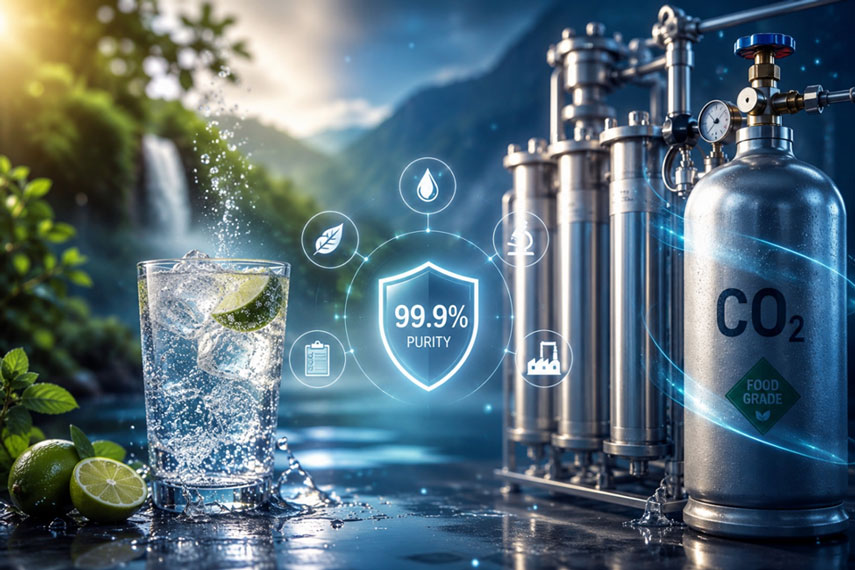
To demonstrate compliance with beverage-grade CO₂ standards, use a documented quality assurance program rather than relying solely on purity measurements. This should include regular testing of CO₂ purity and impurity levels, in accordance with the acceptance criteria in Table 1. Each batch should have a Certificate of Analysis (COA), and independent checks should be done from time to time when needed. Along with testing, regularly inspect and maintain storage tanks, transfer lines, valves, compressors, and filters to reduce the risk of contamination. Keep thorough records of test results, equipment maintenance, filter changes, supplier checks, and batch tracking to meet regulatory requirements and maintain beverage quality consistency [3,6].
Cost, Supply Chain, and Practical Considerations
If CO₂ becomes contaminated or its quality changes, beverage manufacturers can face high costs. These costs may include product recalls, delays, increased expenses, reformulation, or downtime, depending on the severity of the issue. Poor CO₂ quality can also harm a brand’s reputation and reduce consumer trust [5]. To avoid these problems, manufacturers should have strong supplier checks and quality assurance programs [15]. Every CO₂ batch needs a valid Certificate of Analysis (COA). It is important to review suppliers’ quality systems regularly and confirm that CO₂ sources and feedstocks are consistent. Since feedstocks can come from ethanol fermentation, petrochemical processes, or other industrial sources, knowing their origins helps assess supply reliability, potential impurities, and procurement risks [3]. Suppliers should promptly report any changes to CO₂ sources or feedstocks and demonstrate that they continue to meet beverage-grade standards. Quality assurance should also include on-site storage and distribution systems, such as tanks, hoses, pipelines, valves, compressors, filters, and maintenance routines, because contamination can happen during storage and handling. Beverage manufacturers should maintain documented quality management systems and conduct HACCP-based food safety risk assessments to comply with regulations and ensure consistent product quality [15,24]. Logistics and transportation are important for keeping beverage-grade CO₂ quality high throughout the supply chain. Storage vessels and cylinders should meet production needs, withstand the required pressure, work with food-grade CO₂, and resist corrosion. Regardless of the storage system used, tanks and cylinders require regular inspection, cleaning, and maintenance. Good condensate control and proper sanitation also help reduce contamination risks and maintain high gas quality When transporting compressed CO₂, all national and international rules for packaging, labeling, documentation, and safe handling must be followed [4,24]. To reduce contamination risks, it is best to use dedicated food-grade tankers for food and beverage gases only. Suppliers should provide a valid tank cleaning certificate to show the transport vessel was cleaned before loading. Each delivery should also include a valid Certificate of Analysis (COA) confirming that it meets beverage-grade purity standards. At the point of use, filtration should be installed just before the production line to remove any residual contaminants from transport or storage. Before unloading, a quick odor check of the incoming CO₂ should be performed to detect any unusual odors from sulfur compounds, hydrocarbons, or other volatile contaminants. Ongoing monitoring of CO₂ purity, along with effective filtration, preventive maintenance, and sound operational practices, helps maintain beverage-grade quality throughout storage and distribution. This supports regulatory compliance, product consistency, and consumer safety [1,17].
Case Studies and Evidence from the Supply Chain
Case studies show that CO₂ contamination can occur at many points in the supply chain, including during gas capture, purification, compression, transport, storage, and on-site distribution. Contamination can also come from poorly maintained storage tanks, hoses, pipelines, valves, compressors, condensate buildup, saturated filters, or beverage backflow into the gas system [4,8]. Hydrogen sulfide (H₂S) and carbonyl sulfide (COS) are common contaminants. They can cause off-flavors such as rotten-egg, burnt, or sulfur smells. These substances also lead to problems with carbonation, foaming, cloudiness, and chemical odors [1,4]. In the European Union, carbon dioxide used in food and drinks is mainly regulated as the food additive E290, with purity standards set by EU food additive laws. Regulation (EC) No. 1935/2004 and Commission Regulation (EC) No. 2023/2006 also set rules for food contact materials and for good manufacturing practices for equipment and materials that come into contact with food. These rules help ensure that storage and transfer systems do not introduce contaminants into beverages [18]. To demonstrate compliance with beverage-grade CO₂ standards, companies use validated testing methods, Certificates of Analysis (COAs), and standard sampling procedures from organizations such as ISBT and EIGA [3,11]. Keeping beverage-grade CO₂ safe and high-quality requires effective purification, reliable testing, thorough supplier checks, and well-maintained storage and distribution systems throughout the supply chain. This helps ensure product quality, regulatory compliance, and consumer safety [1,3,4,18].
Conclusion
Overall, maintaining carbon dioxide purity is essential in the beverage industry due to its direct impact on consumer safety, product quality, and corporate reputation. Although general food-grade regulations serve as the minimum baseline, the sensory-sensitive nature of carbonated drinks demands strict compliance with beverage-grade regulations and industry guidelines developed by ISBT and EIGA. Contaminants can enter the supply chain through mechanisms such as production, transportation, and storage, causing significant financial damage. Minimizing this risk involves developing an elaborate, multi-layered strategy that includes rigorous supplier qualification (with a COA per batch), point-of-use filtration, and continuous purity monitoring. Ultimately, maintaining a strict chain of custody and robust quality assurance frameworks are critical to preserving sensory performance, regulatory compliance, and the operational efficiency of the beverage company.
Frequently Asked Questions (FAQ)
1: What is the minimum purity required for beverage-grade CO2?
The beverage industry, following standards such as those set by the ISBT (International Society of Beverage Technologists), requires a minimum purity of 99.9%. This high level of purity helps keep products safe, ensures consistent carbonation, and avoids off-flavors or unwanted smells.
2: What is the main difference between food-grade and beverage-gradeCO2?
Food-grade CO2is mainly about limiting hazardous contaminants, such as heavy metals. Beverage-grade CO2 takes it further by also protecting the product’s color, aroma, taste, foam quality, and carbonation stability.
3: At what stage do CO2 contaminations typically occur?
Contamination most frequently occurs somewhere along the supply chain. If non-dedicated tankers are used or storage conditions are poor, moisture and impurities can enter the gas. That’s why it’s important to check the COA (Certificate of Analysis) and filter the gas before use.
4. Why is continuous monitoring recommended?
Routine monitoring helps detect purity deviations before they affect production. Combined with preventive maintenance and regular equipment inspections, it supports consistent beverage quality and regulatory compliance.
5. What are the business risks of poor CO₂ quality?
Insufficient CO₂ purity may lead to product recalls, production downtime, increased operating costs, reformulation, regulatory issues, and loss of consumer confidence, making quality assurance a critical component of beverage manufacturing.
Reference:
1-Carbon Dioxide (CO2) Purity Grade Chart – CO2 Meter
2-CO₂ Purity Grades: Why Beverage CO₂ Quality Matters
3- European Industrial Gases Association (EIGA). (2023). Carbon Dioxide Source Qualification, Quality Standards and Verification (Doc 169/23). Brussels: EIGA.
4- Rather IA, Koh WY, Paek WK, Lim J. The Sources of Chemical Contaminants in Food and Their Health Implications. Front Pharmacol. 2017 Nov 17;8:830. doi: 10.3389/fphar.2017.00830. PMID: 29204118; PMCID: PMC5699236.
5- European Food Safety Authority (EFSA). (2020). Scientific Opinion on the Re-Evaluation of Carbon Dioxide (E 290) as a Food Additive. EFSA Journal, 18(1), 5967.
https://efsa.onlinelibrary.wiley.com/doi/10.2903/j.efsa.2020.5967
6-Understanding and Ensuring CO2 Supply Quality for Brewery Use
7-Importance of Purity in Beverage CO2: A Safety Guide – Ramdon
8- https://surepurity.com/co2-purity-grades/
9- Duffell CJ. Beverage appearance and flavor protection from carbon dioxide quality excursions. Tech. Q. Master Brew. Assoc. Am. 2005;42(1):31-8.
10- Christiansen NF, Andersen C, Pedersen PD, Brorholt LP, Bræstrup F. Methods for measuring impurities in CO2.
11- Kappes SM, Schmidt SJ, Lee SY. Relationship between physical properties and sensory attributes of carbonated beverages. Journal of food science. 2007 Jan;72(1):S001-11.
12- An J, Lee J. Carbonation Perception and Texture Characteristics of Carbonated Beverages Using Focus Group Interviews and Free-Sorting Tasks. Foods. 2026 Jun 4;15(11):2013.
14- Pickering Z, Visioli B. OVERVIEW OF PROVEN AND EMERGING CO2 PURIFICATION PROCESSES FOR CO2 CAPTURE, UTILIZATION, AND STORAGE.
15- Nwaiwu O, Ibekwe VI. Assessment of HACCP Safety System and Good Manufacturing Practices in a Multi-product Soft Drink Bottling Plant. Current Journal of Applied Science and Technology. 2017 Nov 4;24(3):1-2.
17- Steen D. Carbonated beverages. Chemistry and Technology of Soft Drinks and Fruit Juices. 2016 Feb 26:146-73.
18- https://food.ec.europa.eu/food-safety/food-improvement-agents/flavourings/eu-rules_en
19- Dordevic D, Capikova J, Dordevic S, Tremlová B, Gajdács M, Kushkevych I. Sulfur content in foods and beverages and its role in human and animal metabolism: A scoping review of recent studies. Heliyon. 2023 Apr 13;9(4):e15452. doi: 10.1016/j.heliyon.2023.e15452. PMID: 37123936; PMCID: PMC10130226.
20- Wolinska-Kennard K, Schönberger C, Fenton A, Sahin AW. Mouthfeel of Food and Beverages: A Comprehensive Review of Physiology, Biochemistry, and Key Sensory Compounds. Compr Rev Food Sci Food Saf. 2025 Jul;24(4):e70223. doi: 10.1111/1541-4337.70223. PMID: 40625310; PMCID: PMC12235588.
21- Aadil RM, Madni GM, Roobab U, ur Rahman U, Zeng XA. Quality control in beverage production: An overview. Quality control in the beverage industry. 2019 Jan 1:1-38.
22- Chawla H, Anand P, Garg K, Bhagat N, Varmani SG, Bansal T, McBain AJ, Marwah RG. A comprehensive review of microbial contamination in the indoor environment: sources, sampling, health risks, and mitigation strategies. Front Public Health. 2023 Nov 23;11:1285393. doi: 10.3389/fpubh.2023.1285393. PMID: 38074709; PMCID: PMC10701447.
23- Steen, D. P., & Ashurst, P. R. (Eds.). (2008). Carbonated Soft Drinks: Formulation and Manufacture. John Wiley & Sons.
24- https://cleancyclecarbon.com/blog/how-to-evaluate-co2-supply-risk