
How pH Impacts Color Stability in Acidic Carbonated Beverages
Formulating acidic carbonated beverages in the competitive FMCG sector requires rigorous control over physicochemical parameters to preserve visual integrity and sensory performance throughout shelf life. Among these parameters, pH remains one of the most influential. In acidic beverage matrices, color stability is not merely a cosmetic attribute; it is a formulation and thermodynamic challenge that directly affects product consistency and consumer acceptance.
Visual degradation often signals matrix instability, oxidation, or pigment breakdown, all of which can influence perceived flavor through the Halo Effect. For industrial formulators, understanding the molecular interactions between active acidity, carbonation level, and pigment chemistry is essential for optimizing product integrity, reducing rejection rates, and managing production costs.
Chemical and Thermodynamic Mechanisms of pH on Pigment Structure
Depending on the formulation, carbonated beverages typically maintain a pH between 2.5 and 4.0. This acidic environment results from the combined contribution of carbonic acid derived from dissolved CO2 and added acidulants such as citric, malic, or phosphoric acid. The behavior of natural pigments in this matrix varies significantly and depends on their chemical structure, dissociation behavior, and sensitivity to hydration, oxidation, and thermal stress.
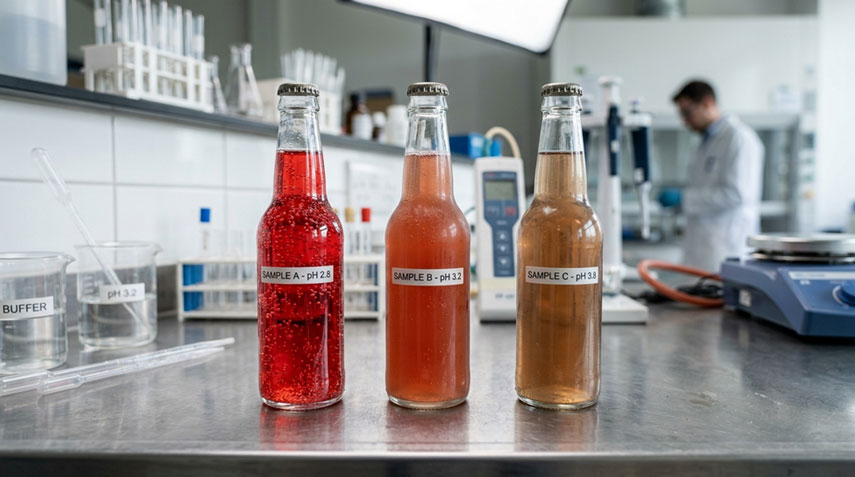
Anthocyanins, important natural pigments derived from juice concentrates such as red grape, pomegranate, and sour cherry, as well as botanical sources such as black carrot, exhibit strongly pH-dependent behavior. At low pH, generally within the range of 1.0 to 3.0, these compounds predominantly exist in the flavylium cation form, which is associated with a vivid red coloration.
As pH increases toward 4.0 to 5.0, hydration reactions become more favorable, and a larger fraction of the pigment may convert into less intensely colored or colorless forms such as the carbinol pseudobase and chalcone-related structures. This transition can result in a substantial reduction in color intensity in the finished product. In commercial production, even modest variation in acid dosing, water composition, or CO2 retention may contribute to measurable color fading over storage.
Acidulants and Buffering Capacity in Color Retention
The selection of acidulants strongly influences pigment stability. Different acids possess distinct pKa values and buffering characteristics, which shape the resistance of the beverage matrix to pH drift during processing and storage.
Phosphoric Acid: Commonly used in cola-type beverages. Its ability to support a low-pH environment can contribute to the stability of color systems such as Class IV caramel under typical soft drink conditions.
Citric and Malic Acid: Widely used in fruit-flavored beverages. Citric acid offers useful buffering capacity because of its polyvalent structure. However, in systems containing transition metal ions such as iron or copper, overall pigment stability may still be negatively affected through metal-catalyzed degradation pathways. For this reason, water quality and trace metal management remain critical.
Water Alkalinity Control: Industrial water quality plays a decisive role in maintaining target pH. Reverse osmosis systems and related treatment processes should be properly controlled to reduce alkalinity and hardness, thereby minimizing unintended neutralization of acidulants and upward pH drift.
Copigmentation Techniques in Industrial Formulation
One advanced strategy for improving color stability in acidic beverages is copigmentation. This approach involves pairing sensitive pigments, particularly anthocyanins, with colorless or lightly colored organic compounds such as flavonols, phenolic acids, or selected peptides.
These compounds can form molecular associations through non-covalent interactions, including hydrophobic interactions and hydrogen bonding. In some systems, these interactions help protect the pigment from hydration reactions and other destabilizing effects, especially at moderately acidic pH values. The result may include improved color retention, a hyperchromic effect (greater apparent color intensity), and a bathochromic shift (a shift toward longer wavelengths). When properly validated, copigmentation can also improve formulation efficiency by lowering the pigment dosage required to achieve the target visual profile.
Industrial Packaging Dynamics and Light Interaction
Packaging material significantly affects both pH retention and color stability over shelf life. Gas permeability, oxygen ingress, and light exposure can alter the chemical equilibrium of the beverage and accelerate pigment degradation.
PET Bottles: PET generally has higher gas permeability than glass or aluminum. Over time, gradual CO2 loss through the package wall can reduce carbonic acid concentration and contribute to a slight rise in pH. Combined with light transmission, especially under unfavorable storage conditions, this can accelerate degradation of light-sensitive natural colors.
Aluminum Cans: Aluminum cans provide an effective barrier against light and very strong protection against oxygen and gas transfer under normal conditions. However, if internal lining integrity is compromised in highly acidic systems, metal interaction with the beverage may increase the risk of color shifts, haze formation, or precipitation.
Objective Sensory Evaluation and the Halo Effect
Color changes caused by pH fluctuations are not only visual; they can also influence taste perception. In sensory science, the Halo Effect describes the tendency of consumers or panelists to associate lower color intensity with reduced flavor impact, sweetness, or freshness, even when the underlying formula remains unchanged.
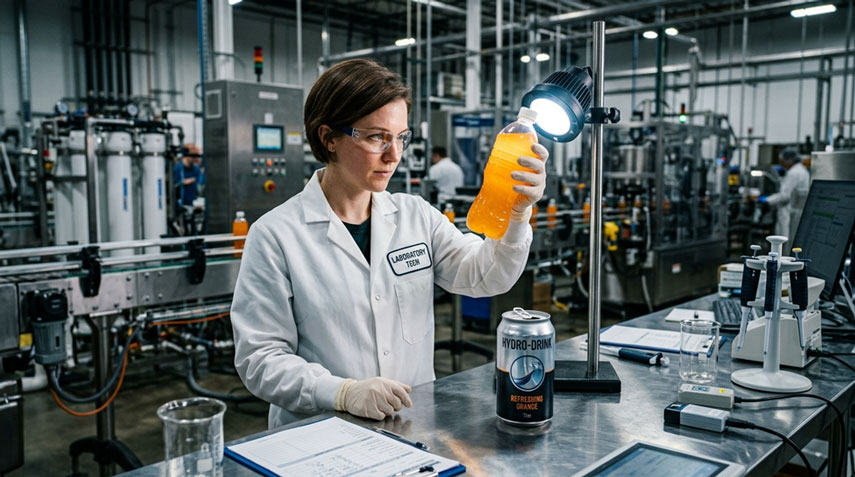
To reduce bias during product development, sensory evaluations should be conducted under controlled lighting conditions or with tools such as opaque cups when the goal is to isolate flavor perception from visual cues. Maintaining color stability through tight pH control helps preserve sensory consistency across production batches.
Technical Analysis Table: Stability of Pigments in Acidic Media (pH 2.5-4.0)
| Pigment Type | Common Industrial Source | Structural/Functional Status at pH < 3.5 | Light/Oxygen Sensitivity | Pasteurization Behavior |
| Anthocyanins | Black carrot, red grape | Relatively stable; red flavylium form favored | Moderate light sensitivity; oxidation risk depends on matrix | Color loss may occur during prolonged thermal processing |
| Betalains | Beetroot extract | Moderate stability in selected acidic systems; performance depends on pH, oxygen, and temperature | High oxidation sensitivity | Generally low thermal resistance |
| Caramel (Class IV) | Ammonia-processed sugar | Highly stable under typical acidic beverage conditions | Highly resistant relative to many natural pigments | Usually stable with minimal visible shift |
| Carotenoids | Paprika extract, beta-carotene | Requires stable emulsification for uniform appearance | Prone to photo-oxidation | Can remain stable if the emulsion system is well protected |
Conclusion
Maintaining color integrity in acidic carbonated beverages is a multidimensional formulation challenge in which pH acts as a foundational variable. The stability of many pigments is closely tied to the acidic environment created by acidulant selection, buffering capacity, and the equilibrium of dissolved CO2. Structural transformations in molecules such as anthocyanins illustrate how even moderate pH drift can affect long-term color retention.
For R&D and Quality Control teams, mitigating color degradation requires a holistic approach. This includes careful acid system design, management of water alkalinity and trace metals, evaluation of packaging-related CO2 loss, and validation of stabilization strategies such as copigmentation. Tight control of these variables supports both shelf-life performance and sensory consistency.
Frequently Asked Questions (FAQ)
1. How can we prevent color fading in Zero Sugar carbonated beverages?
In sugar-free matrices, pigments are more vulnerable due to the lack of sucrose protection. Opting for acylated anthocyanins is a primary step. However, the most effective industrial solution is incorporating our specialized color stabilizers, which reinforce the pigment matrix against pH-driven degradation and compensate for the structural thinning caused by sugar removal.
2. What is the Minimum Order Quantity (MOQ) for acid-resistant botanical extracts?
MOQs vary based on the industrial grade (liquid in drums vs. powder in insulated bags). Our supply strategy is aligned with your supply chain KPIs to prevent capital lock-up and raw material expiration.
3. Do fluctuations in CO2pressure at the filler impact final color?
Yes. Pressure fluctuations alter bottle headspace and directly impact dissolved carbonic acid levels, causing momentary shifts in the beverage’s pH. To counter this, utilizing our advanced gas stabilizers ensures optimal CO2retention and equilibrium, safeguarding carbonation levels and ensuring batch-to-batch color uniformity.
4. What quality documentation accompanies natural colors?
All deliveries include a batch-specific Certificate of Analysis (COA), Halal certificates, and detailed color stability charts mapped across various pH spectrums.