
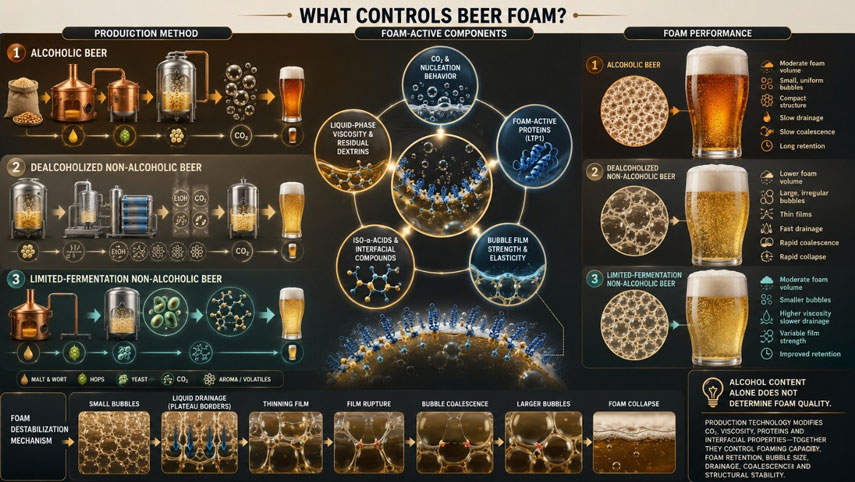
Key Differences in Foam Behavior Between Alcoholic and Non-Alcoholic Beers
Foam behavior in alcoholic and non-alcoholic beers cannot be evaluated solely by initial foam height. Foaming capacity, foam stability, drainage rate, bubble size, coalescence rate, and foam replenishment are independent parameters. One product may generate a large initial foam head that collapses rapidly. Another may produce less foam but retain it for a longer period. Dealcoholized non-alcoholic beers often exhibit reduced foam capacity and stability compared with their alcoholic counterparts. However, this difference is multifactorial and may result from process-induced alterations to foam-active proteins and other interfacial components, as well as changes in liquid-phase properties and bubble dynamics, rather than solely from the absence of ethanol. Their foam may also contain larger bubbles and exhibit a less compact structure. Nevertheless, the sensory relevance of these differences requires careful evaluation, since nucleation-site characteristics and other formation conditions may exert a greater influence on bubble development.
However, this pattern cannot be generalized to all non-alcoholic beers. Products made through alternative fermentation processes or with specialized yeast strains may behave differently and show greater foam stability. Overall foam performance therefore reflects the combined effects of production methodology, the concentration and functionality of foam-active proteins and iso-alpha-acids, carbonation level, liquid-phase rheology, nucleation behavior, and interfacial properties. A holistic evaluation of these factors is particularly important when comparing alcoholic and non-alcoholic beer variants.
Differences in Foaming Capacity, Stability, and Foam Structure
Non-alcoholic beers produced by removing ethanol after fermentation usually generate less foam than the alcoholic version of the same product. The difference is not limited to foam height. Bubble size, foam liquid content, and structural retention time may also change. In these products, bubbles generally merge more rapidly. This process occurs when the thin film separating two adjacent bubbles ruptures. Small bubbles then combine to form larger bubbles. The total number of bubbles decreases, and the foam collapses more rapidly. In the corresponding alcoholic product, bubble coalescence is generally slower. The foam may therefore retain a finer and more compact structure. However, this difference is not caused by ethanol alone. Foam-active proteins, fermentation-derived compounds, CO₂ content, and other surface-active compounds at the bubble interface also contribute.
Non-alcoholic beers produced through limited fermentation or with specialized yeast strains may show greater foam stability than dealcoholized products. Alcohol content alone is therefore not a reliable indicator of foam quality. The production method is also a critical factor. During limited fermentation, more sugars and dextrins remain in the beverage. These compounds increase liquid-phase viscosity and slow foam drainage. However, slower drainage does not always result in more stable foam. If the interbubble film is weak, bubbles can still coalesce and the foam will collapse.
Fully fermented beer usually contains less residual sugar. In contrast, fermentation-derived compounds and foam-active proteins may create a different interfacial structure around the bubbles. Foam stability is governed by the combined rates of liquid drainage, bubble coalescence, gas disproportionation, and interfacial-film rupture. [1].
Differences in the Role of Ethanol in the Two Matrices
Ethanol has two different effects on beer foam. On the one hand, it can facilitate bubble formation by lowering short-time dynamic surface tension at a relevant timescale. On the other hand, it may reduce foam stability by hindering the adsorption of other surface-active components, accelerating drainage, and weakening the thin film between bubbles. Under controlled conditions, these opposing effects can occur simultaneously.
The magnitude of this effect depends on the protein composition, LTP1 content, and interfacial properties of the product. Beers with a higher alcohol content do not necessarily have weaker foam. In some products, a strong protein network and effective Marangoni flows can compensate for the destabilizing effects of ethanol by reinforcing the interfacial film and redistributing surface-active material toward locally thinned regions [2].
While ethanol removal may reduce the direct weakening of interbubble films, it also increases surface tension and may make bubble formation more difficult. Dealcoholization can also alter the CO₂ content and the concentration or functionality of compounds involved in foam formation and stabilization.
In non-alcoholic model systems, protein hydrolysates and appropriate concentrations of iso-alpha-acids have been shown to improve interfacial film strength and foam stability. The absence of ethanol is therefore not inherently beneficial.
The dominant limiting factor may differ between matrices. In some alcoholic beers, ethanol-induced film drainage is important, whereas in some non-alcoholic beers, insufficient bubble generation or weak coalescence resistance may dominate. [3].
Differences Caused by Production Technology
The production method has a major effect on foam behavior in non-alcoholic beer. In dealcoholization processes, the product is first fully fermented and ethanol is subsequently removed. In limited fermentation, ethanol production is controlled from the beginning. These approaches produce beverages with different compositions and foam characteristics.
During limited fermentation, higher concentrations of maltose, maltotriose, and dextrins remain in the beverage. These compounds increase viscosity and may slow liquid drainage from the foam. However, a shorter fermentation process may also reduce the production of CO₂, glycerol, and other yeast-derived metabolites. A more viscous liquid phase alone does not guarantee greater foam formation or a stronger interfacial film. In products made with maltose-negative yeast strains, fermentation continues while alcohol production remains limited. The yeast strain affects residual sugar, glycerol content, and the profile of fermentation-derived compounds. Two non-alcoholic beers with similar alcohol contents may therefore show different foam behavior because they were produced with different yeast strains.
During thermal dealcoholization, ethanol is removed by processes such as vacuum distillation or falling-film evaporation. These processes may also remove part of the CO₂ and volatile compounds. Heat exposure and oxidation may alter the structure of foam-active proteins and affect their functionality at the bubble interface.
Membrane dealcoholization is performed at a lower temperature and generally preserves high-molecular-weight compounds more effectively. However, part of the water, ethanol, CO₂, and volatile compounds may still be removed from the product. The product volume and carbonation level therefore usually need to be readjusted after processing.
Carbonation is another important source of variation between alcoholic and non-alcoholic products. In alcoholic beer, part of the CO₂ is generated during fermentation and retained in the beverage. In many dealcoholized products, CO₂ is lost during processing and must be reintroduced. This can alter bubble number, initial foam volume, and bubble size. Increasing the CO₂ level may produce a larger initial foam head. However, it does not necessarily improve foam stability. When the primary problem is a weak interbubble film and rapid bubble coalescence, additional carbonation cannot compensate for the structural weakness.
Studies of commercial products indicate that beers dealcoholized by vacuum or membrane processes generally tend to have lower foam stability. Nevertheless, both high- and low-performing products have been identified within all production categories. Production technology alone therefore does not determine foam quality. Total protein content is an insufficient predictor of foam performance; the type, molecular structure, and surface adsorption capabilities of proteins, which dictate their ability to form viscoelastic films resistant to coalescence, are critical determinants. A product may contain sufficient protein, while those proteins remain unable to produce stable foam.
Overall, production technology modifies four major parameters: CO₂ content, liquid-phase viscosity, the structural and functional state of foam-active proteins, and the interfacial properties of the bubbles. Together, these factors determine how much foam is generated and how rapidly it collapses [1, 4].
Conclusion
Dealcoholized non-alcoholic beers generally produce less foam, show lower foam stability, and contain larger bubbles than the corresponding alcoholic products. Faster bubble coalescence is one of the main causes of this instability.
However, not all non-alcoholic beers behave in the same way. Products made through limited fermentation or with specialized yeast strains may show greater foam stability. Higher sugar and dextrin levels may slow drainage. Nevertheless, lower CO₂ levels or weak interbubble films can still destabilize the foam.
Foam quality therefore cannot be predicted from alcohol content alone. The production process, CO₂ content, liquid-phase viscosity, foam-active proteins, and iso-alpha-acids must be evaluated together. For an accurate comparison, foaming capacity, foam retention time, bubble size, and coalescence rate should be measured separately.
References
[1] Bossaerts, L., Langenaeken, N. A., Wouters, A. G., & Courtin, C. M. (2026). Insights into the Foaming Properties of Alcoholic and Non-Alcoholic Beers Using Four Different Foaming Methods. Journal of the American Society of Brewing Chemists, 1-16.
[2] Bossaerts, L., Allard, E., Langenaeken, N. A., Wouters, A. G., & Courtin, C. M. (2026). Enhancing bubble formation and foam properties in non-alcoholic beer: the potential of iso-alpha-acids and protein hydrolysates. Food Hydrocolloids, 113014.
[3] Chatzigiannakis, E., Alicke, A., Bars, L. L., Bidoire, L., & Vermant, J. (2025). The hidden subtlety of beer foam stability: A blueprint for advanced foam formulations. Physics of Fluids, 37(8).
[4] Rettberg, N., Lafontaine, S., Schubert, C., Dennenlöhr, J., Knoke, L., Diniz Fischer, P., … & Thörner, S. (2022). Effect of production technique on pilsner-style non-alcoholic beer (NAB) chemistry and flavor. Beverages, 8(1), 4.