
Regulatory Compliance for Beverage Additives Across GCC Markets
Regulatory compliance for beverage additives is an important aspect of beverage production in GCC markets because it is associated with product safety, regulatory approval, and market access.
Beverage additives, including preservatives, sweeteners, colorants, acidity regulators, and stabilizers, are used to achieve specific technological functions and maintain product quality. Their use is subject to regulatory requirements, including approved substance lists and specified maximum permitted levels.
The Gulf Standardization Organization (GSO) provides a regional framework for food standards within GCC countries. However, manufacturers are also required to comply with applicable national requirements related to product registration, labeling, and technical documentation.
Regulatory compliance involves not only ingredient selection but also labeling, supplier verification, technical documentation, and monitoring of regulatory requirements.
Failure to comply with applicable regulatory requirements may delay product registration, restrict market access, or result in regulatory actions, including product recalls. A systematic approach to regulatory compliance may help manufacturers reduce the risk of non-compliance throughout the product lifecycle.
This article reviews the regulatory framework for beverage additives in GCC markets and discusses key compliance requirements, common challenges, and practical considerations for manufacturers.
The GCC Regulatory Framework for Beverage Additives
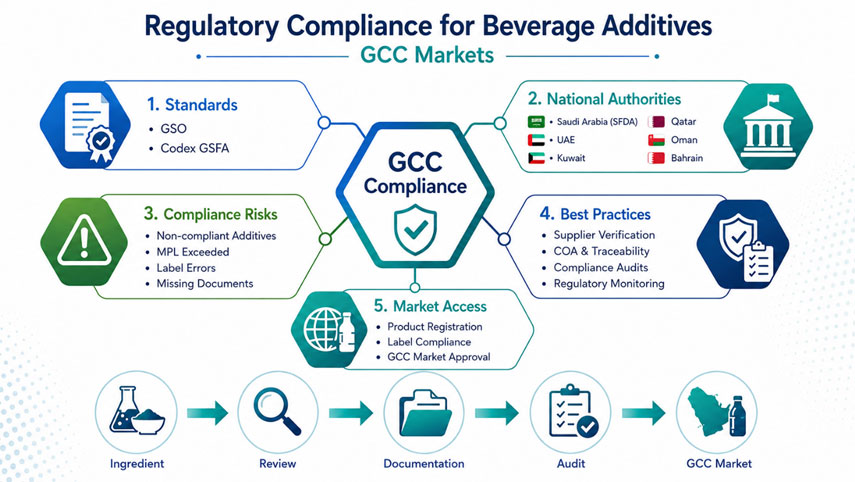
The regulatory framework for beverage additives in GCC markets is based on a combination of regional standards and national regulatory requirements.
The GSO develops and coordinates Gulf Standards and Technical Regulations for the Gulf Cooperation Council (GCC) member states, which include the United Arab Emirates, Saudi Arabia, Bahrain, Kuwait, Oman, and Qatar; national competent authorities in each country are responsible for the implementation, product registration, inspection, and enforcement of these standards.
Manufacturers intending to market beverage products in GCC countries are generally required to comply with both applicable GSO standards and country-specific regulatory requirements.
The Role of the Gulf Standardization Organization (GSO)
The GSO develops Gulf Standards and Technical Regulations covering a wide range of products, including food. These standards provide a regional framework for food safety, product quality, and trade within GCC markets (1,2).
The organization develops Gulf Standards and Technical Regulations through specialized technical committees.
Where appropriate, GSO standards may be developed with reference to internationally recognized standards, including those published by the International Organization for Standardization (ISO) and European Standards (EN) (3).
The GSO also develops regional standards intended to support greater consistency in food regulatory requirements among GCC member states. In the field of food additives, internationally recognized references, including the Codex Alimentarius, are considered during the development of relevant standards (4).
The organization has also developed regional conformity assessment programs, including the Gulf Halal Scheme, which provides a common framework for halal conformity assessment within GCC member states (1)
Codex Alimentarius and GCC Food Additive Standards
Codex GSFA serves as a significant reference standard for food additive regulations in GCC countries, and its provisions are often incorporated into applicable Gulf or national regulations; however, verification of the current, legally binding GSO or national additive lists and specifications is essential (4).
The GSFA provides a reference framework for the safety evaluation and permitted use of food additives, including those used in beverages (4).
The standard includes provisions related to:
- Permitted food additives for beverage applications
- Maximum Permitted Levels (MPLs)
- Functional classes of additives, including preservatives, colorants, sweeteners, stabilizers, and acidity regulators
- International Numbering System (INS) identifiers
- Purity specifications for food additives
Codex-based provisions are incorporated into specific GSO food additive standards; the applicable standard number, version, and effective date, along with the relevant additive category and Maximum Permitted Level, should be independently verified for each ingredient (4).
The use of Codex as a reference contributes to greater consistency in food additive regulation across GCC countries and provides a common basis for regulatory assessment (4). The adoption of Codex principles across GCC countries promotes regulatory consistency while allowing national authorities to introduce additional market-specific requirements.
National Regulatory Authorities Across GCC Countries
While the GSO provides the regional regulatory framework, the implementation and enforcement of food regulations are the responsibility of the competent authorities in each GCC country.
Saudi Arabia
In Saudi Arabia, the Saudi Food and Drug Authority (SFDA) is the competent authority responsible for food regulation and food safety. The SFDA has published technical regulations and guidance documents addressing food labeling and the addition of vitamins and minerals to food products (4,5).
United Arab Emirates
In the United Arab Emirates, food regulatory oversight is shared among federal and emirate-level authorities, including the Ministry of Industry and Advanced Technology (MoIAT), the Emirates Authority for Standardization and Metrology (ESMA), and emirate-level bodies such as ADDED/ADFSA in Abu Dhabi and DED/Dubai Municipality in Dubai. The relevant authority depends on the product type and emirate of operation (4).
Kuwait
In Kuwait, food regulatory activities involve organizations including the Kuwait Public Authority for Industry–Kuwait Standards and Metrology Department (KOWSMD), the Kuwait Municipality, and the Ministry of Health. These authorities participate in the implementation of food standards, inspections, and import control procedures (6).
Bahrain, Oman, and Qatar
Bahrain, Oman, and Qatar regulate beverage additives through their respective national authorities: the Bahrain Standards and Metrology Directorate (BSMD), the Directorate General for Specifications and Metrology (DGSM) in Oman, and the Qatar General Organization for Standardization (QS). These agencies enforce Gulf Standardization Organization (GSO) standards in conjunction with relevant national regulatory requirements (5).
Common Regional Elements vs. Country-Specific Requirements
GCC countries follow a common regional regulatory framework for food additives; however, certain regulatory requirements may differ among member states.
Manufacturers intending to market beverage products in GCC countries should consider both applicable GSO standards and country-specific regulatory requirements when preparing products for individual markets (7).
Regionally Aligned Requirements
Several regulatory elements are addressed through regional GCC standards to promote consistency across member states.
These include the use of the Codex Alimentarius General Standard for Food Additives (GSFA) as a reference for food additive safety assessment and permitted use (4).
The GCC Imported Food Guide also provides a common framework for import procedures based on a risk-based approach to border food control (8).
These regional requirements provide a common basis for food additive regulation and import procedures across GCC markets.
National Deviations
Despite the use of regional GCC standards, individual member states may establish additional national requirements in accordance with their domestic legislation, public health considerations, or market-specific needs (7).
Manufacturers should review applicable national requirements before placing beverage products on individual GCC markets.
Examples of country-specific requirements include:
- Alcohol Limits: The United Arab Emirates applies a specific ethanol content limit for products classified as energy drinks under applicable national regulation; manufacturers should verify the exact percentage, unit of measurement (% v/v), and product definition against the current regulation before formulation.
- Quality Marks: Certain juice and beverage products marketed in the United Arab Emirates may require the Emirates Quality Mark (EQM) in accordance with applicable national requirements.
- Labeling Requirements: UAE Standard 192:2019 requires a warning statement on products containing Quinoline Yellow (E104) and Ponceau 4R (E124); the exact wording, applicable product categories, and current version of the standard should be confirmed. This is a labeling requirement and should be distinguished from a scientifically established health effect (5).
- Halal Certification: Some GCC countries require halal certificates issued or approved by their competent national authorities. For example, products exported to Qatar may require halal certificates approved by recognized certification bodies accepted by the Ministry of Public Health (MoPH), depending on the product category and ingredients; verification with the importer or relevant Qatari authority is recommended (5).
Compliance with applicable GSO standards does not necessarily satisfy all national regulatory requirements.
Manufacturers should therefore consider both regional and country-specific requirements when preparing beverage products for GCC markets.
Common Compliance Risks in Beverage Formulation
Compliance risks in beverage formulation across GCC markets may arise from manufacturing inconsistencies, differences in national regulatory requirements, and the continuous evolution of food standards. To support regulatory compliance, manufacturers are generally required to align formulation practices, ingredient approvals, labeling, and supply chain documentation with the applicable requirements of each target market.
Use of Non-Compliant Additives
The use of non-compliant additives is an important regulatory challenge in beverage formulation.
Differences between the regulations of the manufacturing country and the GCC destination market may allow restricted substances to enter the product (4,12).
Another concern involves ingredients lacking specific GCC market authorization, though international safety evaluations such as JECFA assessments may inform the review process. It should be noted that GRAS status in the United States does not establish regulatory authorization in GCC markets (4,8,12).
Chemical contaminants from raw materials, water, or manufacturing may also affect compliance.
Several regional studies have reported detectable levels of lead, cadmium, arsenic, and pesticide residues in some commercially available beverages, with select samples approaching or exceeding applicable international or national safety limits; findings vary by study, region, and beverage category (9).
Packaging-related chemical migration is also a regulatory consideration.
Migration of bisphenol A (BPA) from polycarbonate packaging or epoxy-coated can linings into beverages has been reported under certain storage and contact conditions in some markets; reported migration levels should be assessed against the applicable Specific Migration Limit defined in the relevant food-contact material regulation (9).
This migration is a concern particularly when measured concentrations exceed the limits set by applicable food-contact material standards (12).
Exceeding Permitted Limits
Maintaining additive concentrations within category-specific Maximum Permitted Levels (MPLs) accounting for quantum satis provisions and carry-over from concentrated ingredients is essential, as even approved additives can cause non-compliance if limits are exceeded.
Manufacturing variability may contribute to deviations from MPL requirements. Factors such as inaccuracies during ingredient weighing, manual handling, or inadequate homogenization during mixing can lead to differences in additive concentrations between production batches.
Variability in raw materials may represent an additional compliance challenge. Beverage concentrates, flavors, and other imported ingredients may contain additive concentrations that differ from those permitted under GCC regulations, requiring manufacturers to implement appropriate quality control measures (4,12).
Although individual beverage products may comply with established MPLs, cumulative dietary exposure remains an important food safety consideration.
Because ADI is a body-weight-based value reflecting intake from all dietary sources, high consumption of one beverage category alone doesn’t necessarily exceed it, though disproportionate intake, especially among children, warrants closer review (9).
Studies conducted in several regional markets have reported beverages containing additives such as Sunset Yellow FCF and Sodium Saccharin at concentrations exceeding permitted regulatory limits, highlighting the importance of routine compliance monitoring (4).
Labeling Errors
Labeling deficiencies represent a common source of regulatory non-compliance in beverage products marketed within GCC countries. Inaccurate or incomplete labeling may affect consumer protection and result in violations of applicable food regulations.
One commonly reported issue is the omission of ingredients or food additives from product labels. Laboratory investigations have identified beverages containing undeclared synthetic additives, including Sunset Yellow FCF and Sodium Saccharin, despite the absence of these substances from ingredient declarations (4).
Compliance may also be affected by the omission of mandatory warning statements. For example, UAE Standard 192:2019 requires a warning statement for products containing additives such as Quinoline Yellow (E104) and Ponceau 4R (E124), while products containing aspartame are required to include a phenylalanine declaration. This labeling requirement should be distinguished from any scientifically established health effect, and the exact wording and applicable product categories should be verified against the current version of the standard.
Recent regulatory updates in the UAE and Saudi Arabia have introduced additional nutritional labeling requirements, including clearer declarations of nutrients such as added sugars and cholesterol. These changes may require manufacturers to revise product labeling to maintain compliance with current regulations.
Failure to include mandatory product information represents another potential compliance issue. Standards such as GSO 9:2013 specify essential labeling elements, including batch numbers, production dates, expiration dates, and manufacturer identification (4,5).
Supplier Documentation Gaps
International sourcing of beverage ingredients may create challenges for traceability, regulatory verification, and compliance documentation. Inadequate supplier documentation can make it more difficult for manufacturers to demonstrate regulatory compliance during inspections or audits.
One common challenge is the absence or invalidity of required certification documents. GCC regulatory authorities generally require official documentation, including health certificates and Halal certificates, that correspond to the relevant production batch and manufacturing date (4).
Incomplete traceability records may also affect regulatory compliance. Missing batch codes or insufficient documentation throughout the supply chain can delay product release, complicate product recalls, or contribute to shipment rejection by regulatory authorities (8).
In addition, suppliers may not always provide the technical documentation necessary to support compliance verification. Documents such as COAs, technical specifications, and stability data support, but do not alone confirm, ingredient compliance; their value depends on validated test methods, lab accreditation, batch traceability, and, for stability data, relevance to the final product and shelf life (10).
| Compliance Risk | Potential Consequences | Recommended Action |
| Non-compliant additives | Registration rejection | Verify GSO/Codex approval |
| Exceeding MPLs | Regulatory action | Routine laboratory testing |
| Labeling errors | Product recall | Regulatory label review |
| Missing supplier documents | Import delays | Maintain COAs and certificates |
| Regulatory changes | Non-compliant products | Continuous regulatory monitoring |

Best Practices for Ensuring Compliance Across GCC Markets
Ensuring regulatory compliance across GCC markets requires a systematic approach that integrates regulatory assessment, supplier oversight, documentation management, and continuous monitoring. Because regulatory requirements may vary among GCC countries, manufacturers should align national compliance activities with regional food safety frameworks.
The following best practices provide a practical framework for developing and maintaining effective regulatory compliance throughout the product lifecycle.
Regulatory Review During Product Development
Regulatory requirements should be considered during the earliest stages of product development. Reviewing ingredient approvals, formulation requirements, and labeling obligations before commercialization helps identify potential compliance issues early (5).
Compliance with GCC technical regulations requires verification of permitted ingredients, maximum additive limits, nutritional requirements, and mandatory labeling elements. Addressing these requirements early reduces regulatory uncertainty and supports more efficient product approval.
Products requiring regulatory review should complete registration and licensing procedures before commercialization. Because approval pathways differ across GCC countries, manufacturers should evaluate the specific requirements of each target market (11).
Early regulatory assessment also minimizes costly reformulation, labeling revisions, and registration delays. This proactive approach improves the likelihood of successful market entry across multiple GCC countries.
Supplier Qualification and Verification
Supplier qualification is an essential element of regulatory compliance throughout the beverage supply chain. The evaluation process should include regulatory approval status, certification validity, quality management systems, and material consistency.
Supplier documentation, including Certificates of Analysis (COAs), health certificates, and other compliance records, should be verified before production. These documents demonstrate that raw materials satisfy applicable regulatory requirements and support inspection readiness (8).
Risk-based supplier qualification programs may also include periodic supplier audits, verification of regulatory certifications, and continuous performance monitoring. These activities strengthen ingredient traceability and reduce the likelihood of non-compliant materials entering production.
Packaging materials should also be evaluated for food-contact suitability. This assessment helps reduce risks associated with chemical migration, material deterioration, and other factors that may affect product safety or regulatory compliance (11).
Maintaining Technical Documentation
Comprehensive technical documentation is a fundamental component of regulatory compliance. Records related to raw material sourcing, manufacturing, batch production, and distribution support traceability and regulatory verification.
An effective traceability system enables products to be tracked throughout the supply chain using accurate batch identification and production records. It also improves responsiveness during inspections, quality investigations, and product recalls.
Documentation supporting nutritional or health claims should be maintained and supported by appropriate scientific evidence. Regulatory claims should remain consistent with applicable GCC requirements and supporting documentation (8,10).
Digital documentation systems improve record accessibility, version control, and traceability. They also facilitate regulatory inspections, document management, and product recall activities.
Periodic Compliance Audits
Periodic internal compliance audits are an important component of an effective quality management system. Regular evaluation of manufacturing processes and documentation helps identify compliance gaps before they result in regulatory findings.
Audit programs should assess formulation records, additive concentrations, labeling accuracy, supplier documentation, and traceability systems against current GCC requirements. Whenever deficiencies are identified, Corrective and Preventive Actions (CAPA) should be implemented to prevent recurring non-conformities.
Routine maintenance and calibration of laboratory equipment contribute to reliable analytical testing. Regular analysis of production samples helps verify that finished products continue to comply with established safety and quality specifications.
Maintaining continuous audit readiness supports more efficient regulatory inspections. It also reduces operational disruptions associated with non-compliance (11).
Monitoring Regulatory Updates
Continuous monitoring of regulatory developments is essential because food regulations across GCC countries continue to evolve. Updates affecting ingredients, labeling, nutritional declarations, and consumer protection may require changes to formulations and compliance procedures.
Participation in regulatory consultation processes helps manufacturers anticipate future requirements where applicable. Early awareness reduces the need for extensive reformulation or packaging modifications after new regulations take effect.
Structured regulatory surveillance enables timely identification and evaluation of updates issued by the GSO and national authorities. Regular review helps maintain alignment between product formulations, labeling, and applicable regulatory requirements (7).
Manufacturers should establish formal regulatory intelligence programs and assign clear responsibilities for regulatory monitoring. A proactive surveillance strategy minimizes compliance risks and supports continuous market access across GCC countries.
Conclusion
Regulatory compliance for beverage additives in Gulf Cooperation Council (GCC) markets involves adherence to both common regional standards and country-specific requirements related to additive approvals, labeling, and registration.
Key supporting practices identified in this review include regulatory assessment during product development, supplier qualification, preparation of technical documentation, and ongoing monitoring of regulatory updates. These practices can help mitigate the risk of non-compliance, although their significance may differ depending on the specific product, company, and market.
As food regulations in GCC countries continue to evolve, adopting a proactive compliance strategy can facilitate more consistent market access. Additional comparative research across GCC member states would clarify the most effective compliance practices.
FAQ
1. If a beverage is already compliant in one GCC country, does it need to be re-registered for another GCC market?
Compliance in one GCC country does not automatically transfer to another. National authorities generally require their own market-specific review alongside GSO standards, even if the formulation is unchanged.
2. Who is responsible for compliance when an ingredient is imported from a third country?
Responsibility stays with the manufacturer placing the product on the market. Imported ingredients still must meet the destination country’s requirements, which is why supplier verification is part of the manufacturer’s own obligation.
3. How can a manufacturer track regulatory changes across several national authorities at once?
This typically involves assigning internal monitoring responsibility and reviewing formulations and labeling against updates from GSO and each national authority on a recurring basis, not only at initial registration.
4. What happens to a product already on the market if a regulatory update makes it non-compliant?
Outcomes vary by country and by the change involved, from a transition period for relabeling to withdrawal from sale. Early awareness generally allows more options than responding after enforcement begins.
5. Does complying with Codex Alimentarius automatically satisfy GCC requirements?
No. Codex informs GSO standards, but individual countries may add requirements beyond Codex, such as specific warning statements or certifications.
References
1. GCC Standardization Organization. GSO strategic direction 2026–2030. Riyadh (Saudi Arabia): GCC Standardization Organization; n.d.
2. GCC Standardization Organization. Intellectual property rights document for documents, publications, products and services of the GCC Standardization Organization. Version ICSC-212203-01-GSO. Riyadh (Saudi Arabia): GCC Standardization Organization; 2022.
3. GCC Standardization Organization. GSO guide for adding watermark to Gulf standards and technical regulations. 2nd ed. Riyadh (Saudi Arabia): GCC Standardization Organization; 2021.
4. Aldhaheri AM. Synthetic food additives in selected beverages sold in the UAE [thesis]. Al Ain (United Arab Emirates): United Arab Emirates University; 2017. Available from: https://scholarworks.uaeu.ac.ae/bio_theses/4
5. Saudi Food and Drug Authority. Overview [Internet]. Riyadh (Saudi Arabia): Saudi Food and Drug Authority; [cited 2026 Jul 23]. Available from: https://www.sfda.gov.sa/en/overview
6. Al-Mazeedi HM, Abbas AB, Al-Jouhar WY, Al-Mufty SA, Al-Mendicar YA. Food safety review in the State of Kuwait as a part of Arab Gulf Area. Int J Food Saf Nutr Public Health. 2015;5(2):110-36. doi:10.1504/IJFSNPH.2015.067561
7. GCC Standardization Organization. Adoption of international and regional standards as national standards—Part 1: Adoption of international standards (ISO/Guide 21-1:2005). Riyadh (Saudi Arabia): GCC Standardization Organization; 2017.
8. The Cooperation Council for the Arab States of the Gulf Secretariat General. GCC guide for control on imported foods. Riyadh (Saudi Arabia): The Cooperation Council for the Arab States of the Gulf Secretariat General; 2015.
9. Ozdemir E, Colak H. Detection of residues in soft drinks sold in the Middle East: a review. Food Health. 2026;12(3):305-17. doi:10.3153/FH26024
10. Masengu R, Al Habsi JS, Muchenje C, Tsikada C. Sustainable food traceability: a comprehensive model for enhancing safety and resilience in the supply chain in the Oman food industry. Future Bus J. 2025;11:97. doi:10.1186/s43093-025-00534-6
11. Saudi Food and Drug Authority. Guidance on technical requirements for food and water manufacture [Internet]. Riyadh (Saudi Arabia): Saudi Food and Drug Authority; 2021 [cited 2026 Jul 23]. Available from: https://www.sfda.gov.sa/sites/default/files/2024-07/TechnicalRequirementsFoodWaterManufacture.pdf
12. Codex Alimentarius Commission. General Standard for Food Additives (GSFA) [Internet]. CODEX STAN 192-1995. Rome: Food and Agriculture Organization of the United Nations and World Health Organization; [cited 2026 Jul 23]. Available from: https://www.fao.org/fao-who-codexalimentarius/codex-texts/dbs/gsfa/en/