
How Foam Stabilizers Work in Non-Alcoholic Malt Beverages
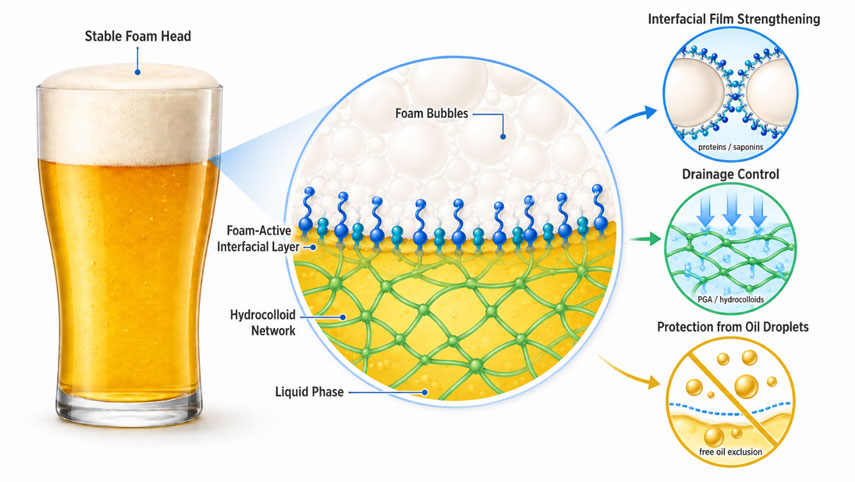
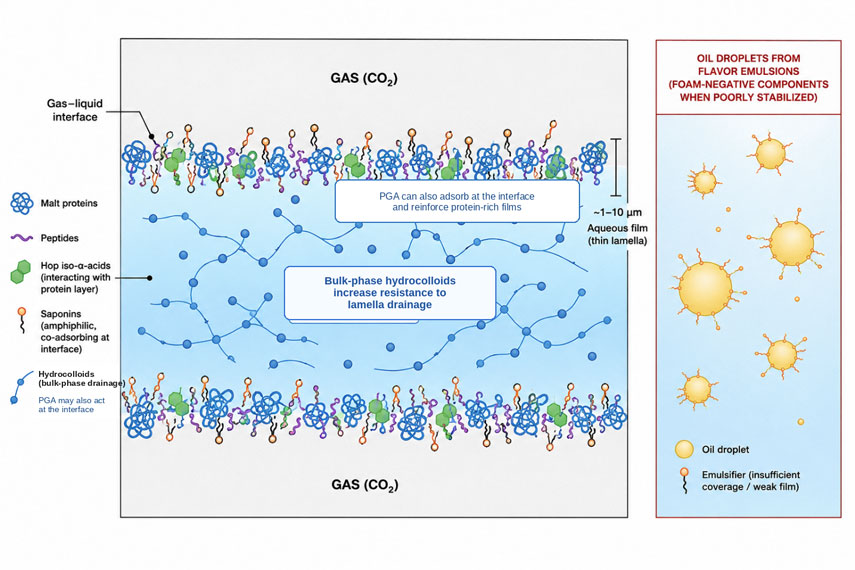
Foam stability in non-alcoholic malt beverages is governed by the physicochemical behavior of the gas–liquid interface, not by carbonation alone. Carbon dioxide creates bubbles. Persistent head retention also requires rapid adsorption of foam-active molecules, a cohesive viscoelastic film, controlled lamella drainage, and protection from free lipids, essential oils, poorly covered emulsion droplets, and process residues. Malt proteins and peptides form the primary interfacial film. Hop iso-α-acids may act as interfacial co-stabilizers. Saponins may support rapid foam generation. PGA and other hydrocolloids may act through interfacial support, bulk-phase drainage control, or both, depending on the matrix.
For beverage manufacturers, the objective is not maximum initial foam volume. The industrial target is a reproducible, fine-bubbled, persistent, and clean-tasting foam profile. It must remain compatible with the intended clarity or turbidity after pasteurization, storage, transport, and serving. Stabilizer selection should therefore start with diagnosis of the dominant failure mode. Weak foam generation, rapid liquid drainage, bubble coarsening, loss of foam after flavor addition, and shelf-life decline are different technical problems. They require different corrective strategies.
Foam Science, Failure Modes, and Terminology
Foamability and foam stability are related but distinct quality attributes. Foamability describes the ability of a beverage to generate foam during pouring or controlled aeration. Foam stability, or head retention, describes how well the formed foam resists drainage, coalescence, and disproportionation over time. Bubble texture refers to the fineness and uniformity of the bubble population, while lacing or cling describes the foam residue retained on the serving surface. A formulation can produce a high initial head yet collapse rapidly, or it can form a smaller head that remains stable for longer. These outcomes must be measured separately [1].
The physical sequence begins when dissolved CO₂ is released at nucleation sites and new gas–liquid area is created. Surface-active molecules must reach that interface quickly enough to lower the energetic cost of bubble formation and prevent neighboring bubbles from merging. The resulting foam then evolves through three principal destabilization routes: liquid drains from the lamellae and Plateau borders; interfacial films rupture and bubbles coalesce; and gas diffuses from smaller, higher-pressure bubbles into larger bubbles, causing disproportionation. Carbonation, temperature, glass cleanliness, pouring energy, and nucleation conditions strongly influence the observed foam and must be standardized before formulation effects are interpreted.
Direct research on flavored non-alcoholic malt beverages remains more limited than the literature on conventional beer. The evidence base therefore includes three levels: finished non-alcoholic malt beverages, beer matrices, and purified protein or emulsion model systems. Results from beer and model systems are mechanistically valuable, but they should be treated as formulation hypotheses that require confirmation in the finished non-alcoholic product. This distinction is particularly important for sweet, fruit-flavored, low-bitterness products whose sugar profile, pH, thermal treatment, and flavor-oil load differ substantially from conventional beer.
Interfacial Foam Science: Protein Fractions and Hop-Derived Components
Malt proteins and peptides form the natural structural basis of foam in malt-derived beverages. Their amphiphilic character enables adsorption at the gas–liquid interface, where partial molecular rearrangement produces a viscoelastic film around each bubble. Protein Z and lipid transfer protein 1 (LTP1) are frequently associated with foam-positive behavior. However, total protein concentration is not a sufficient predictor of performance. Protein identity, molecular-size distribution, exposed hydrophobicity, glycation state, lipid binding, aggregation, and compatibility with the surrounding colloidal matrix all influence adsorption kinetics and interfacial film strength. In beer and protein-model systems, selected hydrophobic fractions and sufficiently flexible polypeptides may adsorb more rapidly and form more elastic films. The response depends on protein concentration, pH, ionic strength, and the bubble-generation method. Non-surface-active, highly aggregated, or precipitated protein may increase haze without improving foam [2,3]. This distinction is operationally important when a beverage is produced from malt extract or processed wort. Clarification, filtration, concentration, enzymatic treatment, and thermal processing can change the distribution and functionality of foam-active fractions. Heat can expose surface-active regions, but it can also promote aggregation, precipitation, or loss of lipid-binding function. Published thresholds are matrix-dependent. No universal time-temperature window can be recommended. Validation must use the actual SKU pasteurization or thermal equivalent and include foam, haze, sediment, aroma loss, and cooked-flavor checks.
Hop iso-α-acids are best known for bitterness, but they can also contribute to foam stabilization at the gas–liquid interface. In a controlled beer-like system, iso-α-acids interacted non-covalently with Protein Z, altered its conformation, and were associated with improved interfacial adsorption, finer bubbles, and longer foam persistence [4]. Because these findings were obtained in a single model system, they should not be interpreted as proof of a universal causal pathway or as a basis for a fixed industrial dose. Performance depends on the availability of foam-active proteins, iso-α-acid type and concentration, pH, ionic strength, matrix composition, and sensory target. This is particularly important in sweet or fruit-flavored non-alcoholic malt beverages, where bitterness tolerance is often much lower than in beer-like products.
| Functional class | Primary role in foam | Typical examples | Best-fit application and critical controls |
| Primary interfacial film formers | Create the main viscoelastic film at the gas–liquid interface. | Malt proteins and peptides, including foam-active Protein Z and LTP1 fractions; standardized saponins when direct film formation is shown. | Use when interfacial film formation is weak. Control protein functionality, haze, sediment, heat stability, sensory effects, and batch variation. |
| Interfacial co-stabilizers | Reinforce an existing protein- or surfactant-rich film. | Hop iso-α-acids; PGA where direct interfacial interaction is demonstrated. | Use only with a compatible primary film former. Control bitterness, pH, ionic strength, protein availability, and package or light exposure. |
| Bulk-phase drainage modifiers | Slow lamella drainage without necessarily strengthening the interface. | PGA, pectin, selected gums, and β-glucan-rich fractions. | Use when foam forms adequately but drains quickly. Control viscosity, mouthfeel, filtration, gelation, carbonation perception, and flavor release. |
| Indirect emulsion protectants | Limit free oil and droplet migration that can disrupt foam. | Gum arabic, modified starch, optimized beverage emulsions, and lower-free-oil flavor systems. | Use in flavored products. Confirm droplet-size distribution, free oil, creaming, turbidity, flavor release, and direct foam retention. |
| Foam-negative control | Prevent interfacial competition and film weakening. | Free lipids, selected surfactants, process antifoams, lubricants, detergent or rinse-aid residues, and CIP carryover. | Audit raw materials, flavor systems, processing aids, transfer equipment, filling lines, and serving surfaces. |
Saponins as Rapidly Adsorbing Foam-Active Ingredients
Saponins are plant-derived glycosides with hydrophilic sugar groups and a hydrophobic aglycone. This amphiphilic structure enables rapid adsorption at the gas–liquid interface. As a result, saponins can improve foam generation when malt proteins adsorb too slowly to stabilize newly formed bubbles.
Available malt-beverage data support this function. Purified sugar beet root saponin used at 0.02 g/L improved foam performance in both classical and lemon-flavored malt beverages and was evaluated against 0.1 g/L PGA [5]. High-saponin Acanthophyllum laxiusculum root extract has also shown strong foaming and emulsifying functionality in malt-beverage applications [6].
These findings confirm the potential of saponins as rapidly acting foam-active ingredients. However, the reported concentrations are formulation-specific and should not be treated as universal industrial use levels. Industrial application requires careful dose control. The optimum level is the lowest concentration that achieves the target foam profile without causing bitterness, astringency, herbal or soap-like notes, color change, or excessive haze. Performance should be confirmed under the intended pH, carbonation, temperature, flavor, and processing conditions. Extract composition is equally important. A crude botanical extract may contain phenolics, pigments, minerals, and aroma compounds that are absent from a purified saponin preparation. Raw-material specifications should therefore cover active-saponin content, extract purity, sensory profile, color, turbidity contribution, microbiological quality, batch consistency, and regulatory status.
PGA and Hydrocolloids: Interfacial Support and Drainage Control
The evidence in this section is mainly beer-derived. Propylene glycol alginate (PGA) is widely associated with foam stabilization in beer-like systems, but its mechanism should not be reduced to bulk viscosity alone. Its partially esterified structure gives it greater hydrophobic character than unmodified alginate. Depending on grade, degree of esterification, pH, protein composition, and ionic conditions, PGA may adsorb at the interface, interact with protein-rich films, and increase resistance to liquid drainage. Beer studies show that foam response depends on chemical structure and degree of esterification, not viscosity alone. Confirm interfacial action with dynamic surface tension or interfacial rheology. Confirm bulk-phase action with viscosity and drainage measurements. Report foam retention and bubble-size evolution separately.
Other hydrocolloids may act predominantly through the continuous phase. Pectin, selected gums, and β-glucan-rich fractions can increase resistance to drainage and improve body, but they cannot fully compensate for a weak or oil-contaminated interface. Excessive use can produce gummy mouthfeel, muted carbonation, haze, filtration difficulty, gelation, or reduced refreshment. A formulation should therefore distinguish between an ingredient that strengthens the bubble film and one that mainly slows liquid flow through the lamella. Higher viscosity is not a direct proxy for foam quality. It may slow drainage but can suppress foam rise, reduce clarity, mute carbonation, and delay flavor release. Measure bubble-size evolution and interfacial film elasticity alongside bulk rheology [7,8]. PGA and hydrocolloids should therefore be evaluated in the complete beverage matrix under the intended processing conditions.
Flavor Emulsions and Foam-Negative Oil Phases
Flavored non-alcoholic malt beverages introduce a major additional variable: hydrophobic flavor components. Citrus oils, spice extracts, herbal fractions, and other oil-based flavor components can compete with proteins and surfactants at the gas–liquid interface. Free oil or poorly protected droplets can enter the lamella, weaken the viscoelastic film, promote coalescence, and accelerate collapse. Lipids are therefore not only a flavor-delivery issue; they are a critical foam-control variable. Foam-negative materials also include certain emulsifiers and surfactants, process antifoams, food-grade lubricants, detergent or rinse-aid residues, and carryover from cleaning-in-place systems; these materials can compete at the interface or reduce film elasticity even when total lipid analysis is low [9].
Flavor-emulsion stabilizers such as gum arabic and modified starch do not necessarily improve malt-beverage foam directly. Their main role is to reduce free oil, limit droplet migration, and maintain stable interfacial coverage around the dispersed flavor phase. In concentrated lemon-beverage emulsions, these stabilizers have been shown to influence oil release, droplet behavior, viscosity, and storage stability [10]. These effects can reduce the availability and mobility of hydrophobic compounds that may interfere with foam. However, emulsion stability alone does not confirm improved head retention. Gum arabic and modified starch should therefore be classified as flavor-emulsion stabilizers unless a direct foam benefit is demonstrated. Droplet-size distribution and storage stability are useful diagnostic indicators, but foam performance must be measured directly before and after flavor addition.
When foam declines only after flavor addition, increasing the dose of PGA or saponin may treat the symptom rather than the cause. The first development route should be to evaluate total oil load, free or unbound oil, droplet-size distribution, emulsifier coverage, homogenization conditions, carrier system, creaming, oil-ring formation, and flavor-release requirements. Reducing oil load, changing the flavor carrier, improving droplet protection, or selecting a more foam-compatible flavor system may be more effective than adding additional foam stabilizer. No single ingredient should be credited with simultaneously solving foam formation, persistence, drainage control, mouthfeel, and visual appearance unless each functionality has been measured independently.
Process and Matrix Conditions That Affect Foam Stabilizer Performance
Foam stabilizers do not perform independently of the beverage matrix or processing conditions. Carbonation controls bubble formation, but it does not guarantee long-term foam stability. Temperature also affects CO₂ release, liquid drainage, viscosity, and bubble lifetime. Comparative tests should therefore use consistent carbonation, temperature, conditioning, and pouring conditions [1,11].
Mixing, homogenization, and thermal processing can alter stabilizer performance. Appropriate processing improves the dispersion of hydrocolloids, saponins, and flavor emulsions. Excessive shear or heat, however, may damage protein functionality, destabilize emulsions, promote aggregation, or reduce aroma quality. Foam performance should therefore be evaluated after the actual production and pasteurization conditions.
The final beverage composition is equally important. pH, salts, sugars, preservatives, flavors, and protein content can change the solubility, conformation, and interfacial behavior of stabilizers. Ingredient screening should therefore be conducted in the complete beverage matrix rather than in water alone.
Mechanism-Based Formulation Strategy
Stabilizer selection should begin by identifying the main cause of foam failure. The base beverage should be compared before and after flavor addition, thermal processing, and storage. Carbonation, sample temperature, conditioning time, fill volume, glass geometry, cleanliness, pouring conditions, and time zero should remain consistent. Otherwise, differences in test conditions may obscure the true formulation effect.
Each candidate should also have one clearly defined primary function. This may be foam formation, foam persistence, drainage control, flavor-emulsion protection, mouthfeel modification, or visual improvement. Additional functional claims should be made only when they are supported by separate measurements.
| Observed problem | Likely technical interpretation | Preferred development route |
| Weak initial foam | Low carbonation, poor nucleation, non-standard pouring, or insufficient rapidly adsorbing surface-active material. | First standardize CO₂, temperature, glass, and dispensing conditions; then screen saponins, foam-active protein fractions, or compatible protein–hop systems. |
| Good initial foam but rapid collapse | Fast lamella drainage, weak film elasticity, or film rupture. | Evaluate PGA or compatible hydrocolloids, then confirm that the protein-rich interface is sufficiently strong. |
| Coarse or uneven bubbles | Coalescence, weak interfacial elasticity, or disproportionation. | Track bubble-size evolution; strengthen the protein–hop system, evaluate saponins, and investigate oil contamination. |
| Foam drops after flavor addition | Foam-negative flavor oil, free oil, or poor emulsion design. | Redesign the flavor emulsion and reduce free oil before increasing stabilizer dose. |
| Foam improves but haze or sediment increases | Colloidal incompatibility, aggregation, or excessive biopolymer concentration. | Adjust stabilizer type, dose, pH, order of addition, hydration, and processing sequence. |
| Foam improves but taste declines | Bitterness, astringency, herbal notes, soap-like perception, or heavy mouthfeel. | Reduce dose, change source or grade, blend complementary stabilizers, or revise product positioning. |
| Foam declines during shelf life | CO₂ loss, colloidal shift, emulsion instability, protein aggregation, or thermal/package effects. | Validate under real-time and accelerated storage, pasteurization, transport simulation, and final packaging conditions. |
| Foam varies strongly with test temperature | Temperature-dependent CO₂ release, viscosity, drainage, and diffusion. | Condition all samples at a defined temperature, then verify performance across the intended serving range. |
Essential Validation Measures
Foam formation and foam retention should be evaluated separately because a high initial foam volume does not necessarily indicate long-term stability. Core measurements should include initial foam height or volume, retention time, foam half-life, collapse rate, drainage, bubble-size distribution, bubble coarsening, and lacing. Foam half-life should be defined as the time required for foam height or volume to decrease to 50% of its value at a specified time zero. It should not be used interchangeably with total retention time or collapse rate.
Comparative tests require consistent dissolved CO₂, sample temperature, conditioning time, fill volume, glass geometry, cleanliness, pouring protocol, observation interval, and replicate number. Ross–Miles and cylinder-shake methods can support comparative ingredient screening, whereas NIBEM-type methods are more suitable for standardized head-retention assessment in carbonated beverages. Results obtained using different methods should not be compared directly, and acceptance limits should be defined for the specific SKU and test method [11].
Promising formulations should be reassessed after flavor addition and under the intended mixing, homogenization, carbonation, and pasteurization conditions. Final candidates should also be evaluated under real-time and accelerated shelf-life conditions in the intended commercial package.
Supporting measurements should include dissolved CO₂, viscosity, turbidity, sedimentation, emulsion integrity, and sensory quality. Acceptance criteria should be defined before testing and should require a meaningful foam improvement without unacceptable haze, sediment, oil-ring formation, excessive viscosity, aroma suppression, bitterness, astringency, soap-like notes, or persistent aftertaste. The final formulation should balance foam performance with physical stability, process compatibility, sensory acceptance, and regulatory compliance.
Conclusion
Foam-supporting ingredients in non-alcoholic malt beverages act through distinct mechanisms. Malt proteins and peptides create the primary viscoelastic film. Hop iso-α-acids may reinforce compatible protein-rich interfaces through specific non-covalent interactions. Saponins can provide rapid surface activity and stronger initial foam generation. PGA may support the interface or slow drainage, depending on grade and matrix. Other hydrocolloids mainly modify continuous-phase rheology. Flavor-emulsion stabilizers act indirectly by limiting free oil and mobile hydrophobic phases.
The most reliable industrial strategy is therefore mechanism-based rather than ingredient-led. Diagnose the failure mode, correct process and test variability first, select the stabilizer system that addresses the actual cause, and validate it in the complete beverage through thermal processing, packaging, distribution, and shelf life. This approach can support evaluation of a persistent, fine-bubbled, visually consistent, and clean-tasting foam profile, provided that performance is confirmed experimentally in the finished product.
References and Further Reading
[1] Gonzalez Viejo, C.; Torrico, D. D.; Dunshea, F. R.; Fuentes, S. Bubbles, foam formation, stability and consumer perception of carbonated drinks: A review of current, new and emerging technologies for rapid assessment and control. Foods. 2019;8(12):596. DOI: 10.3390/foods8120596.
[2] Li, X.; Jiang, K.; Jin, Y.; Liu, J. Comparative study on protein composition and foam characteristics of barley and wheat beer. Foods. 2024;13(21):3400. DOI: 10.3390/foods13213400.
[3] Jaeger, A.; Zannini, E.; Sahin, A. W.; Arendt, E. K. Barley protein properties, extraction and applications, with a focus on brewers’ spent grain protein. Foods. 2021;10(6):1389. DOI: 10.3390/foods10061389.
[4] Chen, C.; Lv, C. Interaction between iso-α-acid extracted from hops and Protein Z improves beer foam quality and stability. Chemistry. 2025;7(2):65. DOI: 10.3390/chemistry7020065.
[5] Motlagh, A. H.; Nasirpour, A.; Saeidy, S.; Keramat, J. Physicochemical and sensory properties of malt beverage containing sugar beet saponins. Journal of Food Science and Technology. 2022;59:4380–4389. DOI: 10.1007/s13197-022-05517-x.
[6] Aryan, S.; Mortazavian, A. M.; Mohammadi, F.; Mahdavi, V.; Moazami, N.; Jazaeri, S. Physicochemical properties of saponin-containing Acanthophyllum laxiusculum extract: Example application in foam stability and qualitative parameters for malt beverage industry. Journal of Food Science and Technology. 2022;59:1577–1587. DOI: 10.1007/s13197-021-05169-3.
[7] Schmidt, F. L.; Sebastian, A.; Tamayo, R.; de Brito, A. D. C. Hydrocolloids as beers foam stabilizer. African Journal of Food Science. 2020;14(5):143–153. DOI: 10.5897/AJFS2020.1922.
[8] Pournaki, S. K.; Aleman, R. S.; Hasani-Azhdari, M.; Marcia, J.; Yadav, A.; Moncada, M. Current review: Alginate in the food applications. J. 2024;7(3):281–301. DOI: 10.3390/j7030016.
[9] Gordon, R.; Power, A.; Chapman, J.; Cozzolino, D.; Chandra, S. A review on the source of lipids and their interactions during beer fermentation that affect beer quality. Fermentation. 2018;4(4):89. DOI: 10.3390/fermentation4040089.
[10] Almeida, T. C. A.; Larentis, A. L.; Ferraz, H. C. Evaluation of the stability of concentrated emulsions for lemon beverages using sequential experimental designs. PLOS ONE. 2015;10(3):e0118690. DOI: 10.1371/journal.pone.0118690.
[11] MEBAK. Method Database: Foam Stability, NIBEM (B-420.08.041); Ross and Clark (B-420.09.100); Lg-Foamtester (B-420.10.100); Steinfurth Foam Stability Tester (B-420.11.100); and Foam Cling Capacity, NIBEM Cling Meter (B-420.12.820). Accessed 11 July 2026. Official method database.