
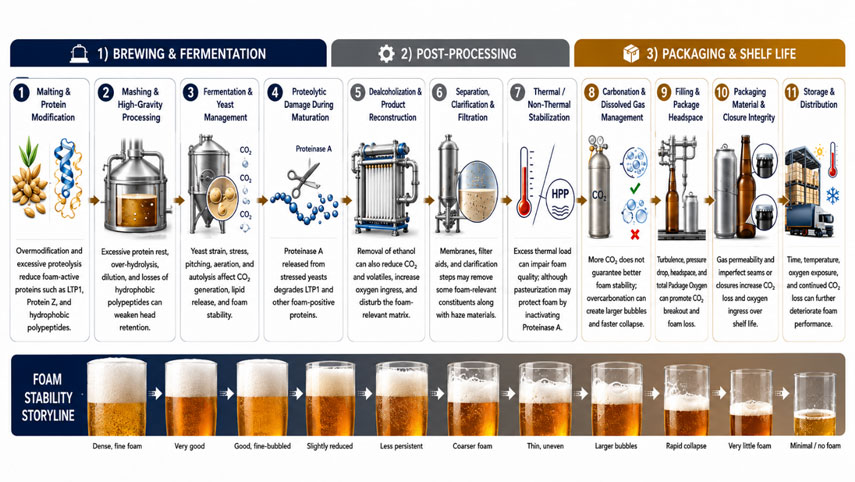
Process Variables That Destroy Foam Before the Product Reaches the Consumer
Foam stability is an important quality attribute of beer and malt beverages, particularly non-alcoholic products. It results from interactions among foam-active proteins and polypeptides, including LTP1, Protein Z, and hordein-derived fragments, as well as iso-alpha-acids, polysaccharides, CO₂, and other components of the beverage matrix. The degree of protein modification during malting, mashing conditions, High-Gravity Brewing, fermentation, and yeast management must be carefully controlled to maintain adequate extractability while preventing excessive degradation of foam-active compounds. Yeast autolysis and the release of Proteinase A can also reduce foam stability during maturation and storage by degrading LTP1 and other foam-positive proteins.
Dealcoholization, filtration, stabilization, carbonation, filling, and packaging also affect foam performance by altering CO₂ concentration, dissolved oxygen, volatile compounds, and surface-active components. Increasing CO₂ does not necessarily improve foam stability, while inadequate packaging and storage conditions may accelerate carbonation loss, oxygen ingress, and deterioration of foam quality. Therefore, maintaining foam stability requires integrated control of the entire production chain and simultaneous monitoring of parameters such as LTP1, Protein Z, hydrophobic polypeptides, Proteinase A activity, dissolved CO₂, Total Package Oxygen, and direct foam measurements using NIBEM or Rudin methods.
1. Malting and Degree of Protein Modification
Malting determines how much, and which types, of grain proteins and polypeptides are transferred into the wort and subsequently into the finished product. Protein modification is essential for improving extractability and ensuring adequate mashing performance; however, overmodification can reduce foam-positive fractions—including Protein Z, lipid transfer protein 1 (LTP1), hordein fragments, and hydrophobic polypeptides—or alter their molecular-weight distribution. A high degree of modification is often associated with poorer foam quality, although the relationship is not linear. Excessively restricting modification is also unsuitable because it reduces extractability and creates processing problems.
Beer foam is not the result of a single protein. Rather, it depends on interactions different foam-active components, including proteins, polypeptides, polysaccharides, and iso-alpha-acids. These interactions should be carefully considered, as the combined effects of these components can influence overall foam formation and stability. These compounds adsorb at the gas–liquid interface and form a film that limits film thinning, rupture, and bubble coalescence. Excessive proteolysis during germination can degrade polypeptides whose molecular weight and hydrophobicity are suitable for formation of this interfacial film. Although LTP1 contributes to foam formation, it cannot ensure foam stability on its own; its performance depends on the presence of Protein Z, hordein fragments, iso-alpha-acids, and other components of the beverage matrix [1].
The effect of malt modification should be evaluated using a suite of indicators, including the Kolbach Index, total and soluble protein, Protein Z4 and LTP1 concentrations, polypeptide molecular-weight distribution and hydrophobicity, viscosity, and a direct head-retention test such as the Rudin method. The Kolbach Index is only a general indicator of the extent of protein modification and cannot, by itself, predict foam quality. In practice, the target modification range should preserve extractability and mashing performance without causing an undesirable depletion of foam-positive proteins and polypeptides.
2. Mashing and High-Gravity Processing
Mashing determines how much of the malt proteins, peptides, and polysaccharides are extracted or hydrolyzed. Insufficient proteolysis can restrict the transfer of nitrogenous compounds that support foam, whereas a prolonged or intensive protein rest may convert surface-active polypeptides into smaller fragments with less capacity to form and stabilize the film surrounding bubbles. The effect of mashing on foam depends on malt composition, the degree of malt modification, the water-to-grist ratio, and the complete time–temperature profile. Consequently, no single temperature or temperature range can be defined as a universal optimum for preserving foam [1].
In high-gravity brewing, increasing original gravity and diluting the product after fermentation can reduce the final concentration of foam-active compounds, but loss of foam stability is not solely a consequence of dilution. Recovery of hydrophobic polypeptides from wort may decrease, or some of these compounds may be lost during boiling, fermentation, and separation. Greater osmotic and ethanol stress also alters yeast performance and may increase the release of undesirable compounds or change the fate of foam-promoting proteins. Under some conditions, high-gravity production has been associated with a disproportionate reduction in hydrophobic polypeptides and poorer head retention [2].
This stage should be evaluated by measuring hydrophobic polypeptides at multiple process points—from the kettle outlet and the start of fermentation through the end of fermentation, filtration, and final dilution. Tests such as the Rudin head-retention value (HRV) or NIBEM should be interpreted alongside these measurements. High-gravity brewing does not inherently cause foam failure; however, original gravity, yeast physiological status, raw-material composition, fermentation intensity, and the dilution ratio and timing must be controlled as an integrated system. Measuring foam only in the finished product does not identify where the actual loss of active compounds occurred.
3. Fermentation and Yeast Management
Fermentation conditions affect carbon dioxide (CO₂) production, pH, metabolite composition, and the status of foam-relevant proteins. In non-alcoholic malt beverages, yeast strain, pitching rate, and aeration regime are major determinants of foam formation because they directly alter CO₂ production and the composition of fermentation metabolites.
The effect of yeast on foam is not limited to CO₂ production. Yeast strain, osmotic and ethanol stress, oxygen or nutrient limitation, fermentation temperature, and the duration of product contact with biomass influence the likelihood of cell damage and autolysis. Autolysis can release intracellular lipids and enzymes such as Proteinase A into the product. Free lipids are potent foam inhibitors that destabilize foam structures by displacing foam-active proteins and polypeptides from the air-liquid interface. However, the overall impact of lipids is system-dependent; when properly emulsified within the beverage matrix, their disruptive potential is significantly minimized, and in specific formulations, they may even contribute to the stability of the foam matrix. Therefore, two products with similar CO₂ concentrations may have different foam stability [3].
Control at this stage should include CO₂ concentration, pH, yeast cell count and viability, the rate of viability loss, Proteinase A activity, foam-active polypeptide concentration, and a direct foam test. In addition to fermentation capacity and CO₂ production, strain selection should consider stress tolerance, susceptibility to autolysis, and the pattern of intracellular-compound release.
4. Proteolytic Damage During Maturation and Storage
Proteinase A is a vacuolar yeast protease that enters the product as a result of severe stress, autolysis, or cell damage. By hydrolyzing surface-active hydrophobic proteins and polypeptides, the enzyme reduces the strength of the bubble interfacial film and impairs head retention. Hydrolysis products derived from surface-active proteins, particularly smaller polypeptides with unfavorable interfacial denaturation kinetics, can further destabilize foam by accelerating film drainage and rupture. Proteinase A is not itself an independent process variable; rather, it is an outcome of yeast management, the severity of fermentation stress, product residence time on the biomass, the timing of yeast removal, and stabilization and storage conditions.
Proteinase A activity during storage can markedly reduce foam stability. By degrading LTP1 and other foam-positive proteins, the enzyme weakens the structure of the bubble interfacial film. Pasteurization can limit this process by inactivating the enzyme; otherwise, proteolytic degradation may continue after fermentation has ended [4].
Control of this damage depends on using healthy yeast, limiting product residence time on yeast, removing biomass promptly, and minimizing conditions that promote autolysis. Proteinase A activity, LTP1 concentration, total protein, the SDS-PAGE profile, and NIBEM are suitable indicators for monitoring this process. Pasteurization can prevent degradation of foam-relevant proteins during storage by inactivating Proteinase A. Nevertheless, an excessive thermal load may impair sensory quality and foam performance through other pathways; process time and temperature should therefore be set only as high as required to stabilize the product.
5. Dealcoholization and Product Reconstruction
Dealcoholization does not remove ethanol alone; it can simultaneously alter CO₂, volatile compounds, dissolved oxygen, and the balance of foam-relevant components. In osmotic distillation, ethanol is transferred through a hydrophobic microporous membrane according to a vapor-pressure difference. Low temperature and pressure limit thermal load, but separation is not fully selective, and the final outcome depends on membrane properties, transfer flux, contact time, and operating conditions. Thermal, vacuum, and membrane processes also differ in the extent to which dissolved gases and volatile compounds are lost. The effect of dealcoholization on foam should therefore be assessed in terms of changes in the entire product matrix, rather than ethanol reduction alone.
In addition to removing ethanol, osmotic distillation can reduce CO₂ and increase oxygen ingress, both of which can impair foam formation and head retention. The reduction in foam performance at this stage is not caused only by the lower ethanol concentration; changes in dissolved gases, volatile compounds, and surface-active constituents also contribute. Accordingly, after dealcoholization the product requires recarbonation, controlled blending, and, when necessary, formulation adjustment [5].
Foam performance in non-alcoholic products cannot be attributed solely to the dealcoholization technology because raw materials, formulation, process severity, and post-separation operations vary among products. A valid assessment should simultaneously consider CO₂, dissolved oxygen, NIBEM, turbidity, bitterness, total nitrogen, polyphenols, and volatile compounds. Dealcoholization and product reconstruction should be treated as one integrated operation because final foam quality depends on separation severity, the magnitude of CO₂ loss, oxygen ingress, and the accuracy of final standardization [6].
6. Separation, Clarification, and Filtration
Filtration is required to remove yeast, microorganisms, suspended solids, and haze precursors, but separation is not completely selective. Some constituents that contribute to foam, aroma, color, and extract may adsorb to the membrane surface, filter cake, or filter aids, or may remain in the retentate. The extent of these losses depends on membrane type, pore size, transmembrane pressure, crossflow velocity, temperature, operating time, and the number of filtration stages. Filtration is therefore not inherently destructive to foam; the outcome is determined by process severity and selectivity.
Reducing pore size improves clarity but can also intensify removal of matrix constituents. A smaller membrane pore size can increase product clarity while simultaneously removing part of the extract and constituents that contribute to viscosity and foam stability. Membranes with larger pores provide higher flux and less quality loss, but offer more limited haze control. Membrane selection should therefore balance clarity, filtration capacity, and preservation of foam half-life. Without direct analysis of proteins and surface-active complexes, however, a decline in foam cannot be attributed to removal of a specific compound [7].
The process objective should not be the lowest possible turbidity at any cost. Turbidity, permeate flux, viscosity, extract, protein, phenolic compounds, beta-glucan, and foam half-life or NIBEM should be monitored simultaneously in both permeate and retentate. Bentonite, silica gel, and polyvinylpolypyrrolidone (PVPP) do not have identical selectivity and may remove some surface-active constituents in addition to their target compounds. Nevertheless, assigning a universal dose or attributing foam loss to a specific adsorbent is not defensible without product-matrix-specific testing.
7. Thermal and Non-Thermal Stabilization
Heat load can either improve or impair foam stability depending on its intensity and duration. Controlled unfolding of LTP1 during wort boiling can increase its hydrophobicity and interfacial activity, thereby promoting foam formation; thermal denaturation is therefore not necessarily destructive [1]. In contrast, a more severe heat load can dissociate the lipid adduct of LTP1b, increase deamidation and hydrophobicity, and induce undesirable chemical changes such as deglycation. Under defined conditions, these modifications have been associated with poorer foam quality, showing that the net effect of heat depends on the initial form of LTP1 and the type of chemical modification produced [8].
Pasteurization can prevent continued degradation of LTP1 and other foam-active proteins during storage by inactivating Proteinase A. Better retention of NIBEM values in pasteurized samples supports this protective effect. However, increasing the time–temperature load beyond what is required can accelerate aging reactions, color change, and colloidal instability [2, 4].
High-pressure processing (HPP) at 600 MPa for 3 minutes can reduce the microbial load of non-alcoholic beers without necessarily causing a detectable change in many physicochemical and sensory properties. This result alone, however, is not direct evidence of foam preservation unless foam is measured independently [9]. Selection between pasteurization and HPP should be based on microbial control, Proteinase A activity, foam stability, color, aging, package compatibility, and cost. For thermal processing, the determining variable is the actual time–temperature load and the number of Pasteurization Units (PU), not merely whether pasteurization is used.
8. Carbonation and Dissolved-Gas Management
CO₂ is essential for bubble formation during dispensing, but increasing its concentration does not necessarily improve foam stability. A higher CO₂ content usually increases the initial foam volume and height and therefore improves foamability; however, faster gas release and the formation of larger bubbles can accelerate coalescence, disproportionation, and bubble collapse. Rapid depressurization, such as upon opening a container, can cause sudden CO₂ release and rapid expansion of gas within the bubbles. This rapid expansion may promote bubble growth and destabilization of the interfacial films, increasing their susceptibility to rupture and accelerating foam collapse. Consequently, a product with a larger initial foam volume may still exhibit lower foam stability or shorter head retention.
Increasing CO₂ can raise the initial foam volume without necessarily improving head retention. Overcarbonation generally produces larger bubbles and more rapid gas release, thereby increasing the rate of foam collapse. CO₂ content should therefore be optimized specifically for each product and package in conjunction with fill volume and pasteurization conditions, rather than being based on a single universal target [10].
The CO₂ target should be established according to product style, package type, and serving method. Dissolved CO₂ concentration, package pressure, initial foam volume, bubble-size distribution, and the rate of foam collapse should be assessed together. Measuring CO₂ only in the final tank is insufficient; gas losses between the tank, carbonator outlet, filler, and final package should also be monitored. Product temperature, carbonation pressure, contact time, and equilibration time can influence CO₂ absorption and retention, but the independent effect of each factor on head retention must be established under the actual conditions of each production line.
9. Filling and Package Headspace
Fill volume and package headspace should be adjusted together because both affect CO₂ retention, internal pressure, and foam stability. Reducing headspace can improve gas retention and foam performance, but an excessively small headspace increases package pressure during heating and reduces the safety margin of the container. Fill volume should therefore be optimized according to package type, CO₂ content, and pasteurization conditions [10].
Higher CO₂ content, smaller headspace, and in-package pasteurization can interact to increase internal pressure and the risk of bulging or mechanical package damage. Mechanical stresses (agitation, pouring) induce shear, increasing bubble collision and film thinning, leading to collapse. Moderate stress is often needed initially for foam creation. Total package oxygen (TPO) and headspace air are also important process-control indicators, although a quantitative, independent relationship with loss of foam stability cannot be defined without product-specific testing [11].
Fill volume, headspace, CO₂, and package pressure should be optimized as a single system. Industrial control should include measurement of actual fill volume, CO₂ before and after the filler, package pressure, TPO, and headspace air. Comparing foam results at the tank outlet and in the final package can determine whether performance was lost during filling or originated in an earlier process stage. Operating limits should be defined for the package type, nominal capacity, filling temperature, and pasteurization schedule of the specific line.
10. Packaging Material and Closure Integrity
Packaging material and closure quality directly affect CO₂ retention, oxygen ingress, and consequently foam stability throughout product shelf life. Aluminum cans and stainless-steel kegs generally provide more effective gas barriers and are associated with smaller changes in CO₂, turbidity, and sensory properties. In contrast, because polyethylene terephthalate (PET) is more permeable to gases, products in PET packaging are more susceptible during long-term storage to CO₂ loss, increased dissolved oxygen, and reduced foam stability.
These findings cannot be generalized to every PET package. Monolayer or multilayer construction, barrier coatings, wall thickness, surface-area-to-volume ratio, closure type, and storage duration can alter gas permeability and final performance. The defensible conclusion is that, under the packages and conditions evaluated, packaging material was associated with changes in CO₂ and foam stability over time—not that every PET package necessarily produces a product with poor foam [11, 12].
Permeability of the package body is not the only factor affecting CO₂ retention; can-seam integrity, crown-cork performance, and other closure systems must also be controlled. The closure must remain stable under internal pressure and pasteurization conditions without damage to the seal or internal liner. Visual integrity alone, however, does not guarantee CO₂ retention or foam stability. Leak testing, internal pressure, CO₂, dissolved oxygen, TPO, and foam performance should be evaluated for each package–closure combination throughout product shelf life [13].
11. Storage and Distribution
After packaging, product foam can still be affected by enzymatic activity, CO₂ loss, and changes in the product matrix. In unpasteurized products, residual Proteinase A can hydrolyze LTP1 and other foam-active proteins during storage. Lower storage temperature can slow the initial decline in foam, but does not necessarily stop proteolytic activity. The substantial decrease in NIBEM over 90 days in unpasteurized samples shows that temperature control is not a substitute for enzyme inactivation or appropriate yeast management [4]. Package type and distribution conditions determine the rate of change in CO₂, dissolved oxygen, and the physicochemical properties of the product. Changes recorded over six- and twelve-month periods demonstrate that foam testing only on the day of filling is insufficient for quality verification. A product with acceptable foam at market release may perform differently at the end of shelf life because of CO₂ loss, oxygen permeation, or changes in surface-active constituents [11, 12].
High temperature and oxygen accelerate flavor staling, color change, and haze formation, but their effect on foam is not always direct or independent. The sequence ‘more oxygen, more haze, and therefore inevitable foam loss’ is not supported by evidence as directly as the pathway involving degradation of LTP1 by Proteinase A and should be interpreted as a matrix-dependent risk [2]. A stability program should monitor NIBEM or foam half-life, CO₂, dissolved oxygen, TPO, temperature, and temperature fluctuations at several points over product shelf life—not only at batch release.
| Process Stage | Critical Variables | Foam-Loss Pathway | Recommended Monitoring Parameters |
| Fermentation | Yeast strain, pitching rate, yeast-contact time | Proteolysis and changes in CO₂ | Proteinase A activity, CO₂, NIBEM |
| Dealcoholization | Temperature, vacuum level, membrane type | CO₂ loss and compositional changes | CO₂, protein content, foam half-life |
| Filtration | Pore size and operating pressure | Removal of foam-active compounds | Turbidity, hydrophobic proteins, NIBEM |
| Pasteurization | Time-temperature profile and pasteurization units (PU) | Structural modification of proteins | PU, LTP1, head retention |
| Carbonation | Pressure, temperature, and equilibration time | Insufficient foam or coarse, unstable foam | CO₂, bubble size |
| Filling | Pressure drop, turbulence, and total packaged oxygen (TPO) | CO₂ loss and oxidation | Packaged CO₂, TPO |
| Packaging | Gas permeability and closure integrity | CO₂ loss and O₂ ingress | Package pressure, CO₂, O₂ |
| Storage | Storage time and temperature | Increased proteolysis and oxidation | NIBEM throughout product shelf life |
Conclusion
Foam stability in beverages is a complex phenomenon driven by the synergistic interaction of various factors throughout the production chain. Specifically, foam destabilization is governed by chemical (e.g., pH fluctuations and protein hydrophobicity), physical (e.g., shear stress and temperature gradients), and environmental variables. For instance, a localized drop in pH can trigger protein denaturation, thereby accelerating the rate of foam collapse. Preserving foam-active proteins and polypeptides, such as LTP1 and Protein Z, requires appropriate control of malting, mashing, fermentation, and yeast management, because excessive proteolysis, yeast autolysis, and the release of Proteinase A can degrade these compounds. Dealcoholization, filtration, stabilization, carbonation, and filling must also be performed under conditions that minimize CO₂ loss, oxygen ingress, and the removal of foam-positive components.
Packaging material, closure integrity, and storage conditions further influence CO₂ retention and foam performance throughout the product’s shelf life. Consequently, optimizing foam quality requires integrated process control and the simultaneous monitoring of parameters such as NIBEM or Rudin foam stability, dissolved CO₂, Total Package Oxygen, Proteinase A activity, and the concentration of foam-active proteins at different stages of production and storage.
References and Further Reading
[1] Evans, D. E., & Sheehan, M. C. (2002). Don’t be fobbed off: The substance of beer foam—A review. Journal of the American Society of Brewing Chemists, 60(2), 47–57. https://doi.org/10.1094/ASBCJ-60-0047
[2] Stewart, G. G. (2004). The chemistry of beer instability. Journal of Chemical Education, 81(7), 963–968. https://doi.org/10.1021/ed081p963
[3] Sohrabvandi, S., Malganji, S. H., Razavi, S. H., & Mousavi, S. M. (2014). The effect of Saccharomyces strains and fermentation condition on the pH, foam property and CO₂ concentration of non-alcoholic beer (Ma-al-shaeer). Applied Food Biotechnology, 2(1), 53–57. https://doi.org/10.22037/afb.v2i1.7130
[4] He, G.-Q., Wang, Z.-Y., & Liu, Z.-S. (2006). Relationship of proteinase activity, foam proteins, and head retention in unpasteurized beer. Journal of the American Society of Brewing Chemists, 64(1), 33–38. https://doi.org/10.1094/ASBCJ-64-0033
[5] Liguori, L., De Francesco, G., Russo, P., Perretti, G., Albanese, D., & Di Matteo, M. (2015). Production and characterization of alcohol-free beer by membrane process. Food and Bioproducts Processing, 94, 158–168. https://doi.org/10.1016/j.fbp.2015.03.003
[6] Rettberg, N., Lafontaine, S., Schubert, C., Dennenlöhr, J., Knoke, L., Diniz Fischer, P., Fuchs, J., & Thörner, S. (2022). Effect of production technique on Pilsner-style non-alcoholic beer (NAB) chemistry and flavor. Beverages, 8(1), Article 4. https://doi.org/10.3390/beverages8010004
[7] Cimini, A., & Moresi, M. (2016). Beer clarification by novel ceramic hollow-fiber membranes: Effect of pore size on product quality. Journal of Food Science, 81(10), E2521–E2528. https://doi.org/10.1111/1750-3841.13436
[8] Mizuguchi, J., Asaka, K., Konishi, M., Inui, T., Uchiyama, S., & Torisu, T. (2025). Heat-induced changes in the chemical structure, hydrophobicity, and size distribution of free/bound lipid transfer protein 1 and their effects on beer foam. Journal of Agricultural and Food Chemistry, 73(38), 24343–24353. https://doi.org/10.1021/acs.jafc.5c07895
[9] Queirós, R. P., González-Angulo, M., Polanco-Estibález, B., Serment-Moreno, V., & Tonello-Samson, C. (2024). Exploring the effects of high pressure processing on the quality of craft beer at an industrial scale. LWT, 194, Article 115824. https://doi.org/10.1016/j.lwt.2024.115824
[10] Thongon, R., Netramai, S., Kijchavengkul, T., Yaijam, G., & Debhakam, R. (2023). Mathematical modeling and optimization of pasteurization for the internal pressure and physical quality of canned beer. Heliyon, 9(11), e21493. https://doi.org/10.1016/j.heliyon.2023.e21493
[11] Gagula, G., Šarić, G., Rezić, T., Horvat, D., & Magdić, D. (2023). Changes in the physicochemical properties of pale lager beer during storage in different packaging materials. Journal of the American Society of Brewing Chemists, 81(2), 351–356. https://doi.org/10.1080/03610470.2022.2068318
[12] Lorencová, E., Salek, R. N., Černošková, I., & Buňka, F. (2019). Evaluation of force-carbonated Czech-type lager beer quality during storage in relation to the applied type of packaging. Food Control, 106, Article 106706. https://doi.org/10.1016/j.foodcont.2019.106706
[13] Domínguez, R., Notario, B., Jiménez, M., Espinosa, M. del M., Romero, L., & Domínguez, M. (2024). Increasing of craft beer shelf life, with and without alcohol, through immersion batch pasteurization. Exploration of Foods and Foodomics, 2, 43–66. https://doi.org/10.37349/eff.2024.00025