
Import Substitution Trends in Food & Beverage Ingredients Across MENA
MENA refers to the Middle East and North Africa, a region with high dependence on imported food and beverage ingredients. Many countries import enzymes, flavors, additives, and functional ingredients because domestic production remains limited.
Import substitution and localization are related concepts, but they are not identical. Import substitution uses policies such as tariffs, quotas, or import bans to reduce foreign purchases. Localization describes a broader increase in domestic production. It may occur through investment, industrial development, or market growth without trade restrictions.
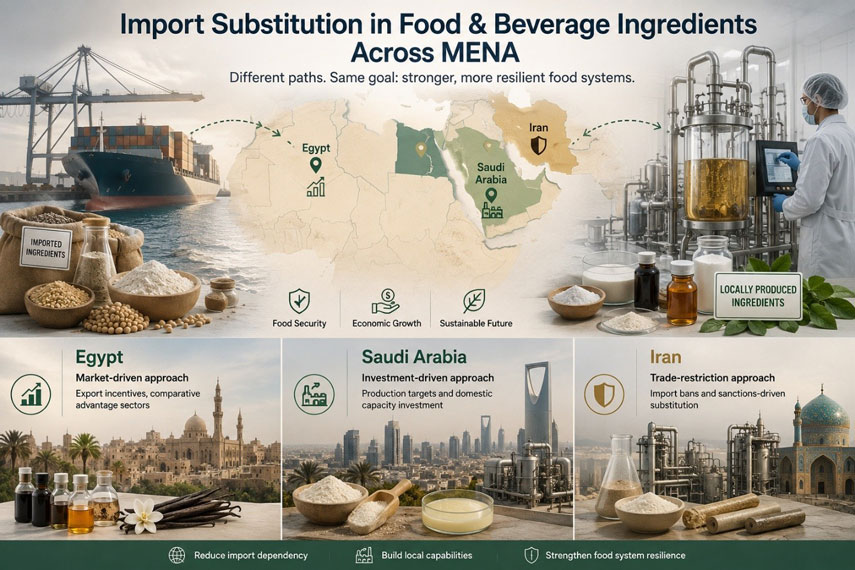
Understanding this distinction is important for the MENA region. Countries have adopted different strategies to strengthen local ingredient production. Saudi Arabia emphasizes industrial investment. Egypt relies on market expansion and export incentives. Iran mainly uses import restrictions and sanctions-driven substitution [1][2].
This article reviews import substitution trends for food and beverage ingredients across these three countries. It focuses on enzymes, flavors, and functional ingredients. It also evaluates commercial opportunities, technological barriers, and regulatory challenges affecting localization. This narrative review is based on approximately 20 sources from PubMed, PMC, Google Scholar, and public databases, including FAO, USDA, IMF, and WEF. It is a scoping review rather than a systematic review. Therefore, evidence quality varies across topics.
Why import dependency matters in MENA
MENA food systems rely heavily on imported grains and processed ingredients. One modeling study found the region derives a large share of its dietary energy from imported grain. Protein dependency is even higher. Russia and Ukraine together supplied a significant share of MENA’s grain imports in the years leading up to 2020. A complete loss of both sources was modeled in the same study. This could meaningfully reduce regional per-capita protein intake [1]. This is a modeled scenario, not an observed event. It explains why some governments treat ingredient localization as a security question, not only a cost question.
Dependency is not spread evenly across the region. Peer-reviewed research on GCC food security reports that, on average, the large majority of the region’s food supply is imported [2]. Country-level figures vary further. A direct FAO assessment finds the UAE among the most import-dependent, sourcing nearly all of its food from abroad. Saudi Arabia’s dependency is somewhat lower, though still substantial, once Red Sea access is factored in [3]. Water-scarce Gulf states are unlikely to expand farmland for flavor precursors or enzyme feedstocks. Any substitution strategy there depends more on industrial biotechnology than on agricultural expansion.
How the three national approaches compare
No source reviewed here directly compares Saudi Arabia, Egypt, and Iran on ingredient localization. The grouping below is this article’s own interpretive synthesis, built from separate country-level sources, not a finding from any single study.
| Country | Import dependency | Main imported ingredients | Localization approach |
| Saudi Arabia | High, and higher still once Red Sea shipping-route exposure is factored in [3][5] | Additives, enzymes, functional inputs; a sizeable, multi-billion-dollar import bill as of 2022 [5] | Investment-driven; a high localization target set for 2030 [4] |
| Egypt | Majority of food additives imported [6] | Additives, flavors, enzymes [6][14] | Market-driven; export incentives, comparative-advantage sectors [6] |
| Iran | Import ban spanning well over a thousand product categories [7] | Broad range, incl. pet food and food ingredients [7][15] | Trade-restriction; sanctions-driven substitution [7] |
| UAE (regional benchmark) | Very high; among the highest import dependence in the region [3] | Not analyzed | Not covered |
Saudi Arabia follows an investment-driven model: it sets production targets and funds domestic processing capacity, without broadly restricting imports [4][5]. Egypt follows a market-expansion model: growth in domestic demand, plus export incentives, is pulling ingredient manufacturing inward gradually [6]. Iran follows a trade-restriction model: sanctions and import bans force substitution directly, ahead of demonstrated local capability [7]. These are three distinct policy logics, not three stages of the same process, and their risks differ accordingly.
Saudi Arabia: investment-driven localization, with a historical caution
Saudi Vision 2030 set an ambitious target for localizing the large majority of food production by 2030 [4]. Official government statistics (GASTAT) reported that both dairy self-sufficiency and table-egg self-sufficiency surpassed full domestic coverage in 2024 [8]. These are self-reported national statistics, not independently audited figures.
Localization at the finished-product level does not necessarily mean ingredient-level self-sufficiency. Saudi Arabia imported a substantial, multi-billion-dollar volume of intermediate food ingredients in 2022 inputs used in further food manufacturing, such as additives and functional compounds. This came even as total food-manufacturing investment was projected to reach tens of billions of dollars by 2030 [5]. This figure aggregates broad USDA reporting categories rather than a single HS code, so it should be read as an order of magnitude for the category, not a precise enzyme or flavor-specific number. Even so, it suggests a gap between headline food-production targets and the ingredient supply chain behind them.
History offers a specific caution here. In the 1980s, Saudi Arabia irrigated desert wheat farms with fossil groundwater, and the country became a wheat exporter within a relatively short span of years [9]. Hydrologists later found the aquifers were not renewable on any usable timescale. The program was phased out starting in the late 2000s [9][10]. This is a single national case; it does not prove that every localization effort will deplete a resource. It does show that production targets set without a resource constraint can carry real long-term risk.
Fermentation and biotechnology: a capital-intensive substitution pathway
Precision fermentation uses engineered yeast, fungi, or bacteria to produce specific molecules, rather than growing whole crops or animals [11]. Industrial hosts such as Saccharomyces cerevisiae and Pichia pastoris are already used at commercial scale. They produce enzymes, dairy and egg proteins, heme, vitamins, and flavor compounds [11][12]. Compared with conventional agriculture, precision fermentation often requires less land per unit of output and can reduce water demand under many production scenarios. However, these advantages are not universal. The overall environmental footprint depends on the feedstock used, media preparation, sterilization, downstream processing, and energy demand for aeration, cooling, and climate control, particularly in hot and arid regions. Consequently, regional comparisons should rely on life cycle assessment (LCA) using clearly defined functional units rather than broad generalizations. Despite these limitations, fermentation-based production is less dependent on arable land and direct rainfall than conventional agriculture, making it a potentially attractive option for water-scarce regions such as MENA [13].
This matters directly for MENA. Enzymes, flavors, and functional proteins are exactly the categories where fermentation is already commercially proven elsewhere. Bulk caloric commodities such as wheat and maize represent a different challenge. At present, no cost-effective biotechnological or cellular-agriculture alternative exists to replace these staple crops at regional production scale. In contrast, biotechnology is already commercially viable for several high-value food ingredients, including enzymes, functional proteins, vitamins, and flavor compounds, where the higher value density can justify controlled-environment production [11–13]. A 2026 synthesis spanning a broad body of published studies found that fermentation-based production consistently used less land and water than livestock or crop systems. Outcomes still depended heavily on strain choice and downstream processing costs [13].
The technology still carries real constraints. One review found the bottleneck in enzyme production has shifted. Designing effective enzymes is no longer the hard part; scaling their production economically is [11]. Fermentation infrastructure still depends on imported starter strains, bioreactors, and licensed technology [12]. Local biomass production does not automatically remove foreign dependency. It can simply move that dependency upstream, into equipment and intellectual property.
Even with those caveats, fermentation-based ingredients appear better matched to MENA’s resource constraints than land-intensive substitution. Whether this becomes competitive regional manufacturing, rather than a licensed extension of foreign biotechnology, depends on capital investment and technology-transfer terms. Those details fall outside the scope of the sources reviewed here.
Egypt: a market-expansion model
Egypt imports most of its food additives today, according to a recent U.S. government trade report. The same report identifies specific comparative advantages Egypt could build on, including herb processing, juice concentrates, date production, and freeze-drying technology [6]. This is a government trade assessment, not a confirmed manufacturing shift, but it is more specific than a general growth forecast.
One commercial market-research forecast projects continued, substantial growth in Egypt’s food enzyme market through the early 2030s [14]. No peer-reviewed equivalent for this figure was found, and the report’s underlying methodology is not public. It should be read only as a directional signal of rising demand, not as evidence of new domestic manufacturing capacity, since rising demand can equally be met by higher imports.
Iran: a trade-restriction model, and its visible tradeoffs
Iran imposed import restrictions on well over a thousand product categories, including several food items, to force domestic production [7]. This is a clear regulatory case of forced substitution rather than market-driven localization.
The pet food sector illustrates the tradeoff. Domestic manufacturing capacity expanded after import curbs. Trade-press reporting describes many consumers as still distrustful of local brands’ quality and consistency [15]. This is one sector’s account, not a measured survey, and may not generalize across ingredient categories. A peer-reviewed household-level study offers a broader, more rigorous version of the same pattern: sanctions measurably reduced both the quantity and quality of food consumption in Iran, even though the food industry mostly continued to meet domestic demand [16]. That study did not examine pet food specifically, but it supports the general direction of the sector-level account.
More broadly, Iran’s manufacturing sector adapted through subsidy cuts, administered price changes, and diversified trade partnerships. Food price inflation rose sharply over the same period [17]. These events occurred together. The source does not show that substitution alone caused the inflation, since sanctions and currency devaluation happened at the same time. A peer-reviewed study of Iran’s pharmaceutical sector found a comparable pattern: sanctions forced manufacturers to prepay in cash for imported raw materials, raising costs even where finished goods were formally exempt from sanctions [18]. This is a different industry, but it illustrates a mechanism financing friction on remaining imports that plausibly applies to food ingredient manufacturing too.
Regulatory and trade-standard barriers
Halal certification requirements function as a compliance barrier for importers under WTO trade law, according to an analysis of SPS and TBT committee filings. Gulf-specific standards such as GSO 2055-2 fall within this broader pattern. They may also work as a structural advantage for already-certified domestic producers [19]. Divergent national additive “positive lists” across MENA markets add a further complication. They can slow any single supplier’s plan to scale ingredient production regionally [6].
What import substitution theory suggests, and where it breaks down
Import substitution industrialization was widely adopted across Latin America and parts of Asia. It ran from the 1930s through the 1980s, using tariffs and quotas to shield “infant industries”. Critics argue it can raise costs, reduce competition, and limit access to more efficient foreign technology and inputs [20].
Comparative trade-policy research suggests export-oriented industrial strategies have often outperformed import substitution over the long run. Outcomes still depend on institutional capacity, subsidy design, and how temporary the protection actually is [21]. This is a general historical pattern across many countries, not a MENA-specific finding.
Applied to MENA food ingredients, the historical trade-policy literature suggests that investment- and market-oriented strategies may face different structural constraints than trade-restriction-based approaches [20][21]. However, comparing these policy models requires clearly defined performance indicators, such as cost competitiveness, supply-chain resilience, domestic innovation capacity, and product quality. Because no study directly compares Saudi Arabia, Egypt, and Iran using these metrics, the discussion presented here should be interpreted as a conceptual comparison rather than evidence of superior policy performance.
Commercial risks that localization strategies still face
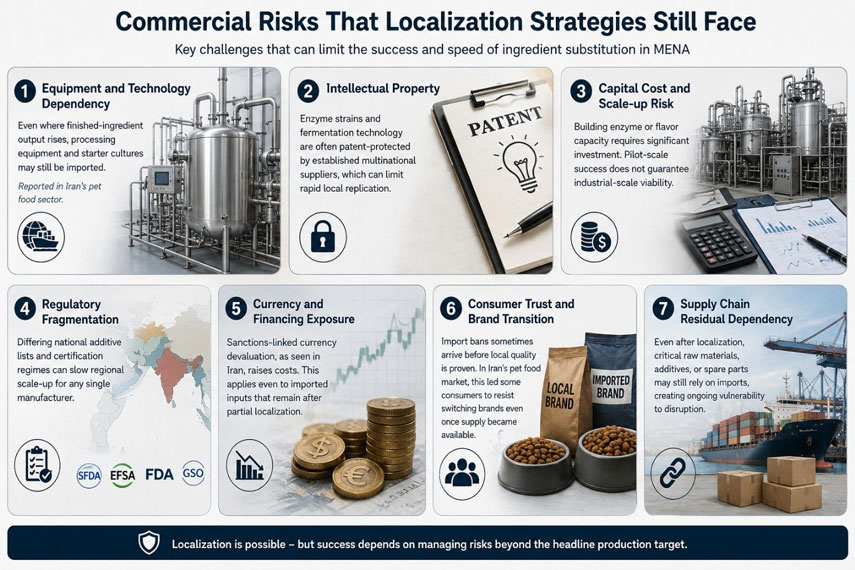
Several practical constraints limit how far ingredient substitution can go in the near term.
Equipment and technology dependency: Even where finished-ingredient output rises, processing equipment and starter cultures may still be imported. This was reported in Iran’s pet food sector [15].
Intellectual property: Enzyme strains and fermentation technology are often patent-protected by established multinational suppliers, which can limit rapid local replication [12].
Capital cost and scale-up risk: Building enzyme or flavor capacity requires significant investment. Pilot-scale success does not guarantee industrial-scale viability [11].
Regulatory fragmentation: Differing national additive lists and certification regimes can slow regional scale-up for any single manufacturer [6][19].
Currency and financing exposure: Sanctions-linked currency devaluation, as seen in Iran, raises costs. This applies even to imported inputs that remain after partial localization [17].
Consumer trust and brand transition: Import bans sometimes arrive before local quality is proven. In Iran’s pet food market, this led some consumers to resist switching brands even once supply became available [15].
None of these risks rules out ingredient localization. They suggest that timelines, quality assurance, and financing plans deserve as much attention as the headline production target.
Conclusion
Import substitution in MENA food and beverage ingredients follows different policy pathways rather than a single development model. Saudi Arabia emphasizes investment-led industrial expansion, Egypt relies primarily on market incentives, and Iran adopts a trade-restriction approach. Each strategy involves distinct trade-offs, and its long-term performance will depend on cost competitiveness, technological capability, supply-chain resilience, domestic innovation, and access to specialized production inputs rather than policy design alone.
Within this context, fermentation-based biotechnology appears to be a promising approach for localizing high-value food ingredients in MENA, particularly enzymes, flavors, proteins, vitamins, and other bioactive compounds [13]. However, its commercial viability at regional scale remains uncertain and will depend on capital investment, energy costs, technology-transfer agreements, and access to specialized production inputs [11][20][21]. Bulk caloric commodities such as grains present a fundamentally different challenge. At present, no cost-effective biotechnological alternative exists for replacing their regional-scale production, whereas precision fermentation is better suited to manufacturing high-value functional ingredients whose economic value can justify controlled-environment production [11–13].
| Claim | Evidence type | Strength | Reference |
| MENA is structurally dependent on imported grain and ingredients. | modeling study, industry statistics. | moderate; partly model-based. | [1][2][3]. |
| Saudi Arabia, Egypt, and Iran are pursuing three distinct localization models. | comparative author interpretation. | interpretive synthesis of country cases. | [4][6][7]. |
| Ingredient-level import dependency can persist despite production-localization progress. | government trade-data report. | moderate. | [5]. |
| Resource-intensive self-sufficiency programs carry ecological risk. | historical case study, government science agency. | single case; illustrative only. | [9][10]. |
| Fermentation-based ingredient production needs less land and water than conventional agriculture. | systematic literature synthesis. | moderate-to-strong; multi-study synthesis. | [13]. |
| Sanctions-driven substitution can raise consumer trust concerns. | sector case study. | single sector; not generalized. | [15]. |
| Import substitution historically underperforms export-oriented policy over the long run. | comparative trade-policy research. | general pattern, not MENA-specific. | [21]. |
Frequently Asked Questions
1. What is the difference between import substitution and localization?
Import substitution refers to policy tools such as tariffs, quotas, or bans that force a shift away from imports [20]. Localization is the broader outcome of a larger domestic production share, which can happen with or without trade restrictions [4][6].
2. Which ingredients are most suitable for domestic production in MENA?
Enzymes, flavors, and functional proteins are strong candidates, since fermentation-based production needs less land and water than farming [13]. Bulk commodities such as wheat remain difficult, since MENA’s water scarcity limits large-scale grain cultivation [9][10].
3. Why are enzymes easier to localize than grains?
Enzymes can be produced by engineered microorganisms in a bioreactor, largely independent of arable land or rainfall [11]. Grain production, by contrast, requires significant water and land, both scarce across much of MENA [1][9].
4. Has Saudi Arabia’s localization strategy reduced ingredient imports?
Finished-product self-sufficiency has reportedly improved in categories such as dairy and eggs [8]. However, intermediate ingredient imports, including additives, remained substantial as of 2022 [5].
5. What risks does Iran’s import-ban approach illustrate?
It shows that forced substitution can expand domestic capacity quickly [7]. It may also raise consumer trust and quality-consistency concerns. Equipment and technology dependency can persist too [15].
References
[1] Rahimi, J., Smerald, A., Moutahir, H., Khorsandi, M., & Butterbach-Bahl, K. (2023). The potential consequences of grain-trade disruption on food security in the Middle East and North Africa region. Frontiers in Nutrition, 10, 1239548.
[2] Hassen, T. B., & El Bilali, H. (2019). Food security in the Gulf Cooperation Council countries: Challenges and prospects. Journal of Food Security, 7(5), 159-169.
[3] Wu, H. H. Geopolitical Risks, Military Conflicts, and Global Transitions: Implications for Food Security, Sustainable Agriculture, and Renewable Energy Development Geopolitical Risks, Military Conflicts, and Global Transitions: Implications for Food Security, Sustainable Agriculture, and Renewable Energy Development.
[4] Alrobaish, W. S., Vlerick, P., Luning, P. A., & Jacxsens, L. (2021). Food safety governance in Saudi Arabia: Challenges in control of imported food. Journal of Food Science, 86(1), 16-30.
[5] Almohaimeed, F. A., & Abouelnour, K. A. (2025). The role of food processing in sustaining food security indicators in the Kingdom of Saudi Arabia. Economies, 13(3), 84.
[6] Farag, M. D. E. D. H. (2020). Halal food in Egypt. The Halal Food Handbook, 369-392.
[7] Perletta, G. (2022). Iran 2022: Domestic challenges to state legitimacy and isolation in the global arena. Asia Maior, 33.
[8] Kinawy, A. A., & Ahmed, R. S. (2024). Implications of population growth on food security in Saudi Arabia. In Food and Nutrition Security in the Kingdom of Saudi Arabia, Vol. 1: National Analysis of Agricultural and Food Security (pp. 383-403).
[9] Salem, H. S., & Yihdego, Y. (2026). Assessment of the challenges facing the transboundary fossil Saq–Disi Aquifer System (SDAS) in Saudi Arabia and Jordan, towards sustainability. Discover Geoscience, 4(1), 203.
[10] Carr, T. R., Iqbal, A., Callaghan, N., Look, K., Saving, S., & Nelson, K. (2009). A national look at carbon capture and storage—National carbon sequestration database and geographical information system (NatCarb). Energy Procedia, 1(1), 2841-2847.
[11] Boukid, F., Ganeshan, S., Wang, Y., Tülbek, M. Ç., & Nickerson, M. T. (2023). Bioengineered enzymes and precision fermentation in the food industry. International journal of molecular sciences, 24(12), 10156.
[12] Rout, S., & Srivastav, P. P. (2025). Recent trends in the production of proteins by precision fermentation for improving the quality and attributes of food: Role of genetic engineering towards next generation of food production. The Microbe, 100551.
[13] Adeyeye, S. A. O., Babu, A. S., Subudhi, A., & Adeyeye, B. R. (2026). Precision fermentation processes for producing novel foods and its sustainable applications. Journal of basic microbiology, 66(2), e70160.
[14] Sarrouh, B., Santos, T. M., Miyoshi, A., Dias, R., & Azevedo, V. (2012). Up-to-date insight on industrial enzymes applications and global market. J Bioprocess Biotech s, 4(002), 320.
[15] Iran’s pet food dilemma: Import bans, inflation squeeze pet owners and brands. Petfood Industry, 2025.
[16] RezaeeDaryakenari, B., Asadzade, P., & Thies, C. G. (2024). Economic sanctions and food consumption: evidence from Iranian households. International Studies Quarterly, 68(3).
[17] Batmanghelidj, E. (2021). The Ins and Outs of Iranian Industrial Resilience under Sanctions. The Muslim World, 111(1), 96-112.
[18] Cheraghali, A. M. (2013). Impacts of international sanctions on Iranian pharmaceutical market. DARU Journal of Pharmaceutical Sciences, 21(1), 64.
[19] Johan, E., & Schebesta, H. (2022). Religious regulation meets international trade law: Halal measures, a trade obstacle? Evidence from the SPS and TBT committees. Journal of International Economic Law, 25(1), 61-73.
[20] Bruton, H. J. (1998). A reconsideration of import substitution. Journal of economic literature, 36(2), 903-936.
[21] Cherif, R., & Hasanov, F. (2024). The pitfalls of protectionism: Import substitution vs. export-oriented industrial policy. Journal of Industry, Competition and Trade, 24(1), 14.